

Scale Technical Authority and Inbound Demand with Hard Tech Content

Build technical authority and inbound demand with a hard tech content strategy that maps to complex buying committees and AI search engines.
How to Build a Hard Tech Content Strategy That Earns Trust
Hard tech content strategy starts with the questions buyers need answered before they can trust a physical product. Map those questions by role: engineers need performance and integration details; business buyers need costs and outcomes; compliance teams need evidence of safety and fit. Then create product pages, test results, field demos, and technical guides that answer them.
Give every reader a clear summary, with deeper proof close at hand. Track qualified inquiries and pilot requests, and update the content when the product or its claims change.
What Distinguishes a Hard Tech Content Strategy from Traditional B2B
Marketing physical hardware differs fundamentally from promoting pure software. Software buyers may be able to test a product through a free trial or API sandbox. By contrast, hard tech, including robotics, advanced computing, aerospace, defense systems, and semiconductors, often requires physical validation, heavy capital investment, and extensive safety verification.
The customer journey in deep technology often involves high-stakes decisions and extended evaluation cycles. In high-consequence industries, an unproven claim can create operational, infrastructure, or regulatory risk.
Evaluating physical technology involves navigating multi-stakeholder committees. You must guide everyone from mechanical engineers and chief information security officers to plant managers and procurement leads. Successfully addressing these diverse concerns requires neuro-mapping tech buying committees across IT, security, finance, and end users.
| Evaluation Factor | SaaS Content Marketing | Hard Tech Content Strategy |
|---|---|---|
| Product Validation | Free trials, interactive sandboxes, freemium self-serve tiers | Hardware pilot deployments, bench tests, and field demonstrations |
| Sales Cycle Duration | Often shorter or self-serve | Often longer, with validation and compliance review |
| Evaluation Committee | A smaller group of software stakeholders | A broader group that may include engineers, finance, operations, and compliance |
| Primary Proof Assets | Feature lists, product screenshots, standard case studies | Architectural diagrams, stress tests, certifications, and field data |
| Post-Purchase Content | UI tooltips, feature update emails, knowledge base articles | Installation playbooks, firmware updates, and maintenance SOPs |
The Pitfall of Oversimplification in Deep Tech Messaging
When technical founders notice that their website fails to generate leads, their initial instinct is often to drastically simplify everything. Marketers frequently advise them to strip out the technical specs and summarize the entire system in a catchy one-liner.
For deep tech companies, this approach often backfires. When you oversimplify complex systems, you risk stripping away the exact architectural proof that technical evaluators require. Engineers, systems architects, and technical directors are inherently skeptical of broad marketing claims. If a product page presents vague slogans without real technical backing, technical buyers will assume the product is unproven or incapable of handling enterprise demands.
The goal is not dilution: it is precise translation. You must maintain engineering credibility by structuring your narrative around a proven technical product messaging framework. Start with the high-level business outcome, and immediately follow it with verifiable engineering data, physics-based proof, and clear specifications.
Multi-Persona Mapping: Engineers, Regulators, and Enterprise Buyers
Enterprise buying groups for hardware can include several decision-makers, each evaluating the product from a distinct perspective. A viable hard tech content strategy builds targeted content tracks for every member of this committee:
- Design and Integration Engineers: Seek exact electrical tolerances, communication protocols, thermal dissipation limits, and API documentation. They want to know precisely how the hardware mounts, connects, and communicates with existing systems.
- Operations and Plant Managers: Focus on mean time between failures (MTBF), installation timelines, facility power requirements, and maintenance schedules.
- Chief Financial Officers (CFOs): Evaluate total cost of ownership (TCO), capital expenditure versus operating expenditure trade-offs, depreciation, and payback periods.
- Compliance and Safety Officers: Require formal documentation showing adherence to industry standards such as ISO, CE, UL, or NIST cybersecurity baselines.
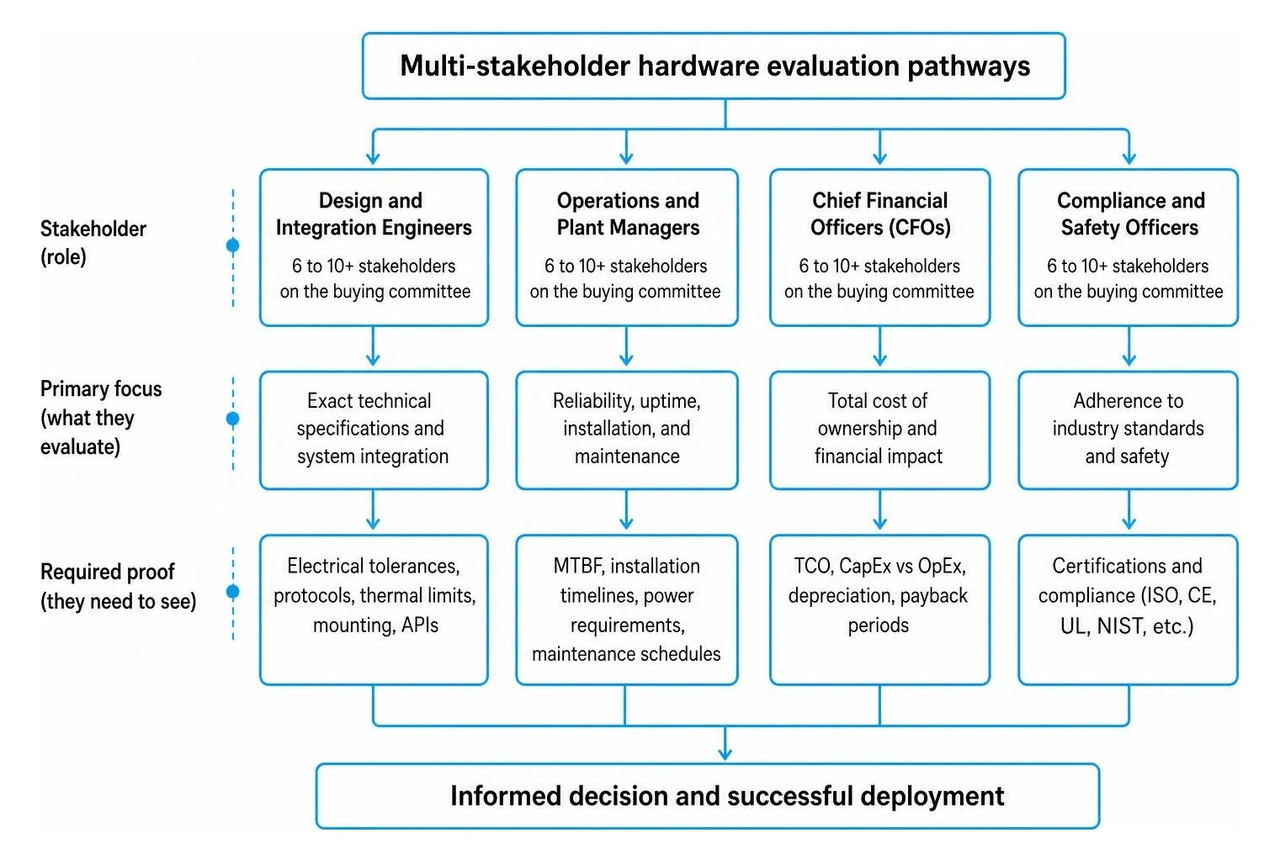
Aligning these technical specifications with high-level commercial outcomes ensures you know how to communicate value propositions to customers without alienating either engineers or executive buyers.
Core Architectural Framework of a Hard Tech Content Strategy
Building technical authority requires a deliberate, structured framework. Rather than publishing random blog posts, hard tech companies need a multi-layered content architecture designed for discovery and deep technical evaluation.

A high-performing strategy uses structured clusters where a central, authoritative pillar page connects directly to detailed technical articles, integration guides, and real-world deployment data. To build a repeatable engine that drives inbound opportunities, founders can apply proven steps on how to create a content strategy that drives results.
Designing a Multi-Tier Hard Tech Content Strategy for Buying Committees
To serve diverse buying committees without cluttering your messaging, organize your content into three distinct tiers:
- Tier 1: Executive Solution Briefs (Top-of-Funnel): Short-form overviews and strategic whitepapers that clearly define the core operational challenge, the limitations of existing approaches, and the commercial impact of your solution.
- Tier 2: Architectural and Validation Whitepapers (Middle-of-Funnel): Comprehensive teardowns, independent bench-test results, and comparative analyses. Buyers who read these deeper technical assets tend to move further along in their purchasing decision.
- Tier 3: Engineering and Integration Guides (Bottom-of-Funnel): In-depth schematics, CAD models, wiring diagrams, and API references. This technical documentation helps prospective customers validate integration feasibility.
When drafting bottom-of-funnel collateral, applying structured formulas for hardware product page copy ensures that technical specs clearly reinforce real-world performance benefits.
Turning Installation, Maintenance, and Compliance Docs into Search Assets
Hardware companies sit on a goldmine of organic search traffic: their internal standard operating procedures, field service guides, and commissioning checklists.
Hardware evaluators search for hyper-specific long-tail queries when designing systems or troubleshooting existing setups. For example, instead of searching for broad terms like "industrial sensors," an engineer is far more likely to search for:
- "How to wire RS-485 Modbus sensors to an edge computing gateway"
- "Thermal dissipation calculations for fanless industrial computers"
- "Class I Division 2 certification requirements for robotic actuators"
Transform these real-world maintenance workflows, installation guides, and compliance teardowns into public, search-optimized articles. Documenting real deployment challenges directly answers high-intent search queries, capturing prospective buyers right when they are designing their technical requirements.
High-Trust Formats and Visual Storytelling for Long Hardware Sales Cycles
Because hardware exists in the physical world, buyers expect tangible proof that it works under real operating conditions. Stock photography and abstract illustrations erode trust. High-trust formats prioritize tangible evidence:

| Content Format | Primary Buying Stage | Key Stakeholders | Core Strategic Purpose |
|---|---|---|---|
| Field Deployment Video | Awareness & Discovery | Executive buyers, Plant Managers | Proves the physical machine functions reliably in live field environments. |
| Interactive 3D Teardown | Consideration & Evaluation | Hardware Engineers, System Architects | Allows technical buyers to inspect component layouts and physical dimensions. |
| Data-Backed Benchmark Report | Consideration & Validation | CTO, Chief Risk Officer | Delivers head-to-head empirical metrics against industry benchmarks. |
| Deployment Case Study | Purchase Decision | CFO, Procurement, Operations | Validates ROI, installation timelines, and operational gains. |
Integrating these formats into your wider pipeline ensures that your digital marketing for tech initiatives consistently build credibility across the entire buyer journey.
Visual Proof: Field Footage, CAD Demos, and Benchmarking
Short-form video can be a useful medium for technical validation. Highlighting physical hardware on live jobsites, in cleanrooms, or on factory floors provides undeniable proof of functionality.
When capturing visual proof, focus on:
- Real Field Footage: Record the physical product operating under harsh conditions, such as extreme temperatures, vibration, dust, or moisture.
- Benchmarking Demonstrations: Show side-by-side data acquisition comparing your hardware's speed, power consumption, or throughput directly against standard alternatives.
- Interactive CAD & 3D Walkthroughs: Let engineers explode assemblies, measure clearances, and evaluate thermal zones directly in their browsers.
These dynamic visual assets form the backbone of a successful campaign when planning how to launch a tech product into competitive enterprise markets.
Leveraging Subject Matter Experts and Defensible Customer Evidence
Your strongest content creators are often the engineers, scientists, and field technicians building your product. Conduct regular interviews with these internal subject matter experts to unpack design decisions, failure analyses, and architectural trade-offs.
Transform these technical interviews into deep-dive engineering blogs, teardowns, and benchmark whitepapers. Authentic, engineer-led discussions establish undeniable authority and protect your content from generic competitor messaging.
Combining expert engineering insights with real customer deployment data creates sustainable marketing strategies for tech that build lasting authority.
Optimizing Content for Generative AI Engines and Machine Discovery
The way technical buyers research solutions is shifting rapidly. AI engines, including ChatGPT Search, Perplexity, and Google AI Overviews, can influence enterprise technology vendor shortlists. Technical buyers may ask AI assistants to compare hardware architectures, verify protocol compatibility, and summarize certifications.

To ensure your hardware products are accurately surfaced and cited by AI engines, you must apply entity optimization guides for 2026 to help algorithms identify your brand as an authoritative industry source.
Executing Your Hard Tech Content Strategy for AI Search Engines
Generative AI engines rely on structured facts, clear data tables, and verifiable technical entities. You can prepare your website for machine discovery by implementing AI engine optimization for tech across your entire content portfolio.
- Structured Schema Markup: Implement comprehensive
TechArticle,Product,HowTo, andFAQschema on every technical asset. Define exact parameters like operating voltage, data throughput, weight, and certifications directly in JSON-LD. - Machine-Readable Specs: Structure specifications in clean HTML tables with clear unit metrics (such as watts, ft³/hour, or MHz) instead of burying them inside scanned PDF datasheets.
- Brand MD Files: Build explicit markdown files containing structured overviews of your systems. Implementing what is a brand MD file helps autonomous AI scrapers understand your core capabilities.
- AI-Ready Brand Guidelines: Establish AI-ready brand guidelines so large language models index consistent definitions of your proprietary technologies.
Measuring ROI and Accelerating the Hard Tech Pipeline
Because hardware sales cycles often span several quarters, measuring marketing effectiveness by immediate form-fills alone will distort your data. Instead, monitor leading indicators of pipeline velocity and customer engagement:
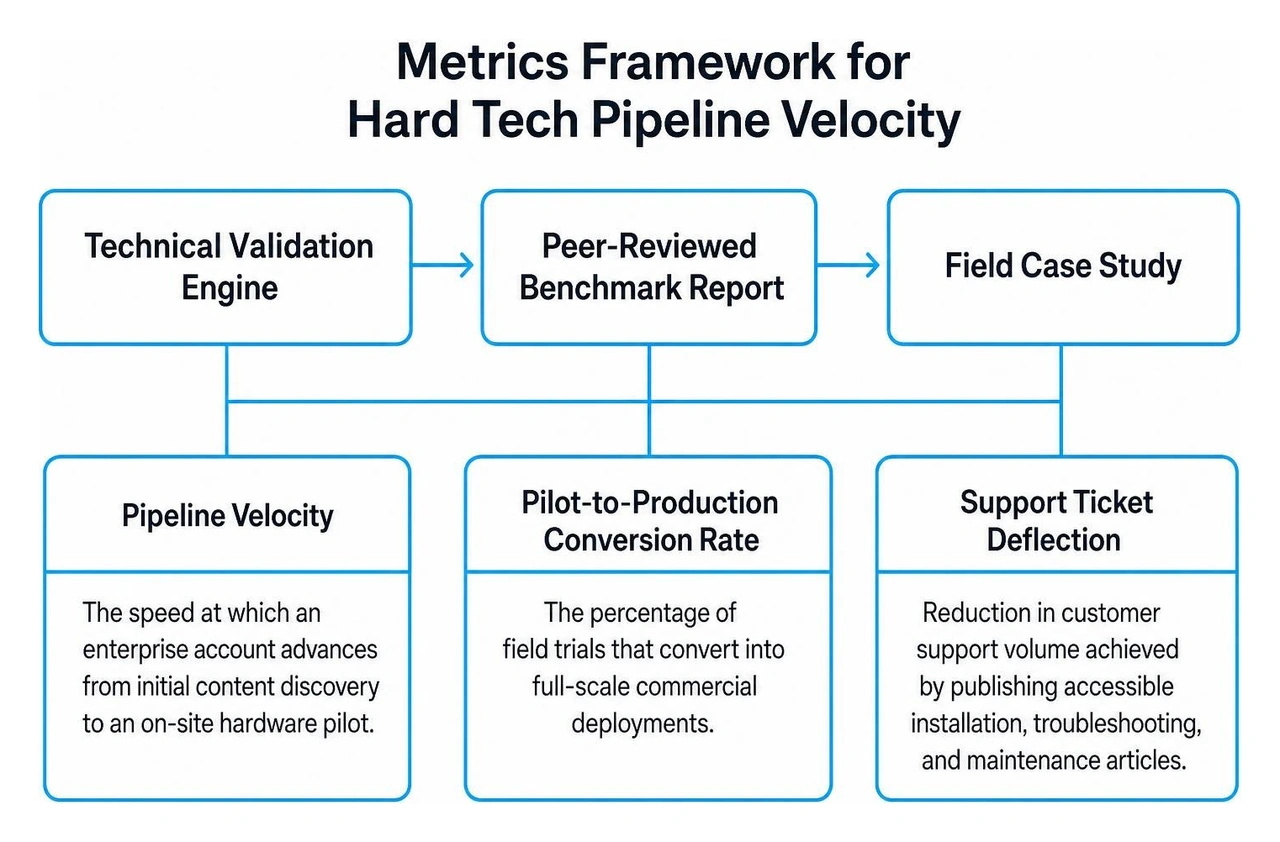
Key metrics to monitor across your pipeline include:
- Pipeline Velocity: The speed at which an enterprise account advances from initial content discovery to an on-site hardware pilot.
- Pilot-to-Production Conversion Rate: The percentage of field trials that convert into full-scale commercial deployments.
- Support Ticket Deflection: Reduction in customer support volume achieved by publishing accessible installation, troubleshooting, and maintenance articles.
- Assisted Conversions on Technical Assets: The frequency with which datasheets, whitepapers, and integration guides are read prior to contract signing.
A disciplined tracking framework lets you master hardware marketing ROI measurement, ensuring your content investments directly lower your overall tech launch CAC.
Frequently Asked Questions About Hard Tech Content Strategy
How do you balance deep technical specs with executive readability?
Use progressive disclosure to structure your content. Place an executive summary at the top of the asset outlining the business outcome, payback period, and operational impact. Immediately follow this overview with linked tabs or jump menus leading directly to raw engineering schematics, power budgets, and benchmark data. This allows executive buyers to understand the business case while giving engineers instant access to the technical specs they need.
How long does it take for hard tech content to generate inbound pipeline?
Technical content can take time to earn search visibility and support inbound inquiries. For hardware companies, evaluate results against the length and complexity of the sales cycle rather than expecting immediate pipeline impact.
What content formats drive the highest conversion for enterprise hardware?
Data-backed whitepapers, independent benchmark reports, interactive 3D component teardowns, and real-world jobsite deployment videos can help buyers evaluate enterprise hardware. B2B buyers look for empirical proof of physics and reliability before committing capital to physical trials.
Scaling Your Technical Authority and Inbound Demand
Building an authoritative content engine requires continuous alignment between engineering truth and buyer psychology. CRISPx plugs in as the founder's marketing and sales team, so hardware founders get the specialized support they need without hiring an internal head of marketing. Available service plans include Launch, Grow, Grow + Ads, and Scale.
Our strategic execution relies on The DOSE Method™, a strategy framework designed to systematically accelerate market demand:
- Diagnosis: Pinpoint bottlenecks in your story, positioning, and content architecture.
- Prescription: Address your biggest conversion barrier first, whether that requires rewriting spec sheets into clear value propositions, building deep technical whitepapers, or optimizing for AI discovery.
- Prognosis: Establish concrete pipeline targets, track pilot conversions, and refine content assets as your product evolves.
Take the guesswork out of your technical positioning. Request your free DOSEscore™ brand checkup of your website and story today, or schedule a strategy call to start building a high-performing technical content engine.
Get a free brand checkup.
We work like a brand doctor. The DOSE Method™ finds what's broken, fixes the biggest problem first, then tracks the results.