

Your Product Page Reads Like a Spec Sheet. Here Is the Fix.

Stop writing hardware product page copy that reads like a spec sheet. Learn the outcome-led framework that turns technical features into buyer confidence.
Why Spec-First Hardware Product Pages Lose Buyers
To fix a spec-heavy hardware product page, lead with the customer outcome first, then support it with technical specifications through progressive disclosure. Start with what the device does for the buyer, not how it is built. When engineer founders build physical products, their instinct is to showcase the engineering feats that took years to complete: clock speeds, thermal dissipation metrics, tolerances, and component choices. However, dumping raw features at the top of a page creates severe cognitive overload. When visitors land on a page and encounter an unfiltered wall of component data, they experience evaluation friction. They cannot quickly determine if the device solves their specific problem, so they bounce.
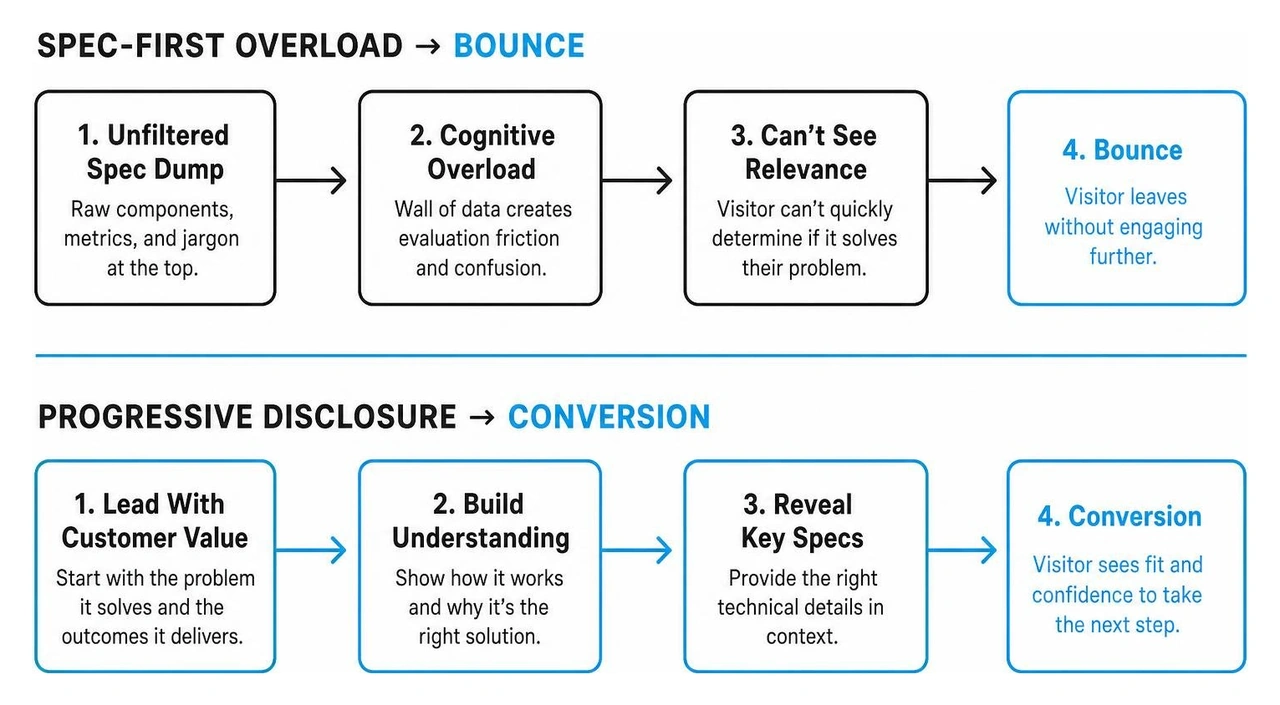
A common problem occurs across technical commerce: people don't get it. When your page reads like a bill of materials, buyers hesitate. Converting that traffic means bridging the gap between raw hardware capabilities and practical use. Aligning your page with a structured technical product messaging framework ensures you lead with customer pain points and value before descending into technical specifications.
The Disconnect Between Engineer Creators and Hardware Buyers
Engineer founders focus on how a device is built. Hardware buyers—whether industrial procurement managers or consumer electronics enthusiasts—focus on what the device allows them to achieve. This disconnect causes decision paralysis.
When a visitor evaluates physical products, their decision relies on distinct emotional and practical drivers:
- Dopamine: They want the outcome or capability your product promises.
- Oxytocin: They trust that the hardware will function reliably without breaking.
- Serotonin: They feel confident choosing a well-engineered solution.
- Endorphins: They experience relief that an operational bottleneck or daily frustration is finally resolved.
Leading strictly with technical parameters bypasses these core motivators. It forces the buyer to analyze data points rather than envisioning the operational outcome.
Translating Technical Specs Using the "So What?" Test
Every technical attribute must answer a fundamental question: "So what?"
If you state that your robotic arm features harmonic drive gearing with zero backlash, ask yourself what that gives the user. The answer: sub-millimeter repeatable placement for sensitive circuit assembly. The harmonic drive is the proof; the flawless placement is the outcome.
Testing every component detail against a real result turns dry data into product page copy buyers can act on.
The Ideal Information Hierarchy for Hardware Product Page Copy
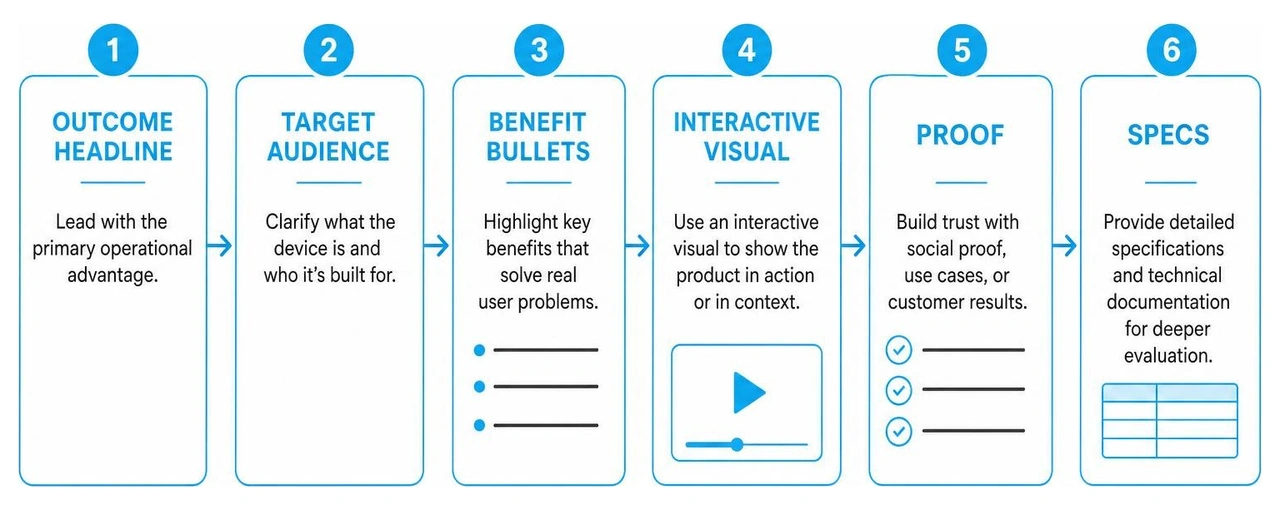
High-converting hardware pages rely on progressive disclosure: revealing high-level value first, followed by functional context, and finally deep technical documentation. This sequence supports both quick-scanning decision-makers and meticulous evaluation engineers during a high-tech product launch.
Anatomy of an Outcome-Led Hero Section
Your hero section must make four things clear at a glance:
- Outcome Headline: A single, direct sentence stating the primary operational advantage.
- Product Subtitle: A clarifying sentence explaining what the device is and who it is built for.
- Primary CTA: A high-contrast call to action ("Order Now", "Request Spec Sheet", or "Configure Device").
- Hero Visual: Clear, high-fidelity imagery showing the physical device.
Keep the hardware front and center with high contrast between the product, the background and the primary call to action. Keep the product title short enough to scan, with the model series and core capability up front.
Pairing Core Benefits with Engineering Proof
Directly below the hero section, break down three primary benefits using a structured formula: Core Benefit + Operational Impact + Engineering Proof.
Take a hypothetical 100W USB-C soldering iron. Instead of listing "100W USB-PD input" on its own, frame each spec through what it does for the user:
- Fast heat-up: Get back to work quickly between joints, powered by 100W USB-C power delivery.
- Precise control: Avoid damaged traces with a built-in display that shows the tip temperature and quick-access presets.
- Safer to leave on the bench: An automatic sleep timer cuts heat when the iron sits idle.
This technique keeps the copy scannable while giving technical evaluators the verification numbers they require.
Balancing Visual Media and Copy to Convert Technical Audiences
Hardware is physical, so text and media must work together. Show the product, not just describe it.
Replacing flat photography with scroll-driven 3D models or exploded-view animations lets visitors inspect internal layouts, PCB construction, and thermal pathways. A short video of the device running in a real operating environment shows buyers what the specs mean.
Optimizing Structured Spec Tables and FAQ Sections for AI Search
Never discard your technical specifications—reposition them. Place a comprehensive, structured spec table in the lower third of the page. This keeps the initial evaluation clean while providing the granular details needed for deep validation.
Structuring this data with valid Product Schema markup makes it easily readable by AI engines and search scrapers. When buyers research products using AI tools like ChatGPT, structured specification tables and targeted FAQ sections allow AI systems to pull accurate technical answers into search summaries.
Social Proof, Industry Certifications, and Trust Signals
Hardware carries inherent operational and financial risk. Buyers want assurance that your device will not fail under load. Place credibility indicators right above your full spec table:
- Regulatory Badges: Display CE, FCC, RoHS, UL, or ISO compliance marks clearly.
- Customer Reviews: Include verified user reviews detailing real deployment scenarios.
- Third-Party Test Reports: Link to downloadable PDF test reports, CAD drawings, or step-by-step installation guides.
Integrating these trust markers reinforces your hardware demand generation tactics, turning casual interest into confident purchase orders.
Before and After: Rewriting Hardware Product Page Copy
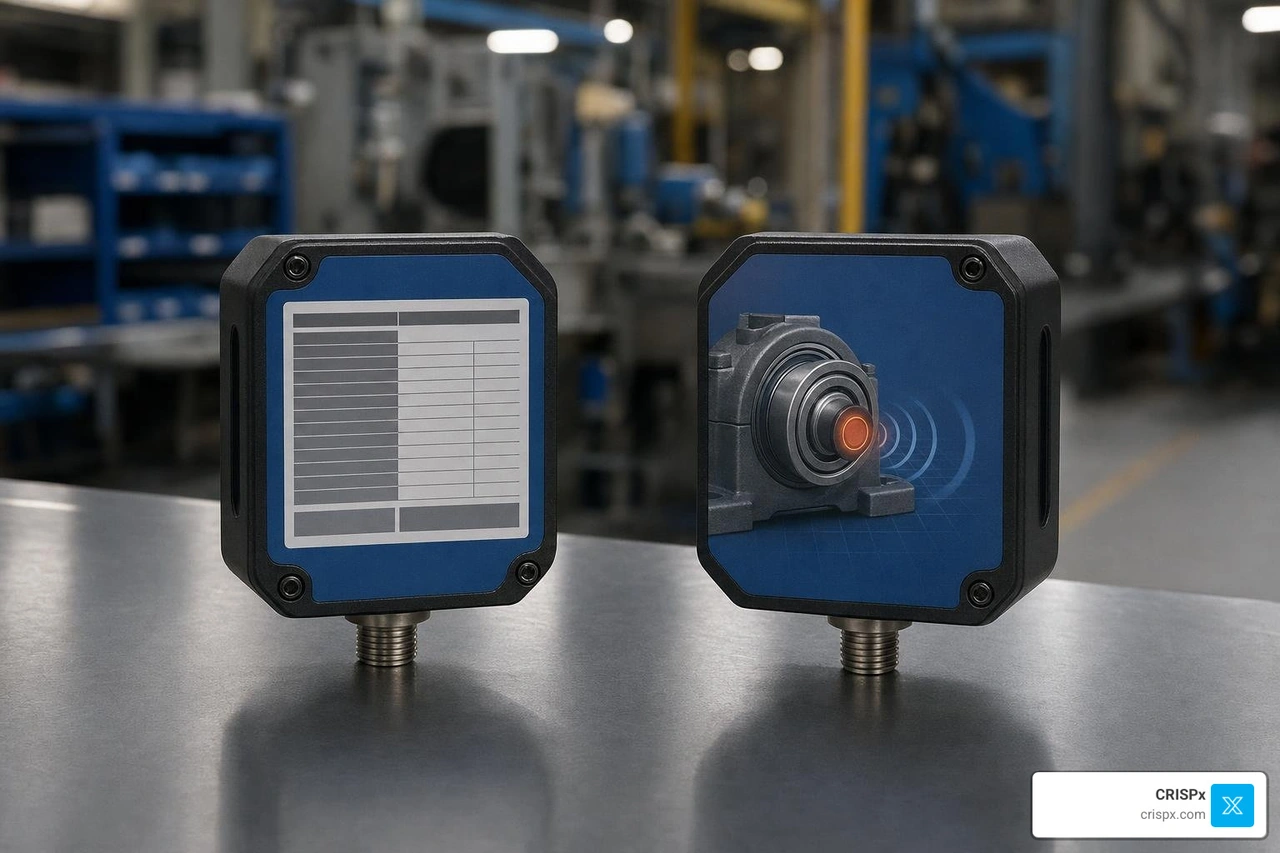
To see how this transformation works, here is a rewrite for a hypothetical industrial vibration sensor.
Before vs After: Headline and Subtitle Copy
| Element | Spec-First Version (Before) | Outcome-Driven Version (After) |
|---|---|---|
| Headline | Model TX-400 IP67 Dual-Band LoRaWAN Vibration Sensor with 3-Axis MEMS Accelerometer | Predict Machine Failures Weeks Before They Halt Your Line |
| Subtitle | Features an STM32 micro-controller, 868/915MHz transmission, and 3.6V LiSOCl2 battery pack. | A wireless, ruggedized vibration monitor that alerts plant managers to motor wear in real time—installing in under five minutes. |
| Primary CTA | View Datasheet | Deploy Your Trial Kit |
Why it works: The original headline described internal components that meant little to an operations director scanning for factory uptime solutions. The rewrite leads with downtime prevention, then defines the device class and installation speed.
Before vs After: Bullet Points and Technical Descriptions
Before (Spec Dump):
- Sampling rate up to 10kHz with integrated FFT calculation.
- Encased in an IP67-rated poly-carbonate blend enclosure.
- Long battery life using low-power sleep state architecture.
After (Benefit + Proof Pairing):
- Catch High-Frequency Bearing Wear Early: Real-time 10kHz edge-computed FFT processing detects microscopic anomalies before heat and friction destroy shafts.
- Survives Harsh Industrial Washdowns: An IP67-sealed polycarbonate housing resists high-pressure water jets, cutting fluids, and ambient plant dust.
- Five-Year Zero-Maintenance Power: Low-power sleep cycling draws under 15µA, keeping the sensor active for over five years without battery replacements.
Using active verbs, concrete numbers, and clear real-world contexts transforms dry parameters into undeniable value propositions.
Measuring and Optimizing Hardware Product Page Copy
Writing your copy is the first step; tracking its real-world performance ensures sustainable commercial growth. Combining behavioral metrics with data-driven product marketing helps identify exact points of evaluation drop-off.
Key Conversion Metrics to Track
Monitor these key indicators to evaluate your product copy:
- Add-to-Cart / Demo Request Rate: Set your own baseline before you change the copy, then compare after each rewrite.
- Scroll Depth & Dwell Time: If users leave within 10 seconds without scrolling past the hero, your headline is too complex or lacks clear outcome framing.
- Spec Table Interaction: High interaction with spec tables paired with low CTA conversions indicates that your price, compatibility, or availability details need clearer positioning.
- Bounce Rate on Mobile Devices: Many visitors will see the page on a phone, so make sure your text is scannable and avoids wide, unformatted tables.
Tailoring Hardware Copy for B2B vs B2C Buyers
Understand who holds the purchasing card:
- B2C Hardware Buyers: Value ergonomics, out-of-the-box setup ease, aesthetic build quality, and immediate utility. Keep sentences short and focus on personal convenience.
- B2B Hardware Buyers: Focus on risk mitigation, mean-time-between-failures (MTBF), compliance certifications, supply chain availability, and ROI. Provide downloadable CAD models, compliance documentation, and multi-unit volume tiers.
Frequently Asked Questions About Hardware Product Page Copy
How Long Should a Hardware Product Description Be?
Keep the overview short enough to scan: a brief outcome-led paragraph, supported by a few benefit-driven bullet points. Follow this with a comprehensive technical specification table and an interactive FAQ section to address buyer objections.
How Do I Keep Specs Accessible for Engineers Without Overwhelming Non-Technical Buyers?
Use progressive disclosure. Place your outcome headline, core value proposition, and benefit-proof bullets at the top of the page for high-level evaluators. Position deep engineering parameters, pinouts, and full spec tables in a dedicated, structured table further down the page.
How Can I Optimize Hardware Product Page Copy for AI Search Engines?
Use natural question-and-answer phrasing within your FAQ sections, implement standard Product and TechArticle schema markup, maintain clean key-value tables for all specifications, and ensure naming conventions match standard engineering search queries.
Conclusion
Building breakthrough hardware requires world-class engineering, but selling it requires crystal-clear communication. When you replace spec-heavy walls of text with an outcome-first narrative, you help buyers instantly understand why your device matters—and give them the exact engineering proof they need to buy.
At CRISPx, we plug in directly as your marketing and sales team so you do not need to hire a head of marketing. Whether you are preparing to ship your first production run or scaling an established product line, our Launch, Grow, Grow + Ads, and Scale plans provide complete marketing execution.
We apply our proven DOSE Method™—Diagnosis, Prescription, and Prognosis—to pinpoint where your messaging falters and build predictable demand. Our track record:
- Tony Crisp has 30 years in branding, 100+ hardware launches and 8+ patents.
- Robosen Optimus Prime went from Kickstarter to CES, then Hasbro and Disney licenses.
- FuzeDrive ran a top 1% Indiegogo campaign.
- SecureCircle was acquired by CrowdStrike.
Ready to see how your messaging stacks up? Get a free DOSEscore™ brand checkup to review your website and story, or book a strategy call with our team today.
Get a free brand checkup.
We work like a brand doctor. The DOSE Method™ finds what's broken, fixes the biggest problem first, then tracks the results.
