

Build AI-Ready Brand Systems That Protect Your Identity at Scale

How to turn a PDF brand book into brand.md, DESIGN.md and design token files that AI tools can read, so your hardware brand stays consistent at scale.
Introduction
Buyers need to understand what your hardware does for them before they read the specifications. Clear AI writing rules help keep that story consistent, at launch, after the initial sales spike, and on product pages that might otherwise read like spec sheets.
To build AI-ready brand guidelines, convert your static brand rules into files that AI tools can read. Use brand.md for voice and tone, tokens.json for design tokens, named values for colors, spacing, and type, and DESIGN.md for visual rules. Add clear boundaries, such as banned words, tone scales with a 1–5 rating from formal to casual, and paired examples. These rules help AI tools follow your brand instead of drifting into generic copy.
Speed with AI comes with a hidden cost: brand drift. When large language models (LLMs) and diffusion models, AI tools that generate images from noise, lack explicit boundaries, they default to generic phrasing and mismatched visuals.
For hardware companies producing robotics, consumer electronics, defense systems, and computing components, generic output creates major friction. When marketing assets read like dense spec sheets or sound like robotic filler, the launch falls flat, growth stalls, and potential buyers walk away confused.
Why Traditional Brand Books Fail in AI Workflows
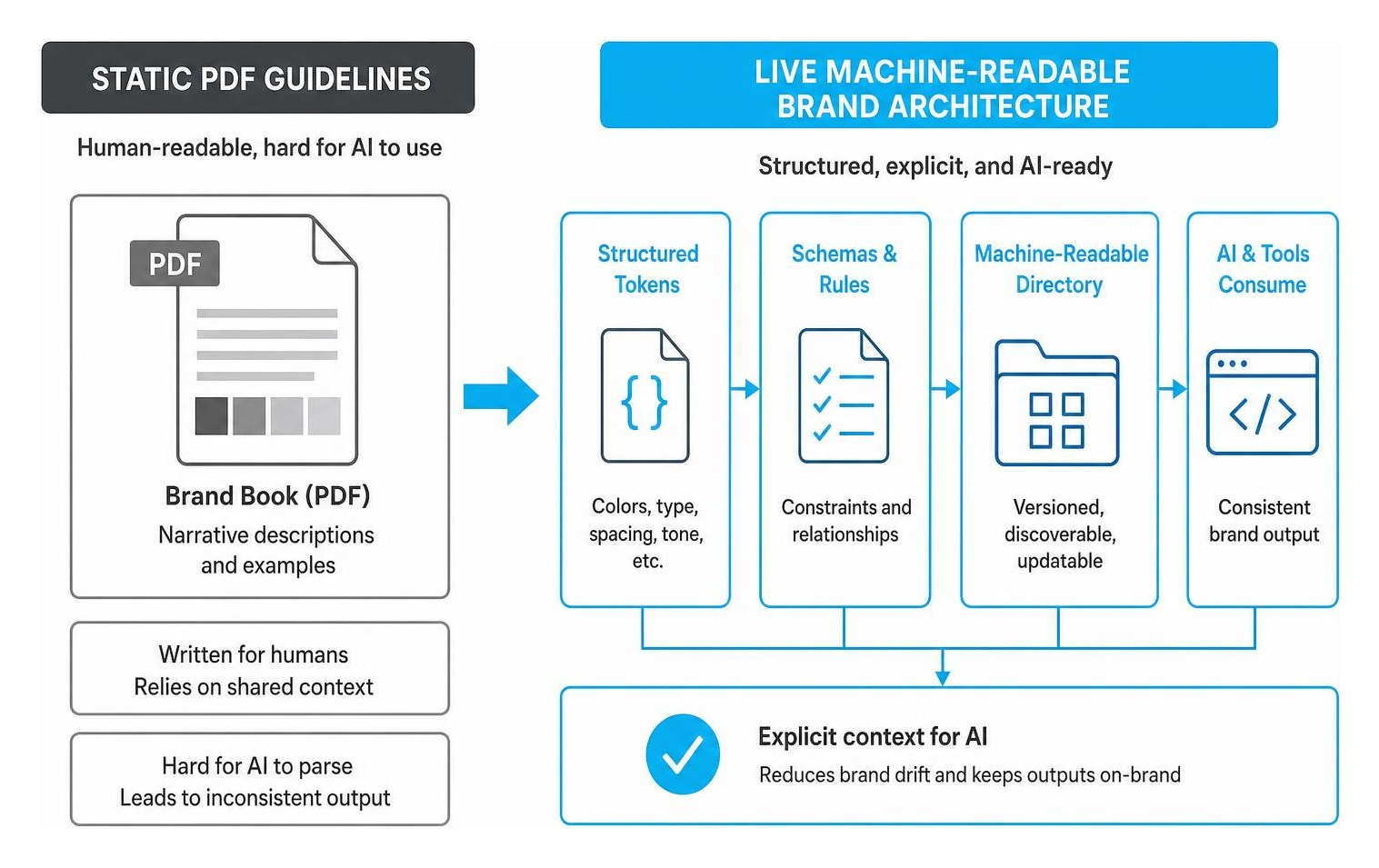
Traditional brand books are created for human designers and copywriters who share cultural context. When a PDF style guide describes a brand as "innovative, approachable, and bold," a human creator interprets those adjectives through industry experience. An AI model interprets them through statistical probability, often returning overused buzzwords, exclamation points, and stock corporate phrasing.
PDFs store information in page layouts rather than as directly queryable rules. AI agents may struggle to extract layout rules, color relationships, or rules about what not to do from a graphic document. Treating AI like a human creative hire without clear rules for its work can lead to drift. To address this, teams can focus on mapping how AI tools fit into creative work to turn broad design ideas into testable rules.
| Dimension | Human Brand Books (PDF) | Machine-Readable Brand Guidelines |
|---|---|---|
| Primary Audience | Human designers, agencies, internal staff | LLMs, coding agents, automated pipelines, people |
| Format | Static PDF, multi-page slide decks | Plain text, Markdown (brand.md), JSON, YAML |
| Voice Definition | Narrative prose, mood boards, adjectives | Tone scales, banned-word lists, paired examples |
| Design Tokens | Visual swatches, font specimen graphics | Role-based design values in Design Tokens Community Group (DTCG) JSON format; HEX/RGB color values; rem sizes relative to the root font size |
| Constraint Method | Visual suggestions and editorial review | Code-enforced rules, regular-expression checks for banned text, tests of file structure |
| Integration | Shared cloud drive, manual onboarding | Model Context Protocol (MCP) connections to tools and data, model-level instructions, Git repositories that track file changes |
Core Architecture and Files in AI-Ready Brand Guidelines
An AI-ready brand system turns written identity rules into separate, structured files stored with your code or content. Following the machine-readable brand specification, the system uses a manifest, a directory file that lists your identity files, design tokens, and workflow rules.
A machine-readable brand repository can contain:
brand.manifest.json: The starting file listing descriptive information, API addresses for software connections, and component file locations.brand.md: Core identity, how the brand differs from alternatives, voice rules, and things to avoid.DESIGN.md: Visual and layout rules for user interface (UI) tools and coding agents, including how components look in states such as selected or disabled.tokens.json: Design variables in Design Tokens Community Group (DTCG) format.SKILL.md: Task-specific prompts, scoring guides for checking results, and step-by-step agent instructions.AGENTS.md: Instructions for coordinating agents that write code or content.
Encoding Voice, Tone, and Boundaries in AI-Ready Brand Guidelines
Your brand.md file serves as the main instructions for text generation tools. Instead of relying on broad descriptions, it gives tools a defined format and specific rules to follow. Documenting clear voice rules is a core part of developing your brand identity for use with AI tools.
Defining Visual Tokens, Typography, and Design Constraints
Visual rules must be converted into structured data using formats like DESIGN.md and tokens.json. Adhering to the Design Tokens Community Group (DTCG) standard allows coding assistants and design tools to parse typography, spacing, and colors without manual intervention. This level of technical clarity is fundamental when building branding for tech companies.
Key visual rules include:
- Semantic Color Tokens: Give colors names based on their roles, such as
background-surface-dark,text-primary, andaccent-interactive, with exact HEX and RGB values. - Accessibility Constraints: Set a minimum 4.5:1 contrast ratio between text and its background for all text elements. Use the Web Content Accessibility Guidelines (WCAG) 2.2 to guide accessibility checks.
- Layout Limits: Define maximums, such as allowing no more than 3 brand colors per single asset layout.
- Logo Clear Space: Set minimum padding, such as requiring clear space equal to 2x the height of the logomark.
Structuring Operational Workflows with AI-Ready Brand Guidelines
Using structured brand guidelines across several tools takes some coordination. Put instructions into SKILL.md or AGENTS.md files to give agents the rules they need for a task. Machine-readable systems are central to using AI agents in tech branding.
Tools can read these files locally or fetch them through the Model Context Protocol (MCP). Load instructions in stages, giving agents only what they need for the current task. This approach, called progressive disclosure, leaves more room for relevant information in the model's limited working context.
Step-by-Step Implementation: Building Your Machine-Readable Brand Rules
Transitioning from static manuals to active, machine-readable brand guidelines follows three distinct phases.
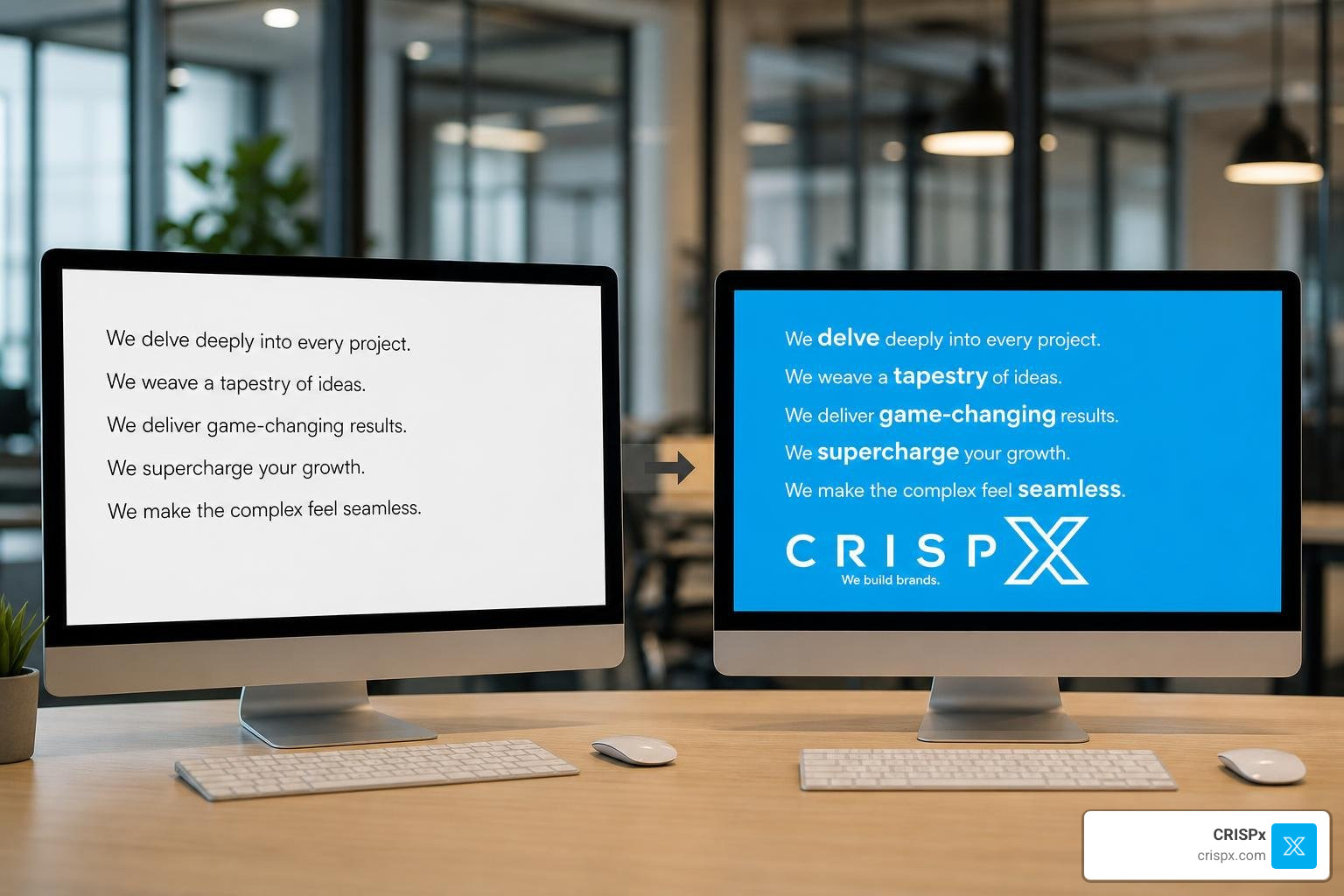
Teams establishing AI-driven content marketing workflows can use these phases to turn existing brand materials into rules their AI tools can follow.
Phase 1: Review and Consolidate Your Brand Rules
Gather all existing brand assets into one shared repository. Remove duplicate rules and resolve conflicts across old slide decks, PDFs, and internal wikis. Identify the messaging rules that must not change, approved technical claims, and verified product capabilities.
Phase 2: Convert Guidelines into JSON, YAML, and Markdown
Turn written rules into defined data formats, DTCG design tokens, and Markdown guides. Track file changes in version control. Use semantic versioning (SemVer): major numbers for incompatible changes, minor numbers for compatible additions, and patch numbers for compatible fixes. This helps engineering, design, and marketing track updates. These files also help with balancing creative freedom with AI structure across every channel.
Phase 3: Build Paired Examples and Banned-Word Lists
Show the model pairs of preferred and unwanted wording. Give it a few examples for each channel, such as email, product pages, and social posts. These examples guide the model toward your brand's voice.
Testing, Governance, and Human Oversight at Scale
Structured brand rules need regular testing and automated checks. Add checkpoints to your brand equity management systems to help protect what makes your brand distinct as content production grows.

Stress-Testing AI Prompts and Checking Results
Before using brand instructions in daily work, test whether conflicting requests can make the model ignore them:
- Prompt Injection Testing: Test whether the model drops banned-word restrictions when given conflicting user instructions.
- Claim Inflation Checks: Verify that the AI refuses to invent technical specs, battery life figures, or latency metrics not found in source documentation.
- Scoring Guide: Score sample batches from 0–3 on tone, correct terminology, accessibility, and required format. Target an average score of 2.3 or higher with zero critical failures.
Three Levels of Checks and When People Review
As output grows, set clear boundaries between automated checks and human review:
- Tier 1 (Blocking): Automated checks before publishing reject content with unverified safety claims, regulatory errors, or forbidden statements about the brand's position in the market.
- Tier 2 (Human Review): Content that strays somewhat from the brand's voice or proposes a new campaign message is flagged for human review. People make the final calls on taste, creative detail, and strategy.
- Tier 3 (Auto-Repair): Simple rule violations, such as banned words or invalid design token names, are corrected automatically during generation.
Using Machine-Readable Rules Across Teams
Different teams can use the same machine-readable brand rules in their daily work:
- Product & Engineering: Coding assistants read
DESIGN.mdto build user interface components using verified design tokens. Check the results before release. - Sales: AI outreach tools read
brand.mdto draft technical email sequences that speak directly to engineer buyers without corporate fluff. - Marketing & Content: Content workflows read
SKILL.mdto generate case studies, launch materials, and social updates that follow the approved brand message. - People & Recruiting: HR teams apply voice rules to job descriptions so technical hiring posts avoid generic corporate wording.
Frequently Asked Questions about Machine-Readable Branding
What is the difference between human and AI-ready brand guidelines?
Human guidelines use prose, layout examples, and descriptive language, often stored in PDFs. AI-ready guidelines use structured text files in formats such as Markdown, JSON, and YAML. They include numeric limits, design tokens, rules about what to avoid, and examples pairing prompts with preferred responses. AI tools can read these files, and software checks can test whether outputs follow the rules.
How do machine-readable rules help prevent brand drift at scale?
They turn subjective guidance into testable rules. These systems define clear limits, named design values, and banned-word lists. Automated checks test content or code against those rules before publication or release.
Which file formats can an AI-ready brand kit use?
A kit can use brand.manifest.json as its directory index, brand.md for identity and voice rules, and DESIGN.md for layout and visual styling. Use tokens.json for DTCG design tokens, and SKILL.md or AGENTS.md for task instructions and coordination between agents. Choose the files your tools can read and use.
Conclusion
An AI-ready brand system can help keep your identity consistent as you generate more content and code. At CRISPx, we plug in as your outsourced marketing and sales team so you never need to hire an internal head of marketing. We work alongside engineer founders across four clear subscription plans: Launch, Grow, Grow + Ads, and Scale.
Our team brings deep domain experience to technical products:
- Tony Crisp has 30 years in branding, 100+ hardware launches and 8+ patents, and co-founded AViiQ (acquired).
- Robosen Optimus Prime went from Kickstarter to CES, then Hasbro and Disney licenses.
- XFX became NVIDIA's #1 graphics card partner worldwide and went public.
- FuzeDrive ran a top 1% Indiegogo campaign.
- SecureCircle was acquired by CrowdStrike.
- Element U.S. Space & Defense serves clients like Anduril, SpaceX and NASA.
We run every engagement through The DOSE Method™, a practical strategy framework designed for technical markets:
- Diagnosis: Find what is broken in your message and the steps buyers take toward a purchase.
- Prescription: Fix the biggest problem first, from unclear messaging to website steps that make it hard to buy or inquire.
- Prognosis: Set measurable targets, track performance, and adjust.
We use this framework to address four buyer responses:
- Dopamine: They want the product.
- Oxytocin: They trust the engineering and reliability.
- Serotonin: They feel proud to align with your brand.
- Endorphins: They feel relief that their technical challenge is solved.
If your product is built but your site reads like a raw spec sheet, take the next step. Get your free DOSEscore™ brand checkup to review your website and story, or book a strategy call with our team today.
Get a free brand checkup.
We work like a brand doctor. The DOSE Method™ finds what's broken, fixes the biggest problem first, then tracks the results.