

Mastering Product Positioning for Highly Technical and Complex Hardware

Build a technical product messaging framework that turns complex hardware specs into buyer demand and shortens sales cycles.
Why Hardware Needs a Technical Product Messaging Framework
A technical product messaging framework is a structured system that translates hardware engineering specifications into clear business value. It connects what your product does at the component level to the operational and financial outcomes buyers care about. Instead of leading with clock speeds, thermal tolerances, and bus bandwidths, the framework leads with the buyer's problem and supports every claim with the engineering mechanism behind it.
Hardware companies face three common pitfalls: the launch falls flat because the product is ready but the story is not, growth stalls because early sales spike and then fade, and people don't get it because the site reads like a raw bill of materials. When you build deep-tech products, consumer electronics, robotics, or space systems, it is tempting to believe the engineering speaks for itself. It does not.
Research shows that prospects conduct 60 to 80 percent of their research online before ever speaking to a sales team. Furthermore, according to Gartner research, 61 percent of B2B buyers prefer a rep-free buying experience. If your technical architecture is buried under jargon or isolated in PDF spec sheets, you lose deals before the first discovery call.
Generic marketing slogans fail technical buyers. When positioning a technical product for engineer buyers, technical audiences demand to know the concrete mechanism behind any performance claim. If you claim your robotics system cuts factory downtime by 40 percent without explaining the onboard compute architecture that enables it, technical champions assume you are selling vaporware.
Executing a successful high-tech product launch strategy requires aligning what your hardware does with why an executive should write a check for it. A structured messaging architecture bridges this gap. It shortens complex evaluation cycles and gives internal champions the exact words they need to justify your product to their procurement and finance teams.
Product Positioning vs. Product Messaging
Founders often confuse positioning with messaging. They are closely linked, but they serve two distinct operational purposes.
Product positioning is the strategic foundation. It defines the mental category where your product sits in the customer's mind, who it is for, and why it is fundamentally different from the competitive alternative. Positioning changes slowly as your market matures.
Product messaging is the tactical execution. It translates your positioning into headlines, web copy, sales decks, ad campaigns, and spec sheet callouts tailored to specific buyer personas and funnel stages.
| Dimension | Product Positioning | Product Messaging |
|---|---|---|
| Primary Purpose | Defines market context, target category, and core differentiation | Translates strategy into customer-facing words, pitches, and copy |
| Audience | Internal stakeholders, product leaders, and executive strategy teams | External buyers, technical champions, decision-makers, and partners |
| Cadence of Change | Slow-changing (reviewed annually or upon major market shifts) | Dynamic (adapted across channels, campaigns, and buyer personas) |
| Output | Positioning statement, competitive alternatives matrix, category definition | Taglines, value pillars, modular boilerplates, and sales talk tracks |
Translating Spec Sheets into Commercial Demand
When engineer founders build product landing pages, they often list clock speeds, thermal tolerances, and bus bandwidths. Listing technical specifications is necessary, but it does not tell buyers what outcome to expect.
To turn technical specifications into business demand, you must walk up the translation ladder to explain technical products in clear business language. The translation ladder takes an engineering attribute and connects it directly to workflow improvements and business outcomes.

- Technical Capability: "Our edge compute module runs inference at 15W TDP."
- Workflow Effect: "Which means your autonomous mobile robots can process visual SLAM locally without draining their battery or dropping connection to the cloud."
- Business Consequence: "Which allows warehouse operators to run 18-hour continuous shifts per charge, reducing idle charging downtime by 35%."
- Concrete Proof: "Validated in customer field tests across 50,000 operational hours."
- Why Now: "Eliminating the need to re-engineer floor infrastructure before peak shipping season."
By leading with the business outcome and supporting it with the technical mechanism, you equip both the technical champion (who cares about the TDP) and the economic buyer (who cares about battery life and shift throughput) to approve the purchase.
Researching Hardware Buyers and Validating Core Value
You cannot craft strong messaging in an internal conference room. High-converting messaging is discovered by listening to your market. 91% of Product Marketing Managers own positioning and messaging as a core responsibility, and the most effective ones rely on direct customer data. Using data-driven product-market fit insights ensures your value proposition reflects how buyers actually choose products.
To define your core value, analyze three intersecting vectors:
- The Customer Need: What acute, painful operational bottleneck is keeping the buyer awake?
- The Market White Space: What are competitors ignoring or over-complicating?
- Your Unique Capability: What engineering mechanism can your team deliver that no alternative can match?
A practical formula for capturing this is the classic value proposition framework:
For [Target Buyer] who struggles with [Operational Problem], our product is a [Product Category] that provides [Core Business Benefit]. Unlike [Primary Alternative], our product [Unique Mechanism and Proof].
Uncovering Voice-of-Customer Language and Real Pain Points
Engineers tend to write about products using formal, academic phrasing. Your customers, however, describe their problems in simple, urgent language.
Mine recorded sales calls, support tickets, and industry forums for exact verbatim phrasing. When interviewing technical users, listen for emotional friction. As we explore in our work on human narratives that build emotional trust, buyers remember messages that address their daily frustrations rather than generic corporate buzzwords.
If a robotics engineer tells you, "I spend three hours every morning manually recalibrating optical sensors because the thermal drift throws off our zero point," that sentence is gold. Your headline should not be "Next-Gen Enterprise Sensor Calibration." It should be "Eliminate Daily Sensor Drift Recalibration with Thermally Stabilized Optics."
Mapping Personas Across the Technical Buying Committee
Hardware purchases rarely involve a single buyer. Enterprise and industrial hardware sales often require evaluating multiple stakeholders at once. Neuro-mapping the technical buying committee ensures your messaging addresses every stakeholder's unique priorities:
- The Hardware/Design Engineer (Technical Champion): Wants architectural precision, data sheets, integration ease, and thermal/power reliability. They fear buying something that fails in testing and derails their project schedule.
- The IT & Security Director: Wants compliance, firmware update roadmaps, network isolation, and backward compatibility. They fear security vulnerabilities and unsupported legacy hardware.
- The Operations / Line-of-Business Manager: Wants throughput, ease of operator training, uptime metrics, and safety certifications. They fear line stoppages and expensive integration delays.
- The CFO / Procurement Officer (Economic Buyer): Wants clear ROI, unit economics at volume, predictable maintenance costs, and vendor stability. They fear budget overruns and vendor lock-in.
Coordinate your messaging across these touchpoints by developing role-based multi-channel launch sequences that deliver the right level of technical depth to each stakeholder throughout the sales process.
Core Components of an Actionable Messaging Hierarchy
A messaging framework acts as the single source of truth across product development, sales, marketing, and executive leadership. Building one prevents mixed messages and sets the foundation for building scalable messaging systems.
A complete framework consists of five essential layers:
- Core Narrative & Value Proposition: A concise, 10-word summary of the primary transformation your product delivers.
- Target Audience & Use-Case Definitions: Clear breakdowns of who uses the product and the exact conditions under which they deploy it.
- Strategic Value Pillars: Three mutually exclusive pillars that explain how the product achieves its core promise.
- Mechanism and Feature Callouts: The specific architectural, software, or component details that make each pillar possible.
- Concrete Proof Points: Hard metrics, benchmark studies, regulatory certifications, and customer logos that validate every claim.
Developing MECE Value Pillars
To ensure your messaging is clear and comprehensive, your value pillars should be MECE: Mutually Exclusive and Collectively Exhaustive.
- Mutually Exclusive: No two pillars should make the same claim. If Pillar 1 is about integration speed and Pillar 2 is about setup time, they overlap and dilute your story.
- Collectively Exhaustive: Together, your three pillars should address every primary concern a buyer has—performance, reliability, and total cost of ownership.
Treat these pillars like modular building blocks that can be assembled across different marketing channels.
Consider how a high-performance industrial compute module might structure its three MECE pillars:
- Pillar 1: Sustained Edge Performance (Compute & Architecture): Runs heavy AI computer vision models locally without throttling.
- Pillar 2: Zero-Downtime Ruggedization (Reliability & Field Readiness): Operates reliably in harsh, unconditioned environments from -40°C to 85°C.
- Pillar 3: Drop-In Modular Integration (Deployment & Cost): Replaces legacy form factors without requiring custom carrier board redesigns.
Concrete Proof Points and Modular Boilerplates
For every value pillar you establish, pair it with hard proof. Technical buyers are skeptical of unsupported claims. If you claim fast deployment, your proof point should be "drop-in PCIe form factor with pre-compiled Linux kernel drivers that deploy in under 15 minutes."
To maintain consistency across marketing collateral, PR, and investor updates, build modular boilerplates directly into your framework:
- The Tagline (3–5 Words): High-impact, rhythmic summary of the product's primary role.
- 25-Word Elevator Pitch: Focuses strictly on who the product is for and its main business outcome.
- 50-Word Overview: Adds the primary architectural mechanism and competitive alternative context.
- 100-Word Comprehensive Boilerplate: Complete narrative including customer pain, mechanism, workflow impact, key proof points, and category definition.
Step-by-Step Execution: Building and Testing the Hierarchy
Constructing an effective framework requires balancing engineering reality with commercial strategy. When executing marketing strategies for high-tech hardware, build your hierarchy in structured phases.
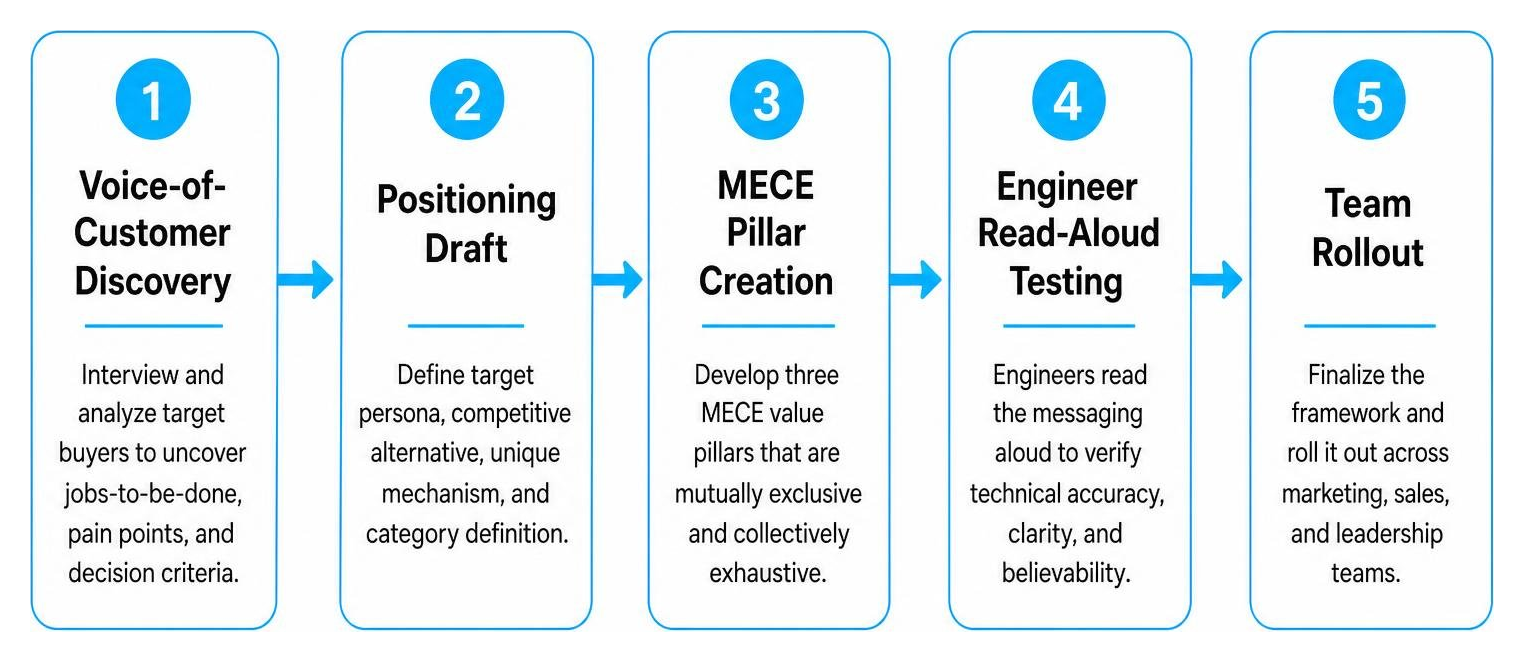
Constructing Your Technical Product Messaging Framework
Follow this structured process to build your messaging matrix:
- Complete the Positioning Worksheet: Fill out your target persona, competitive alternative, unique mechanism, and category definition.
- Draft the Primary Core Message: Write a one-sentence promise answering what the product achieves, for whom, and why it matters today.
- Define Three MECE Pillars: Write an active, benefit-led headline for each pillar followed by a two-sentence narrative explanation.
- Map Mechanisms to Each Pillar: List the exact hardware components, firmware algorithms, or architectural choices that make each claim possible.
- Attach Evidence: Tie every mechanism to a benchmark figure, patent, safety certification, or pilot test result.
- Create Persona-Specific Angles: Adjust your phrasing to speak directly to the engineer, operations manager, and CFO while keeping the core value identical.
Pressure-Testing Claims with Engineers and Decision-Makers
Before publishing your messaging across your website and collateral, pressure-test it against internal and external audiences.

- The Engineer Read-Aloud Test: Hand your homepage copy or product overview to five engineers who match your buyer profile. Ask them to read it aloud and explain what the product does in their own words. Note where they stumble, pause, or express skepticism.
- The "Wince" Test: Have a lead hardware engineer review your value claims. If they wince at a headline because it overpromises or uses vague buzzwords, rewrite it until it accurately reflects the engineering reality.
- The "So What?" Test: Read each claim and ask "so what?" until you reach a business consequence. If your feature is "gold-plated interconnects," the answer is "corrosion resistance," which leads to "zero field service calls over a 5-year operating window." That final consequence is what belongs in your headline.
Rollout, Governance, and AI-Era Maintenance
A messaging framework only works if your team uses it. Storing it away in a forgotten folder leads right back to inconsistent web copy and disjointed sales decks.
To roll out your framework effectively:
- Create a Central Living Document: Host your framework in a clean, accessible format that every team member can reference.
- Enable Sales and Engineering Teams: Provide sales reps with modular talk tracks and provide technical sales engineers with mechanism-to-benefit cheat sheets.
- Audit Marketing Touchpoints: Update your website headers, data sheets, pitch decks, and digital campaigns to ensure complete consistency.
Scaling Your Technical Product Messaging Framework for AEO and Machine Agents
In today's market, humans are no longer the only audience reading your technical copy. Buyers increasingly use tools like ChatGPT, Claude, and Google AI Overviews to research, compare, and recommend hardware architectures. 27% of all AI application spend now flows through product-led growth channels, and AI evaluation agents rely on structured, unambiguous copy.
As we discuss in our analysis on entering the agentic era of tech branding, your product messaging must be structured for Answer Engine Optimization (AEO). AI search engines reward concise, well-defined value pillars backed by clear technical facts.
You can also structure your technical product definition using open documentation models such as the PRODUCT.md open standard. A PRODUCT.md file sits in your repository or web root, providing a clear, machine-readable summary of your product's audience, core capabilities, brand tone, and commercial parameters. This ensures both human developers and autonomous AI buying agents interpret your technical capabilities accurately.
Iterating Across Product Lifecycles and Strategy Shifts
Your messaging framework should adapt as your product, market, and customers evolve.
Schedule quarterly messaging reviews to evaluate whether your copy is still driving commercial demand. Consider updating your messaging when:
- Your Product Matures: You transition from an unproven pilot board to a fully certified production module.
- Market Feedback Shifts: Customers consistently find value in a feature you originally treated as a minor add-on.
- Competitors Adapt: A competitor attempts to match your claims, requiring you to emphasize a deeper technical differentiator.
- Sales Adoption Drops: Your sales team stops using official collateral because it feels disconnected from real customer conversations.
Frequently Asked Questions About Technical Product Messaging
How long does it take to develop a technical messaging framework?
For a focused hardware or deep-tech company, developing a complete v1 framework takes between three and six weeks. Week one focuses on customer interviews and market discovery; weeks two and three cover drafting the positioning worksheet, value pillars, and proof matrices; and the remaining weeks are dedicated to pressure-testing copy with engineers and rolling it out across your team.
Who should own messaging inside an engineer-led startup?
Product marketing typically leads and manages the messaging framework, but it requires active collaboration across leadership. The founder and product leads must validate the core positioning and technical mechanisms, while sales teams provide continuous feedback from buyer conversations. Marketing owns the final copy, but the entire leadership team must sign off to ensure company-wide alignment.
How does messaging differ between hardware champions and economic buyers?
Messaging for hardware champions focuses on technical mechanisms, architecture, and workflow impact—answering how it integrates and why it won't fail. Messaging for economic buyers focuses on business risk, operational efficiency, and financial return—answering how it lowers operating costs or accelerates time-to-market. Both messages derive from the same core value proposition, but they highlight different altitudes of the translation ladder.
Conclusion
Disciplined technical messaging turns complex hardware engineering into clear commercial demand. When your positioning is clear, your value pillars are distinct, and every claim is backed by technical proof, you eliminate the confusion that slows down hardware sales cycles.
At CRISPx, we plug in as your complete outsourced marketing and sales team so you don't need to hire a head of marketing. Whether you are preparing for launch, expanding post-launch momentum, or scaling enterprise sales, we work alongside engineer founders across our structured plans: Launch, Grow, Grow + Ads, and Scale.
Our work is built on proven industry experience:
- Tony Crisp has 30 years in branding, 100+ hardware launches and 8+ patents, and co-founded AViiQ (acquired).
- Robosen Optimus Prime went from Kickstarter to CES, then Hasbro and Disney licenses.
- XFX became NVIDIA's #1 graphics card partner worldwide and went public.
- FuzeDrive ran a top 1% Indiegogo campaign.
- SecureCircle was acquired by CrowdStrike.
- Element U.S. Space & Defense serves clients like Anduril, SpaceX and NASA.
We guide your messaging using The DOSE Method™ strategy framework:
- Diagnosis: We audit your site and find what is broken in your messaging.
- Prescription: We fix your biggest messaging bottleneck first to drive immediate clarity.
- Prognosis: We establish performance targets, track buyer response, and adjust your story as you grow.
Ready to see how clearly your hardware story communicates to real buyers? Visit our free DOSEscore brand checkup and resources to get a full review of your website and story, or book a strategy call with our team today.
Get a free brand checkup.
We work like a brand doctor. The DOSE Method™ finds what's broken, fixes the biggest problem first, then tracks the results.