

Securing Maximum Brand Visibility Across Next-Gen AI Search Engines

Master AI engine optimization for tech to win citations across ChatGPT, Perplexity, and Google AI Mode.
The Paradigm Shift: Understanding AI Engine Optimization for Tech
AI engine optimization for tech is the practice of structuring technical content so AI search engines can retrieve, extract, and cite it in synthesized answers. For hardware and software companies, this means publishing clear, factual, well-structured pages that answer buyer questions directly, then making those pages easy for AI crawlers to parse and verify.
Search has fundamentally evolved. For decades, tech companies engineered web pages to capture keyword volume, earn domain authority, and secure a spot in the traditional list of ten blue links. Today, generative discovery powered by large language models (LLMs) is redefining how technical buyers, system integrators, and enterprise procurement teams evaluate hardware and software.
When an engineer asks an AI assistant to evaluate brushless DC motor controllers for autonomous mobile robots or compare low-power edge processors, the engine does not merely return a list of links. It retrieves relevant passages across multiple sources, evaluates claims, resolves entities, and synthesizes a direct answer with citations.
This process relies on Generative Engine Optimization (GEO) and Retrieval-Augmented Generation (RAG). Instead of matching raw keywords, neural search models break down prompts into vector embeddings, perform query fan-out across multiple sub-topics, and select trusted sources from a distinct citation core.
Understanding the difference between traditional algorithms and neural retrieval mechanisms is the first step in building a resilient digital presence.
| Dimension | Traditional Search (SEO) | AI Engine Optimization (AIEO / GEO) |
|---|---|---|
| Primary Goal | Rank on page one for target keywords | Get extracted, cited, and recommended in synthesized answers |
| Retrieval Unit | Entire URLs matched to keyword strings | Modular text chunks and passages matched by semantic embeddings |
| Platform Behavior | User clicks through blue links to explore | User receives a synthesized answer and clicks citations for validation |
| Ranking Factors | Backlinks, page authority, keyword density | Information density, factual accuracy, schema, clean HTML extraction |
| Index Dependency | Strict rank order (positions 1-10 capture ~70% clicks) | Disparate retrieval (citations frequently pull from beyond Google page one) |
| Traffic Value | Broad informational traffic with varied intent | Highly qualified, high-intent traffic with specific commercial context |
Fundamental Mechanics: AIEO Versus Traditional Search Algorithms
The mechanics separating traditional SEO from AI engine optimization come down to how content is retrieved and valued. In classic search, ranking near the top of the SERP is everything. However, in AI search, being in Google's top ten is not a prerequisite for being cited.
An extensive analysis of 15,000 queries revealed that, on average, only about 12% of the URLs cited by AI assistants also rank in Google's top 10. Perplexity overlaps with Google's top ten roughly 29% of the time, while ChatGPT, Gemini, and Copilot sit closer to 8%. Furthermore, 50% of citations in Google AI Mode were not on page one of standard Google search results.
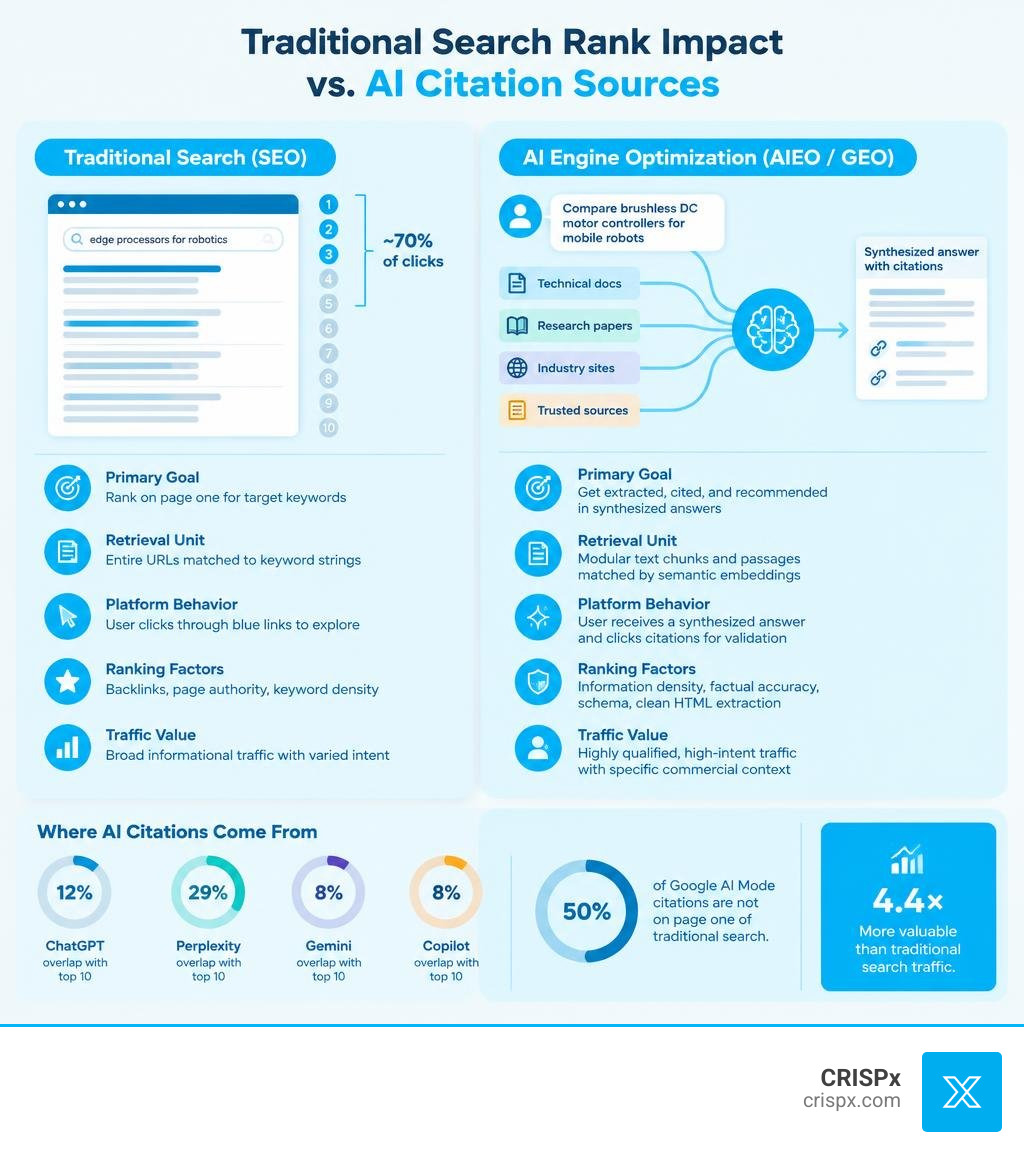
AI engines bypass the traditional page-one monopoly because their neural retrieval systems search for direct semantic answers and verifiable claims rather than domain power alone. When a model processes a user prompt, it performs passage retrieval, extracting dense, factual paragraphs that answer specific technical questions.
Capturing these citations matters because visitors who find a brand in an AI answer are 4.4 times more valuable than those from traditional search. These buyers arrive having already read a synthesized comparison that validated the product against their constraints. Integrating these principles into modern AI in digital marketing strategies allows technical brands to capture high-intent commercial buyers before competitors even know the RFP exists.
Implementing AI Engine Optimization for Tech Across Multi-Engine Architectures
Optimizing for generative discovery requires navigating how different platforms collect, process, and cite information. No two AI engines operate identically:
- Google AI Overviews & AI Mode: Deeply tied to Google's primary search index and quality ranking systems. It uses extensive query fan-out, generating dozens of background sub-queries to compile comprehensive answers. It serves over 100 million monthly active users across the US and India alone.
- ChatGPT Search: Relies heavily on Bing's search infrastructure alongside custom live web retrieval agents. With over 700 million weekly active users, it pulls from dynamic live index calls and established training data. ChatGPT users also maintain active search habits, adding 5 ChatGPT sessions per week on top of their regular web searches.
- Perplexity AI: Uses its own independent web crawler (PerplexityBot) supplemented by SerpApi integrations. It displays a strong preference for fresh content, structured data tables, and direct technical specifications.
- Claude: Grounded by live search integrations (such as Brave Search) and Common Crawl data, focusing on clear, verifiable explanations.
- Microsoft Copilot: Directly integrated into the Bing index, relying on IndexNow pings and semantic markup for grounding.
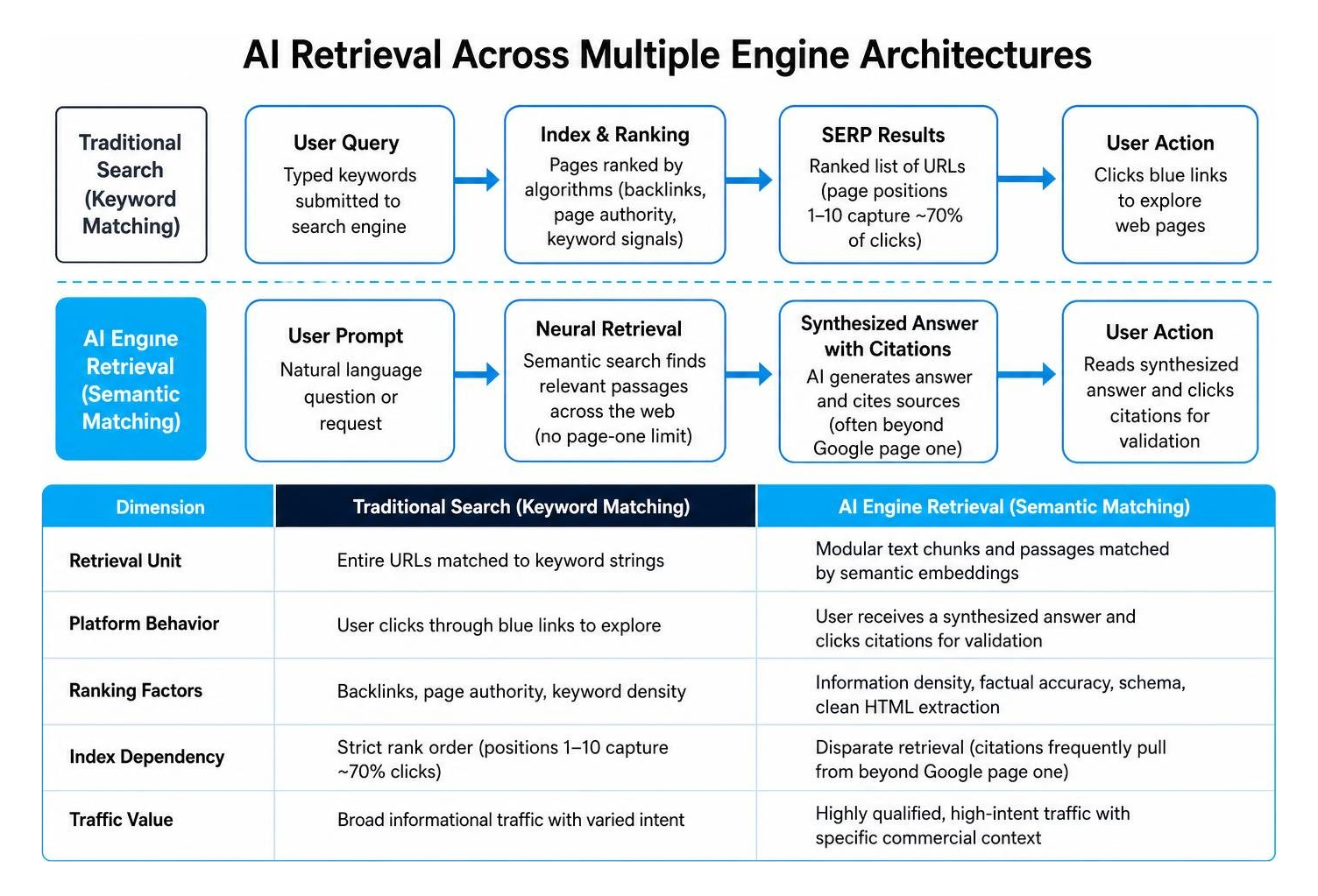
Understanding these distinct architectures is essential. For detailed multi-platform strategies, consult this Tactical guide to AI search and LLM optimization.
Technical Infrastructure: Engineering Your Site for Neural Crawlers and Retrieval
If AI crawlers cannot parse your technical product pages, your brand does not exist in generative search. Many engineering and tech companies inadvertently block AI models through client-side rendering frameworks or overly restrictive firewall rules.

Optimizing technical infrastructure requires shifting from client-side execution to clean server-rendered architectures. Review the Developer guidelines for AI content optimization for comprehensive deployment patterns.
Crawler Permissions, Edge Security, and Rendering Protocols
The most common technical pitfall in tech marketing is hiding critical product specifications inside dynamic JavaScript elements, tabs, or modal popups. Most AI crawlers do not run complete JavaScript rendering pipelines like Googlebot does on desktop indexing. If your specifications require client-side execution, AI bots see an empty page.
To guarantee complete crawlability:
- Deploy Server-Side Rendering (SSR) or Incremental Static Regeneration (ISR): Ensure that your complete HTML payload--including spec tables, performance metrics, and FAQs--is present in the raw server response.
- Audit Web Application Firewalls (WAF) & CDNs: Security layers like Cloudflare, Fastly, or Akamai frequently classify AI bots as malicious scrapers. Whitelist critical AI user-agents:
GPTBot,OAI-SearchBot,ClaudeBot,PerplexityBot, andCCBot. - Configure robots.txt Explicitly: Avoid blanket disallow rules that lock out AI search bots.
- Adopt the IndexNow Protocol: Instantly notify Bing and Copilot-powered retrieval engines whenever hardware documentation or product lines are updated.
- Maintain Core Web Vitals: Low latency, high stability, and fast Time to First Byte (TTFB) ensure crawl bots can parse your technical library without timing out.
Schema Markup and Structured Entity Graphing
Large language models rely heavily on knowledge graphs and semantic entity resolution to associate a company with its capabilities, component categories, and hardware benchmarks. Structured data acts as a direct translation layer between your web pages and neural embeddings.
Implement comprehensive JSON-LD schemas across all technical assets:
- Organization Markup: Define your brand name, leadership, official social profiles, parent organizations, and explicit sameAs references (such as Crunchbase, Wikidata, and industry registries) to establish unambiguous entity identity.
- Product & TechArticle Markup: Structure your physical specifications--voltage tolerances, processing throughput, thermal limits, interface standards--in standardized schema fields rather than generic body copy.
- FAQPage Schema: Adding structured Q&A schema can boost citation probability by 28% to 40% on platforms like Perplexity and ChatGPT, as it presents ready-made question-and-answer pairs for direct retrieval.
Structuring your digital assets accurately is foundational when preparing technical brands for future agentic interactions.
High-Extraction Content Architecture and Brand Authority for Hardware Founders
For hardware founders in consumer electronics, robotics, space and defense, and computers and components, a common challenge is that web pages often read like internal datasheets. When your site reads strictly like an engineering schematic, human buyers struggle to grasp the commercial context, and AI search engines struggle to synthesize why your product matters.

At CRISPx, we help engineer founders overcome three primary hurdles:
- The launch falls flat: The hardware is built, but the story is missing.
- Growth stalls: Early launch interest fades because ongoing demand generation is absent.
- People don't get it: The site reads like a raw spec sheet with no clear problem-to-solution narrative.
Solving these problems requires a content architecture designed for high machine extraction and human clarity. Learn more about structural frameworks in this guide to AIEO and machine behavior.
Tactical Execution of AI Engine Optimization for Tech Content Hubs
To maximize extraction and citation, structure your content into clear, modular information chunks. Neural search models extract answers paragraph by paragraph rather than indexing pages as monolithic blocks.
Implement these structural rules across your technical hub:
- Answer-First Writing: Answer the core question in the first two sentences of every section. Provide the conclusion upfront, then follow with technical elaboration. Research indicates that approximately 44% of ChatGPT citations originate from the first third of a document.
- Question-Based Heading Hierarchies: Use explicit, natural-language headings (H2s and H3s) that match actual buyer inquiries (e.g., "How does lidar sensor drift behave in high-vibration aerospace environments?").
- Context-Inclusive Brand Mentions: When stating capabilities, always link your brand name directly to the specific solution in the same sentence (e.g., "The XYZ-200 controller from [Brand] reduces latency to under 2ms in high-speed pick-and-place robotics").
- Embed Clean HTML Tables: AI engines parse standard HTML tables far more reliably than embedded images or downloadable PDFs. Use tables for pinouts, tolerances, power ratings, and compatibility matrices.
- Publish Original Benchmark Data: Passages containing three or more concrete data points achieve significantly higher citation rates. LLMs prioritize citable, empirical evidence over generic descriptive claims.
Adopting this modular model forms the core of high-authority AI-driven content marketing.
Building Citation-Dense Topical Authority and Verification Signals
AI engines evaluate authority not just by counting external backlinks, but by assessing consensus across the broader technical ecosystem. A brand mentioned consistently across industry publications, technical forums, and peer reviews builds a high-confidence entity score in the model's weights.
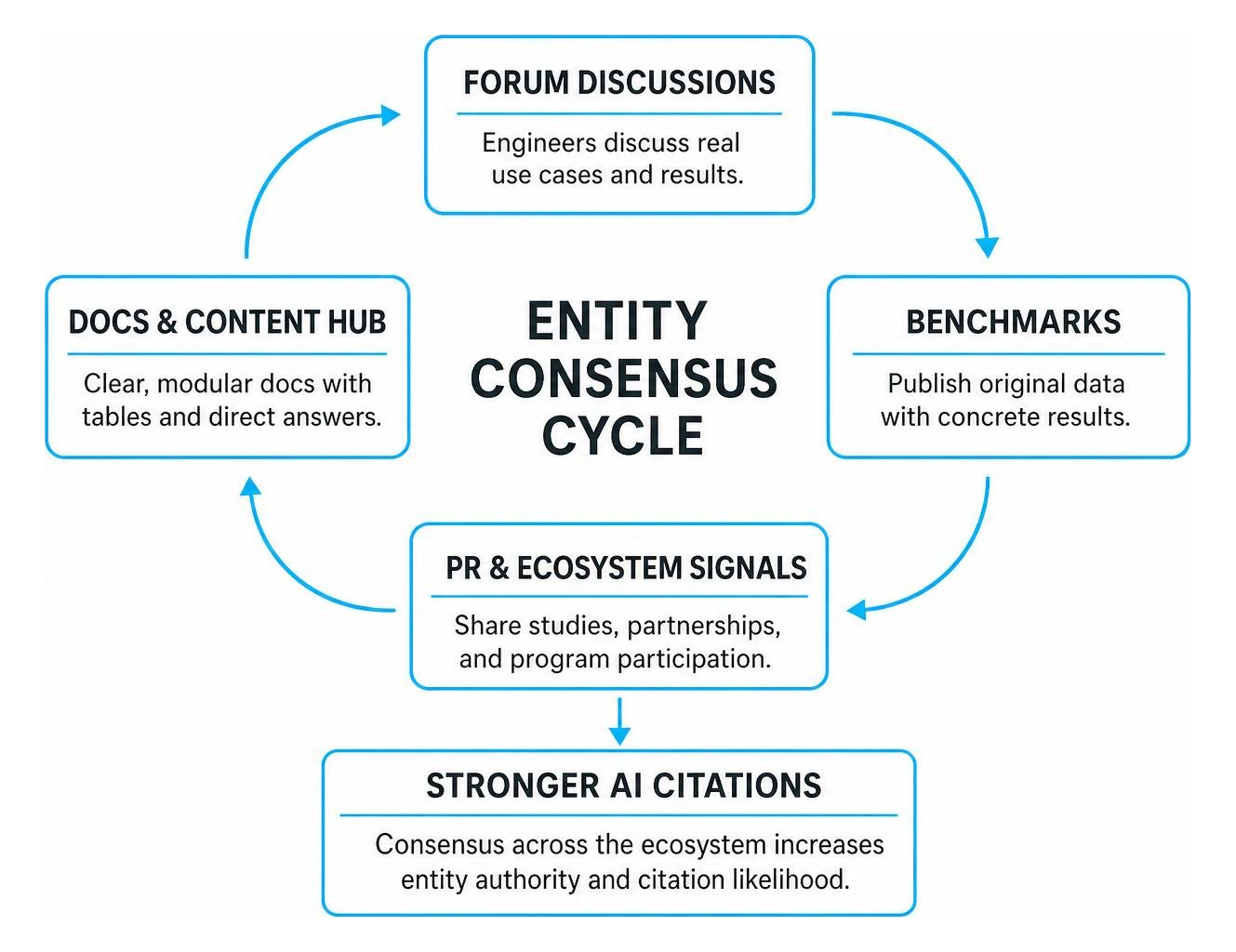
To establish verified authority:
- Publish First-Party Benchmark Studies: Release white papers detailing stress tests, mean time between failures (MTBF), and power efficiency curves.
- Engage in Technical Community Discussions: Active, authentic participation in engineering forums and Reddit threads provides credible consensus data that AI models cite when synthesizing recommendations.
- Leverage Ecosystem Validation: Highlighting public institutional support, research consortium participation, or regional programs builds credibility. For example, the federal Tech Hubs program under the CHIPS and Science Act of 2022 was authorized for $10 billion over five years, with over $800M in Congressional appropriations as of July 2026. Hardware companies participating in such initiatives gain valuable validation signals that models recognize.
- Maintain Clear E-E-A-T Signals: Prominently display author credentials, engineering lead bios, peer-reviewed citations, and verified corporate metadata across your documentation.
These trust signals anchor your position when entering the agentic era of tech branding psychology.
Measurement Frameworks, Ecosystem Ethics, and Competing as an Emerging Tech Brand
Measuring visibility in generative search requires looking beyond standard organic keyword rankings and impression counts.
Because AI search tools are projected to drive more traffic than traditional search engines by 2028, tech organizations must build robust measurement frameworks while navigating broader industry shifts. Explore strategic approaches to AI-powered consumer engagement to modernize your reporting.
Tracking AI Referrals and Generative Engine Visibility
Traditional web analytics dashboards often misclassify AI referral traffic as direct visits or standard organic clicks. Tracking GEO performance requires a dedicated setup:
- Custom Referral and UTM Tracking: Configure analytics filters to isolate traffic from AI domains such as
chatgpt.com,perplexity.ai,claude.ai, andcopilot.microsoft.com. - Server Bot Log Auditing: Monitor server access logs to track crawl frequency from agents like
GPTBot,PerplexityBot, andClaude-SearchBot. Spikes in crawl activity often precede increased brand citations. - Prompt-Based Share of Voice Tracking: Run routine, structured prompt tests across major AI engines for unbranded technical queries (e.g., "What are the most reliable radiation-hardened microcontrollers for cubesats?") to assess whether your brand is mentioned, how it is framed, and what sources are cited alongside it.
- Citation Share Analysis: Track the specific URLs the engines cite most frequently to identify which documentation or spec pages require updating or expansion.
- Conversion and Lead Quality Metrics: Track downstream pipeline velocity. Because AI referrals typically deliver buyers with deeper context, monitor deal size and sales cycle length for inbound leads citing AI discovery.
Workism, Compute Pressures, and Strategic Agility for Startups
The rapid emergence of AI search intersects with broader cultural and operational dynamics across the tech sector.
Within knowledge work, the rise of automated synthesis has prompted reflection regarding employee burnout and the concept of "workism"--the belief that professional output is the primary source of personal identity. As AI abstracts away routine copywriting, research synthesis, and administrative workflows, engineering and marketing teams must preserve the collaborative "messy middle" where genuine creative problem-solving and authentic brand positioning occur.
Simultaneously, the industry faces practical and ethical challenges. Compute constraints, rising data center energy demands, and controversies surrounding surveillance technologies require tech brands to operate with clear principles and transparency.
For startups competing against legacy giants with massive balance sheets, agility is the ultimate advantage. Large incumbents often possess slow-moving marketing bureaucracies and outdated, client-side web architectures that fail in neural search.
By executing a focused technical strategy--publishing granular documentation, maintaining server-rendered pages, and publishing original benchmark data--an emerging hardware startup can systematically win citations across high-value commercial prompts.
Balancing these elements is critical when balancing AI structure with creative brand messaging.
Frequently Asked Questions About AI Engine Optimization for Tech
How do AI crawlers handle client-side JavaScript rendering?
Most dedicated AI search crawlers and retrieval agents (such as GPTBot or PerplexityBot) rely on fast, plain HTML parsing rather than running full JavaScript execution pipelines. If your key technical specifications, product differentiators, or comparison tables are rendered strictly via client-side JavaScript, AI bots may record an empty page and skip your site during real-time retrieval. To ensure your content is indexed, use Server-Side Rendering (SSR) or Static Site Generation (SSG).
Why do pages outside Google's top ten get cited by ChatGPT and Perplexity?
AI search engines do not rely solely on traditional domain-level backlink metrics. Instead, their RAG pipelines perform passage-level semantic vector searches. If a focused, technical article on page three or four of Google provides a direct, highly accurate, and well-structured answer to a complex prompt, the AI engine will extract and cite that specific passage over a more generic, high-authority article that ranks higher on standard SERPs.
Does adding structured data guarantee inclusion in generative AI answers?
No markup guarantees inclusion. However, implementing structured data (such as JSON-LD FAQPage, Product, and Organization schemas) significantly reduces entity ambiguity. It helps LLMs identify your exact specifications, product categories, and brand credentials during retrieval. This makes it easier for the model to extract and cite your data accurately when constructing answers.
Conclusion
Generative search is changing how engineering-led tech brands build visibility and drive commercial demand. Relying solely on legacy SEO and static spec sheets is no longer sufficient when enterprise buyers use AI assistants to evaluate, compare, and shortlist technical solutions.
At CRISPx, we act as the outsourced marketing and sales team for hardware companies run by engineer founders across consumer electronics, robotics, space and defense, and computers and components. We plug directly into your company across four flexible plans--Launch, Grow, Grow + Ads, and Scale--so you do not need a full-time head of marketing.
Our strategy is grounded in thirty years of proven execution. Tony Crisp has 30 years in branding, 100+ hardware launches and 8+ patents, and co-founded AViiQ (acquired). Robosen Optimus Prime went from Kickstarter to CES, then Hasbro and Disney licenses. XFX became NVIDIA's #1 graphics card partner worldwide and went public. FuzeDrive ran a top 1% Indiegogo campaign. SecureCircle was acquired by CrowdStrike. Element U.S. Space & Defense serves clients like Anduril, SpaceX and NASA.
We guide our clients through The DOSE Method™--a clear strategic framework to diagnose your biggest marketing hurdles, prescribe focused fixes, and establish reliable tracking:
- Diagnosis: Identify what is broken in your positioning, technical infrastructure, or AI visibility.
- Prescription: Fix the biggest constraint first--turning confusing spec sheets into clear commercial value.
- Prognosis: Set clear targets, monitor AI citations, track pipeline metrics, and adjust.
If you are ready to ensure your technical products are found and recommended across generative search, run your free DOSEscore brand checkup or book a strategy call today to evaluate your website and story.
Get a free brand checkup.
We work like a brand doctor. The DOSE Method™ finds what's broken, fixes the biggest problem first, then tracks the results.