

Help AI Understand Your Hardware Company

Learn entity optimization for tech brands to help search engines and AI tools identify your company and explain its products.
Why Entity Optimization for Tech Brands Helps AI Identify Your Company
Entity optimization helps search engines and AI tools recognize your company as a distinct business, not just keywords on a page. Give them consistent facts about who you are, what you build, and who buys from you. These facts can help them describe your company accurately. Search engines and AI models do not read websites like people do. Clear facts matter more than buzzwords, animations, or clever taglines. These systems can identify companies, products, and other things—called entities—and connect information about them.
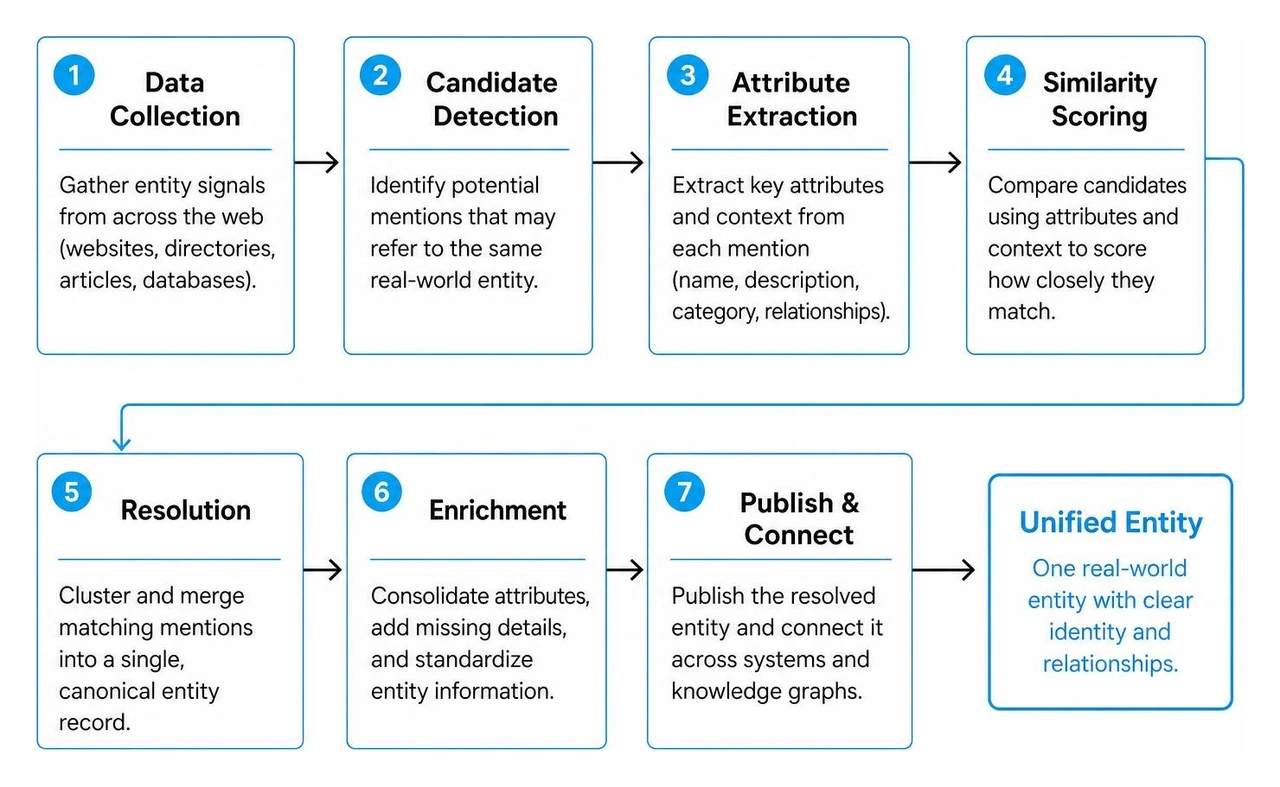
When an engineer founder brings an advanced robotics platform or embedded sensor system to market, three classic problems usually show up:
- The launch falls flat: The product is ready, but the narrative is confused, leaving search engines unsure what category the company belongs to.
- Growth stalls: Sales jump at launch, then fade. Buyers need clear product information and reasons to keep considering your hardware.
- People don't get it: The website reads like an internal engineering spec sheet rather than explaining what the product does for the buyer.
If buyers struggle to understand your product, AI search tools may struggle too. For ai in digital marketing, clear, organized facts matter. AI tools do not just match keywords on a page. They can use knowledge graphs—databases of things and their relationships—to build answers.
For hardware companies, keep company facts consistent and seek credible outside references rather than collecting low-quality links.
How AI Models and Search Engines Form Brand Understanding
Large language models (LLMs) can draw on patterns learned during training and information retrieved when answering a question. Using retrieved information to help generate an answer is called retrieval-augmented generation (RAG).
- Patterns Learned During Training: Models learn from material such as public web pages, technical whitepapers, news articles, and code repositories. When your brand name repeatedly appears alongside terms such as "autonomous mobile robot," a model can learn an association between your company and that technology.
- Information Retrieved When Answering: When a prospective buyer asks ChatGPT, Google Gemini, or Claude for vendor recommendations, the tool may search the web. It can use retrieved sources to help generate an answer, but this does not guarantee that it verifies every claim.
If your homepage calls your system an "all-in-one cognitive throughput platform" while your Crunchbase profile says "supply chain software" and your distributor lists you as "industrial hardware," the AI encounters conflicting signals. Conflicting descriptions can lead AI tools to invent incorrect specifications or leave your company out of an answer.
Entity SEO vs Traditional Keyword SEO
Traditional keyword SEO focuses on matching words in a buyer's query to words on a webpage. Entity SEO helps search systems recognize your company as one distinct organization. It connects verified company facts, leadership, products, and customer use cases.
| Dimension | Traditional Keyword SEO | Entity-Based SEO |
|---|---|---|
| Primary Focus | Exact keyword strings and query volume | Real-world entities, concepts, and relationships |
| Search Mechanism | Matches query words to indexed pages | Connects facts and relationships; retrieves sources to help build answers |
| Key Ranking Signals | Page title tags, keyword density, backlinks | Fact consistency, schema markup, corroboration |
| Handling of Synonyms | Requires distinct pages for variants | Connects different terms to the same company, product, or concept |
| Resilience to Updates | Vulnerable to core algorithmic shifts | Consistent company facts remain useful as platforms change; visibility can still vary |
Traditional search engines and AI tools both need to match references to the same company, product, or concept. Clear company and product descriptions can help them identify your category when buyers compare hardware options.
The Company Facts Search Systems Need
Clear, consistent company facts help search systems identify who you are, what you manufacture, and who buys from you. Practical marketing strategies for tech start with organizing those facts so both buyers and search systems can understand them.
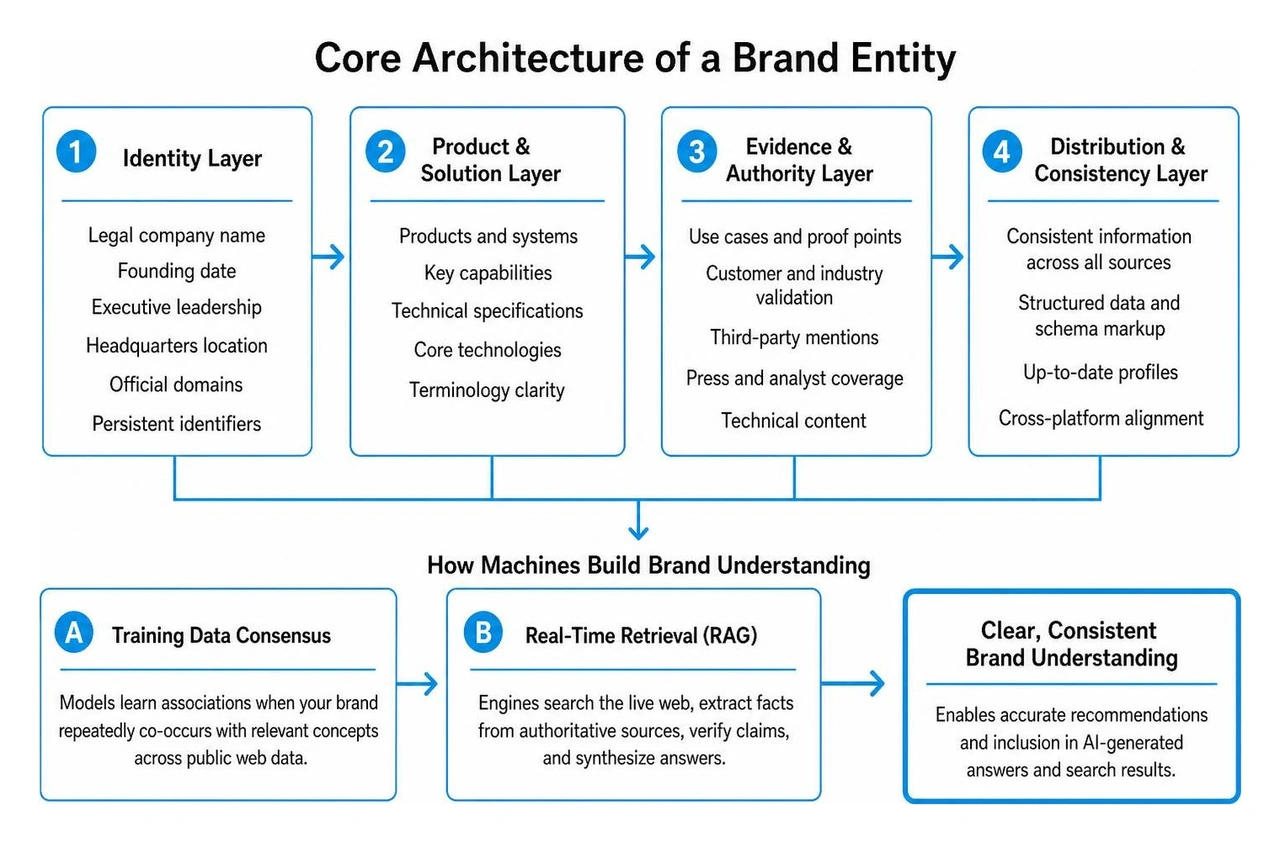
Four Foundational Layers of Entity Optimization for Tech Brands
Organize your company's search information into four groups:
- Identity Layer: Your company's core identifying facts. Include your legal company name, founding date, executive leadership, headquarters location, and official domains. Also include stable identifiers that search systems use to recognize your company, such as its structured-data
@id. - Descriptive Layer: Clear, plain-language category definitions. Instead of using marketing slogans, state exactly what your hardware does (for example, "Industrial robotic arms for micro-electronics assembly"). Lead with buyer outcomes, then back those claims with engineering specifications.
- Association Layer: The links between your company and related products, industries, and technologies. Include your target industries, technical standards, hardware integrations, component suppliers, and direct category alternatives.
- Corroboration Layer: Independent sources that support your claims. Look for third-party references that confirm the facts on your website.
These four groups help founders check where company information is unclear or inconsistent. Use them to plan how to make your company easier to find in AI answers.
Structured Data and Schema Markup as Machine Labels
Structured data labels facts for search engine crawlers. While people use visual design and typography to understand a page, search crawlers can read JSON-LD, a structured-data format that labels company facts and relationships.
For tech and hardware brands, start your structured-data setup with the Organization type on your homepage and the Product type on individual product pages.
Key schema properties include:
@id: A stable web identifier for your company, used consistently across your structured data.legalNameandname: Your company's legal name and common trading name.sameAs: A list of external URLs that identify the same company, such as its Crunchbase, LinkedIn, or Wikidata profile, or relevant SEC filings.knowsAbout: A list of topics, protocols, and technical disciplines your team specializes in.
Using structured data correctly gives search engines a clean map of your product line and technical capabilities.
Practical Steps: Keep Facts Consistent, Distinguish Your Company, and Verify Claims
Keep company facts consistent across your websites, public databases, and industry coverage.
A disciplined approach to b2b brand building helps your website, profiles, and other online materials describe the same company.
Resolving Lookalike Names and Disambiguation for Tech Brands
Hardware startups often face name collisions—sharing names with software platforms, consumer retail brands, or foreign agencies. When two companies share identical names, AI tools can mix up their product lines or attribute press about one company to the other.
To help AI tools tell your company apart from others:
- Keep One Company Fact Sheet: Maintain a single document with your exact company name, standard category description, leadership team, and headquarters details.
- Explain Which Company You Are: Add a clear sentence to your homepage copy and footer stating what your company is and what it is not. For example (a made-up company): "Apex Robotics is an Irvine-based manufacturer of subsea autonomous drones, not to be confused with Apex Robotics Software of London."
- Check Your Wikidata Entry: Ensure your Wikidata item has accurate properties that distinguish it from other businesses. Check
P31(instance of),P452(industry), andP856(official website).
External Corroboration Across Directories, Reviews, and Press
Do not rely only on your own website. Independent sources can help AI tools check your company facts.
Prioritize credible outside sources:
- Industry Registries and Marketplaces: Maintain active profiles on relevant platforms such as Crunchbase, PitchBook, ThomasNet, and GitHub organizations.
- NAP+ Consistency: Keep your Name, Address, and Phone (NAP) consistent across directories. Also standardize product names, executive titles, and category descriptions.
- Earned Trade Coverage: Seek press coverage and podcast appearances for your technical leaders. Independent coverage gives search systems another source for checking your company's identity.
Keep Company Facts Consistent Across Brands and Websites
Hardware companies may manage several related businesses and websites: parent companies, subsidiaries, product lines, developer documentation portals, and localized sales domains. Without clear ownership of company facts, these sites can give search systems inconsistent descriptions.

Clear descriptions of your company and product lines help search systems understand a large catalog. This follows the same principles as brand architecture for growing companies.
To help search crawlers read your company and product websites:
- Render Critical Text in Plain HTML: Avoid hiding core company descriptions behind client-side JavaScript or dynamic Single Page Applications (SPAs)—sites that load content through scripts. Putting key company facts in the initial HTML makes them easier for crawlers to read.
- Implement Clean Permissions: Review your
robots.txtfile, which gives crawlers access instructions. Set access for bots such as GPTBot, ClaudeBot, and PerplexityBot according to your site's policies. Check each platform's documentation because search and training crawlers can serve different purposes. - Deploy Dedicated Evidence Pages: Create stable URLs for pages that answer technical questions and explain integration methods, component standards, and system compatibility. These give search tools specific sources to reference.
Measuring Entity Strength and Avoiding Common Pitfalls
Regularly check how AI tools describe and cite your company. Go beyond search rankings: track factual accuracy, whether your company appears in the right product category, and how often AI answers cite it.
Using advanced marketing analytics helps engineering leaders measure how accurately AI tools describe their products.
Track AI Citations and Product Accuracy
Track how major AI systems represent your brand using a structured evaluation process:
- Use a Fixed Set of Buyer Questions: Create a standard set of 10 to 20 buyer queries. Include direct questions about your company ("What does [Company] manufacture?"), category questions ("Top industrial autonomous mobile robot vendors"), and comparison questions.
- Run Monthly Evaluations: Run these questions across ChatGPT, Google Gemini, Claude, and Perplexity on a set monthly schedule.
- Score Fact Accuracy: Track whether the tools use your current product names, describe your capabilities accurately, and reference your official domain.
Pair this qualitative testing with regular marketing performance tracking to measure branded search volume and referral traffic from AI platforms.
Mistakes That Make Your Company Harder to Identify
Several technical and editorial mistakes can make your company harder to identify:
- Alias Sprawl: Using multiple variations of your brand name across marketing campaigns.
- Schema Contradictions: Publishing prices or product specifications in JSON-LD structured data that conflict with the visible page text.
- Orphan Subdomains: Hosting technical documentation or developer portals on subdomains without connecting their structured data to your main
Organizationschema@id. - Inflated
sameAsLinks: Linking to unmaintained social profiles or irrelevant directories, which can make your company's identity less clear to search systems.
Frequently Asked Questions about Brand Entity Optimization
What is brand entity optimization in modern search?
Brand entity optimization means organizing company facts so search engines and AI tools can distinguish your business from others. Keep your website text, structured data, and independent references consistent. This helps search systems identify your products, category, and capabilities.
Does my tech company need a Wikipedia page to establish an entity?
No. Wikipedia is a major source for knowledge graphs, but writing about your own company creates a conflict of interest under its guidelines. Tech brands can help search systems identify their company through accurate Wikidata entries, consistent JSON-LD structured data, Crunchbase profiles, patents, and independent trade press coverage.
How long does it take to see results from entity SEO?
Timing varies by platform. Watch for updated company descriptions in search snippets after fixing structured data and directory listings. Changes in how AI tools describe and cite your company may take longer as models and search indexes are updated. Check regularly rather than relying on a fixed timeline.
Conclusion
Building a hardware product takes substantial engineering work. Clear product descriptions help search engines, AI assistants, and potential customers understand what it does.
At CRISPx, we plug in as your marketing and sales team so you do not need a head of marketing. Through our Launch, Grow, Grow + Ads, and Scale plans, we help explain your products and reach buyers.
Our strategy framework is The DOSE Method™:
- Diagnosis: We review your website, product messaging, and how your company appears in search to find what is holding back growth.
- Prescription: We fix the biggest problem first, whether it is structured data, product messaging, or the launch plan.
- Prognosis: We set growth targets, track results across your marketing channels, and adjust the plan as your market changes.
Our team's hardware and technology experience includes:
- Tony Crisp has 30 years in branding, 100+ hardware launches and 8+ patents.
- Robosen Optimus Prime went from Kickstarter to CES, then Hasbro and Disney licenses.
- FuzeDrive ran a top 1% Indiegogo campaign.
- SecureCircle was acquired by CrowdStrike.
To evaluate how search engines, AI models, and buyers perceive your company, get a free DOSEscore™ brand checkup of your website and story today, or book a strategy call with our team.
Get a free brand checkup.
We work like a brand doctor. The DOSE Method™ finds what's broken, fixes the biggest problem first, then tracks the results.
