

Avoid Costly Tooling and Channel Mistakes with Hardware Product Launch Strategy

Avoid costly tooling and channel mistakes with this hardware product launch strategy guide covering lean NPI, DFM, and pre-launch demand.
Build the Launch Plan Before You Cut Tooling
A Hardware product launch strategy should connect product readiness with customer demand. Start by testing the problem with buyers and building a waitlist. Then prove the product works, check that it can be made at a viable cost, and test it with users. Choose launch channels only after you know what you can build, ship, and support.
That order matters. A working prototype does not prove a factory can make thousands of reliable units. And a strong launch campaign cannot fix a product buyers do not understand. Plan tooling, certification, messaging, and sales channels together so each launch promise matches what the product team can deliver.
The 7-Phase Lean NPI Hardware Product Launch Strategy
Physical devices cannot be patched with a quick overnight code update once steel tooling is cut or retail inventory is on the water. Applying software-only agile tricks directly to physical manufacturing leads to scrap, late deliveries, and burned capital. Hardware engineering demands a structured gate framework that protects cash reserves while moving fast enough to capture market share.
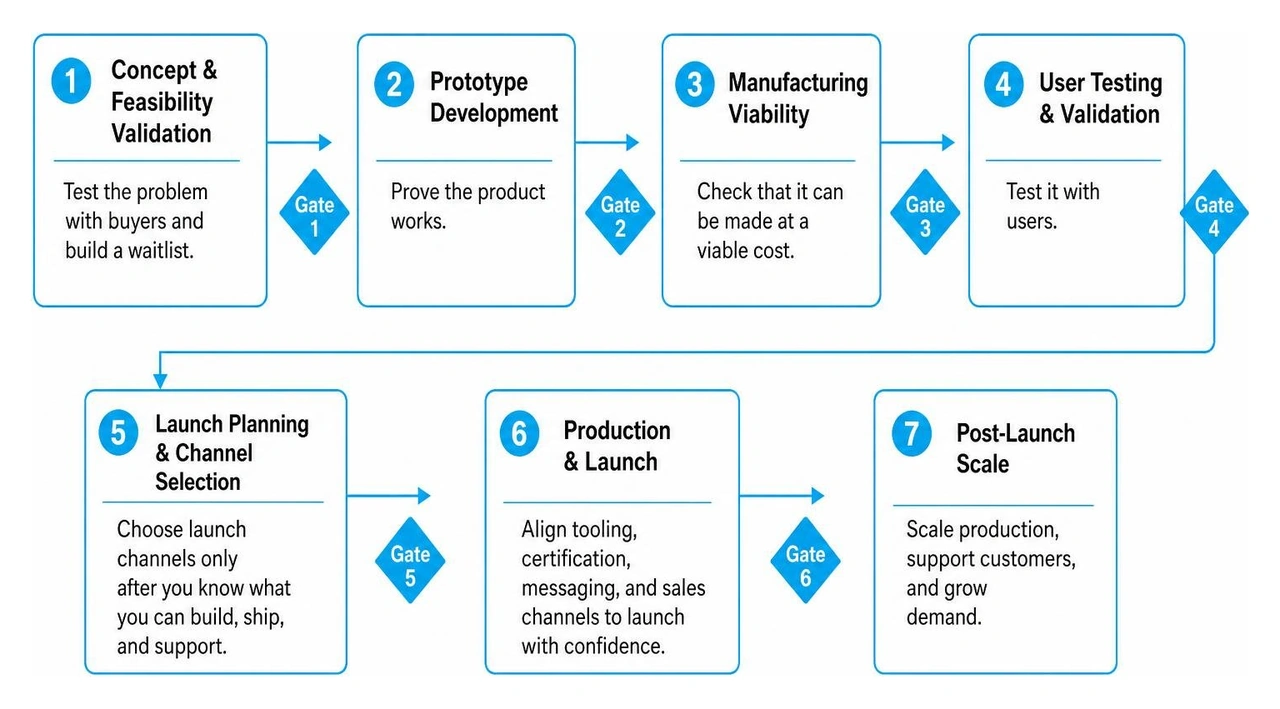
Modern hardware teams bridge this gap by adopting a structured stage-gate approach. A Lean NPI framework can give hardware and robotics teams a practical way to coordinate engineering milestones with customer discovery. This approach combines disciplined engineering milestones with continuous customer discovery.
Aligning engineering validation with commercial positioning is essential when planning a high-tech product launch. Moving through seven structured phases ensures that physical progress matches buyer demand every step of the way.
Concept and Feasibility Validation
The initial Concept phase gives founders time to complete structured empathy interviews to map real operational pain points. Using a Jobs-to-be-Done (JTBD) canvas, the team uncovers what functional and emotional outcomes the customer expects, rather than simply collecting a wishlist of technical features.
Next, the Feasibility phase evaluates whether the concept can survive the factory floor. Engineers develop the initial bill of materials (BOM), create software bills of materials (SBOM) for connected systems, and build an early financial model. Teams initiate a Design Failure Mode and Effect Analysis (DFMEA) to identify thermal, structural, and electrical risks before committing substantial capital.
EVT, DVT, and PVT Engineering Verification
Once the product architecture is locked, teams typically plan three verification cycles:
- Engineering Validation Test (EVT): Focuses on proving that the core technology works within the intended enclosure. Teams integrate Voice of Customer (VoC) loops to verify that the functional architecture meets early user expectations.
- Design Validation Test (DVT): Focuses on the final physical form, fit, and aesthetic materials. Engineers run systematic A/B usability tests, measure Net Promoter Scores (NPS) among test cohorts, and adjust mechanical layouts to resolve ergonomic flaws.
- Production Validation Test (PVT): The manufacturing dress rehearsal. The assembly line runs at standard speed using production tooling. Teams can evaluate more than one contract manufacturer during this phase to reduce single-source supplier risk.
Scaling into Mass Production and Post-Launch Growth
Mass production shifts the operational focus to yield rates, packaging integrity, and direct fulfillment. Product Lifecycle Management (PLM) systems maintain strict version control across engineering changes, firmware releases, and vendor revisions.
To maintain healthy margins after inventory ships, founders must track unit economics against actual customer acquisition costs using established frameworks for hardware marketing ROI measurement. Feedback loops gathered by customer support feed directly into the engineering backlog for future firmware and hardware iterations.
Prototyping vs. Design for Manufacturing (DFM): De-Risking Scale
A functional benchtop prototype answers the question: Can this idea work? Design for Manufacturing (DFM) answers the far more dangerous question: Can a factory build these at production volume with low defect rates and healthy profit margins?
Founders often confuse these two milestones. 3D printing and CNC machining allow rapid physical iteration in the lab, but they hide mass-production constraints such as draft angles, sink marks, wall-thickness uniformity, and cycle times.
| Stage Focus | Rapid Prototyping (3D Printing / CNC) | Design for Manufacturing (DFM) |
|---|---|---|
| Primary Goal | Functional proof-of-concept and look-like form | High-yield, cost-effective factory production |
| Tooling Investment | Minimal (Standard additive / subtractive machines) | High (Hardened steel molds, stamping dies, custom jigs) |
| Part Count | Often high with custom fasteners and glued joints | Consolidated parts with snap-fits and standardized fasteners |
| Unit Economics | High per-unit cost; low initial capital outlay | Low per-unit cost; requires volume to amortize tooling |
| Assembly Time | Manual, ad-hoc assembly requiring skilled labor | Streamlined, error-proofed (poka-yoke) factory workflow |
Applying DFM principles early can simplify product assembly substantially. Early DFM work can reduce unnecessary assembly steps. Consolidating components, removing loose wiring harnesses, and simplifying interfaces can help protect margins before hard tooling is cut.
Mitigating Tolerance Stacking and Supplier Bottlenecks
Physical parts vary slightly within defined manufacturing limits. When multiple molded, stamped, and machined parts mate together in an assembly, these minor dimensional variances compound, a failure mode known as tolerance stacking.
Unchecked tolerance stack-up results in rattles, pinched wiring, compromised water seals, and high scrap rates on the factory floor. Engineers prevent this through rigorous mold-flow simulations, tight quality assurance protocols, and First Article Inspection (FAI) reports on every molded sample before authorizing full production runs.
Managing Certification and Hard Tooling Lead Times
Hardware schedules encounter their biggest bottlenecks in tooling fabrication and compliance testing:
- Hard Tooling: Precision hardened-steel injection molds can require substantial lead time per tool to fabricate, polish, and tune.
- Regulatory Certifications: Mandatory regulatory compliance testing (FCC for emissions, CE for European safety, and BIS for Indian markets) can require substantial lead time after production-representative samples are assembled. Connected devices using wireless protocols also require Bluetooth SIG approvals.
Maintaining multi-tier supply chain visibility allows operations teams to track component lead times and avoid sitting on idle inventory while waiting for safety marks and wireless certifications.
Building Audience and Demand Before Day 0
The most dangerous assumption an engineer founder can make is assuming that building a superior technical product guarantees customer interest. When marketing is treated as an afterthought, the launch falls flat on day one because no pre-existing audience is waiting to buy.

Successful hardware companies build their community long before physical units leave the factory. Modern pre-launch strategies rely on psychology-driven pre-launch sequences that prime early adopters and cultivate active tribes.
A high-converting landing page targeting the right audience can help test whether paid traffic is producing qualified email sign-ups. Testing messaging early confirms demand before locking capital into raw inventory.
Pre-Launch Waitlists and Community Tribe Building
Standard email sign-up forms often capture passive interest that evaporates when purchase day arrives. To separate true buyers from casual browsers, leading hardware teams deploy paid reservation funnels. Asking for a small refundable VIP deposit can help distinguish stronger purchase intent from casual interest.
For crowdfunding campaigns, following a structured Kickstarter checklist for hardware ensures the launch meets platform requirements. Crowdfunding teams should review the platform's hardware transparency requirements:
- Conceptual 3D renders alone are not permitted to represent finished devices.
- Hardware creators must show physical, functional prototypes operating on camera.
- Teams should clearly explain how connected devices use AI models and data when the platform requires that disclosure.
Gathering VIP backers into private channels like Discord or WhatsApp can create a direct feedback channel for features and pricing while building an early community.
Framing a Novel Hardware Product Launch Strategy
When introducing an unfamiliar technology, product pages should explain the buyer outcome before moving into engineering specifications.
Founders must apply a clear technical product messaging framework that leads with the customer outcome before diving into components:
Instead of leading with "Quad-core neural processing unit with 120Hz refresh," frame the message around the practical outcome: "Automate precise shop-floor inspection in real time with on-device computer vision."
Back up novel claims with unedited, real-world video demonstrations rather than computer-generated animations. Showing the device solving a real problem can make the product easier for prospective buyers to evaluate.
Launch Rollout Models: Staggered Regional vs. Nationwide Execution
Choosing between a staggered regional release and an immediate nationwide launch determines cash flow, customer support load, and brand perception.
| Metric / Dimension | Staggered Regional Launch | Immediate Nationwide Launch |
|---|---|---|
| Supply Chain Pressure | Low; allows small production batches and line tuning | High; requires deep inventory reserves and buffer stock |
| Feedback Loop Speed | Rapid; field issues are resolved before wide distribution | Slower; field repairs risk widespread brand damage |
| Fulfillment & Logistics | Geographically concentrated white-glove delivery | Broad distribution network across multiple shipping hubs |
| Marketing Efficiency | Geo-targeted ad spend and localized PR | National PR campaigns, broad media, and paid acquisition |
| Early Revenue Velocity | Controlled, gradual revenue ramp | Immediate top-line revenue spike |
Tonal provides one example of a staged hardware rollout, including an in-home beta trial with prototype units.
When commercialization began, as highlighted in a TechCrunch teardown of Tonal's rollout, the device launched exclusively in the San Francisco Bay Area in August 2018. It expanded across California by December 2018, and completed its nationwide rollout by March 2019. The staged rollout gave the team time to learn from early in-home installation logistics before wider distribution.
Trade-Offs in Channel Selection and Showroom Strategy
Physical showrooms and pop-up trial spaces can bridge the gap for novel, high-consideration hardware products. Letting prospective buyers interact with a working device can help them evaluate a novel, high-consideration product.
Direct-to-consumer (DTC) web sales preserve margin and keep customer data in-house, while physical retail partnerships can add an in-person discovery channel. Balancing these channels requires strict inventory allocation to prevent stockouts in one channel while capital sits tied up in another.
Executing a Multi-Channel Hardware Product Launch Strategy
A successful product launch requires coordinated momentum across channels during the opening days:
- Launch Day Blitz: Coordinate email sequences, SMS alerts to VIP waitlists, PR articles, and influencer reviews as the launch goes live.
- Demand Generation: Deploy hardware demand generation tactics across paid search and social channels, using video assets that highlight real customer outcomes.
- Subscription Integration: For smart devices pairing hardware with software, introduce recurring service tiers early to improve customer lifetime value and offset hardware acquisition costs.
Frequently Asked Questions About Hardware Launches
How long does the complete hardware development and launch process take?
For a mid-complexity connected device, taking a product from a validated concept to market launch can take many months. Highly complex systems involving specialized robotics, medical hardware, or custom silicon can require a much longer development cycle. Schedule buffers must account for hard-tooling fabrication and regulatory lab testing (FCC, CE, BIS).
When should a hardware startup transition from prototype to crowdfunding or pre-sales?
Startups should open public pre-sales only after completing the Engineering Validation Test (EVT) milestone. At this point, the product works reliably, looks like the final commercial design, and has verified manufacturing pricing. Before opening pre-sales, teams should confirm manufacturing readiness and prepare functional video proof that meets the platform's transparency requirements.
Why do well-funded hardware products fail after initial manufacturing?
The most common failure modes after initial production include:
- Unresolved tolerance stacking that leads to high factory scrap rates and low assembly yields.
- Prematurely scaling mass-production lines before completing comprehensive DVT reliability tests.
- Rushing through customer discovery, resulting in a product that works technically but solves a problem buyers will not pay for.
- Burning marketing budgets on broad ad spend without an established pre-launch waitlist or clear outcome-focused messaging.
Conclusion
Executing a successful hardware launch requires disciplined engineering, realistic scheduling, and early demand generation. Founders who master the handoff from prototyping to DFM, account for certification timelines, and validate market demand before cutting steel avoid costly re-tooling mistakes and position their products for sustainable growth.
CRISPx plugs in as the founder's marketing and sales team so they do not need a head of marketing. The team provides hands-on execution through its Launch, Grow, Grow + Ads, and Scale subscription plans.
To review your product narrative, messaging, and site structure, get a free DOSEscore™ brand checkup of your own website and story, or book a strategy call today.
Get a free brand checkup.
We work like a brand doctor. The DOSE Method™ finds what's broken, fixes the biggest problem first, then tracks the results.