

A Founder Guide to Crowdfunding Physical Tech Products

Learn the complete playbook for crowdfunding for hardware products, from pre-launch audience building to post-campaign scaling and manufacturing.
Crowdfunding for hardware starts before launch
To launch crowdfunding for hardware, start with a working prototype and proof that people want it. Build a waitlist, test your message and price, then get manufacturing and shipping quotes. Choose a platform that fits your buyers. Set a funding goal and delivery date based on those costs, not your best-case estimate.
A funded campaign is only the start. You still need to make, test, certify, and ship the product. This guide covers how to prepare for those steps before you ask backers to trust you with their money.
The Reality of Crowdfunding for Hardware: Risks, Timelines, and Capital

Plan for the operational work behind a physical product: tooling lead times, freight, component tolerances, testing, and the cash needed before delivery. Build these assumptions into the campaign plan before setting a funding goal.
Cash shortfalls, product defects, supply chain problems, and pricing mistakes are common reasons hardware startups struggle.
Start with supplier quotes, production estimates, and fulfillment assumptions, then turn them into a campaign budget. The Kicktraq Hardware Campaign Tracker can be used to review active campaigns. Treat those examples as context only, and base the final goal on documented costs, compliance planning, and logistics allowances.
The NPI Journey and Cost Traps in Hardware Development
Use a New Product Introduction (NPI) process to move from an initial concept to factory output. Treat each stage as a budget and risk checkpoint before committing to production.

- Engineering Validation Test (EVT): Test the core architecture and document what still needs refinement.
- Design Validation Test (DVT): Test the production enclosure, industrial design, and relevant environmental conditions.
- Production Validation Test (PVT): Validate the factory process, assembly instructions, and quality controls before broader production.
Build the reward price from a confirmed Bill of Materials (BOM), the factory's Minimum Order Quantity (MOQ), and the expected tooling budget. Include a practical allowance for inspection, scrap, and early production adjustments. The startup product launch guide offers a planning reference for these cost categories.
Validating Market Demand vs. The Prototype-to-Production Gap
Before launch, evaluate whether the prototype can be manufactured at the expected volume. A bench-level proof of concept may demonstrate an idea, but it may not show that the final product is ready for delivery.
Film the prototype in use and state clearly which functions have been tested. Pair that demonstration with supplier quotes and a production-feasibility review before accepting public funds. The Dragon Innovation Manufacturing Guide provides an example of a specialized manufacturing approach.
Choosing the Right Platform for Your Physical Tech Product
Choose a platform based on the audience you want to reach, the campaign terms you can support, and the information backers need before committing.
| Platform | Primary Audience | Fee Structure | Technical Verification Requirements | Best Fit |
|---|---|---|---|---|
| Kickstarter | Review the platform's current audience and category fit | Confirm current platform and payment fees | Review current prototype and campaign requirements | Consider for consumer-facing physical products |
| Indiegogo | Review the platform's current audience and international reach | Confirm current platform and payment fees | Review current verification and trust-badge requirements | Consider for consumer gadgets and ongoing demand |
| Crowd Supply | Review fit for technical and open-source buyers | Request current launch, fulfillment, and fee terms | Review the current technical-review process | Consider for developer tools and professional hardware |
| MakerWorld | Review fit for makers and 3D-printing communities | Confirm current ecosystem fees and terms | Review current community and project requirements | Consider for modular hardware and maker kits |
Generalist Giants: Kickstarter vs. Indiegogo
Confirm Kickstarter's current funding rules before selecting the platform, then set the campaign goal from the production plan. Prepare audience outreach before launch so the team can direct interested buyers to the page. Use the Kickstarter checklist for hardware as a planning resource.
Review Indiegogo's current funding options and InDemand terms to determine whether they fit the post-campaign sales and production plan.
Specialized Ecosystems: Crowd Supply, MakerWorld, and Open Hardware
For an FPGA development board, open-source lab power supply, or niche microcontroller, compare mainstream platforms with communities that already serve technical buyers.
Evaluate whether Crowd Supply's audience and review process fit the product and its documentation. Hardware projects such as the Crowd Supply FPGA Dev Board Case Study illustrate the value of pairing specialized developer gear with open-source design files and direct technical specifications.
For 3D printing and modular build projects, assess dedicated maker hubs, including the MakerWorld Hardware Crowdfunding Hub, which links creators directly with active makers and digital fabrication users.
The Pre-Launch Playbook: Audience Building and Demand Validation
Treat the campaign page as the destination for an audience built before launch, not the only channel for creating demand.

Build and engage a waitlist before launch. When a launch falls flat, review both the product story and the audience-building work completed before the campaign.
Executing Pre-Launch Lead Generation and Paid Reservations
Create a landing page that explains the product and gives interested buyers a clear way to register. Use relevant acquisition channels to bring suitable visitors to that page. An optional VIP reservation can add another input when assessing interest.
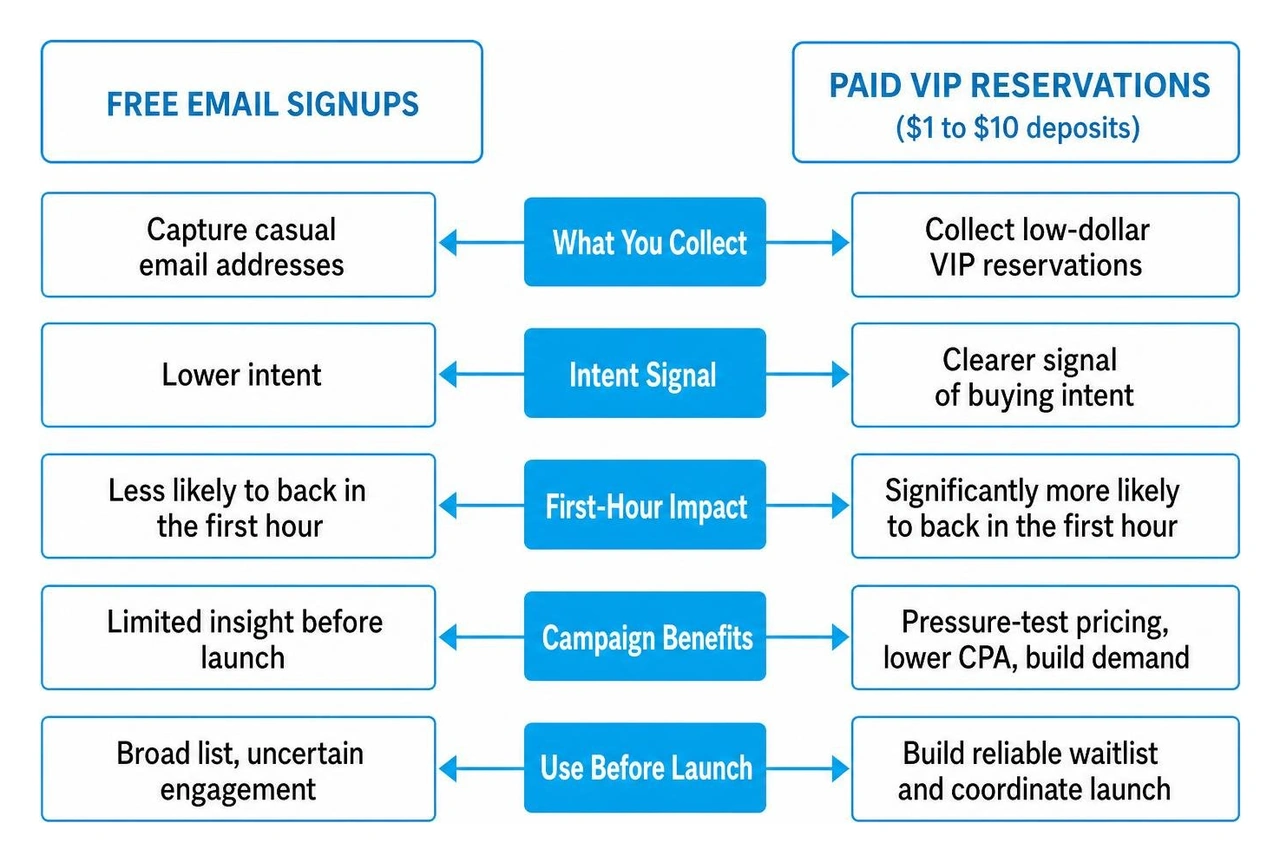
Use reservation feedback to review pricing and interest before committing heavily to tooling. The hardware demand generation tactics resource can inform that work. Create a launch communication plan, such as the product launch marketing plans, that tells registered supporters when and how to participate.
Crafting Technical Messaging That Sells Without Jargon
Start product messaging with the buyer's practical outcome. Add clock speeds, sensor models, and materials after the page establishes why the device matters in the buyer's work or daily use.
Use a structured technical product messaging framework to lead with primary user benefits before detailing component specifications:
- Capability: Programmable USB-C power delivery.
- Buyer outcome: A compact power option for a field-testing bench.
Understanding how to communicate value proposition to customers bridges the gap between deep technical capabilities and the specific problems your backers want solved.
Structuring a High-Converting Hardware Campaign Page and Reward Tiers
Make the campaign page answer three core questions quickly: What is this device? Who is it for? Why should backers trust the team to make it?
Clear, benefit-led hardware product page copy structures information logically: a clear hero image, third-party validation, an honest timeline, and detailed component breakouts.
Video Storytelling and Proof of Functionality
Structure the campaign video around the buyer's problem, a working demonstration, manufacturing preparation, and a clear call to action:
- Open with the core problem.
- Show the hardware solving that problem in a real-world setting.
- Include a close-up demonstration of the physical prototype.
- Introduce the team, explain manufacturing preparation, and outline how funds will be used.
- End with a direct invitation to back the project.
Use footage of the working prototype to explain what exists today and what remains in development. If the campaign uses renders, label them clearly as concept visuals rather than final-product proof.
Setting Margins, Tier Structures, and BOM Multipliers
Setting prices too low can create post-campaign operational stress. Set the target retail price only after modeling the full cost to manufacture, deliver, support, and sell the product.
Include factory assembly labor, packaging, freight, platform and payment fees, return reserves, and any future distributor margins in the pricing model.
Design reward tiers around what the team can deliver profitably:
- Launch tier: Set a limited opening tier that fits the campaign budget.
- Follow-on tier: Add a second option once the opening allocation is claimed.
- Core campaign tier: Price the main offer to support fulfillment and customer support.
- Optional bundles: Add accessories, cases, cables, or mounting kits only when they can be delivered with the base product.
Marketing, Momentum, and Scaling Beyond the Campaign
Build a launch plan that coordinates public relations, specialized review channels, paid acquisition, and direct community outreach where they fit the audience.

Use the hardware marketing ROI guide to define the campaign metrics the team will monitor. Before increasing spend, compare return on ad spend (ROAS) and cost per acquisition (CPA) with the cost and margin assumptions in the campaign plan.
Multi-Channel Launch Stacking: PR, Influencers, and Paid Ads
Send working pre-production units to relevant reviewers and niche publications early enough to allow for testing and editorial planning. Coordinate publication dates with the launch plan where appropriate.
Independent teardowns and performance reviews can provide useful third-party context for prospective backers. Support launch activity with paid social, retargeting, and regular progress updates when those channels fit the plan.
Transitioning Crowdfunding Momentum into Equity and Retail Growth
A crowdfunding campaign can provide market evidence to document for later fundraising conversations. Document conversion, backer engagement, and capital raised so the team can explain the campaign's market evidence in later fundraising conversations.
Use reward-campaign results as part of the evidence considered in follow-on capital planning. Before considering Regulation Crowdfunding (Reg CF) or Reg A+ pathways, obtain qualified legal and financial guidance. Prepare a clear record of margins, cost-reduction plans, and campaign performance for later investor conversations.
Frequently Asked Questions about Crowdfunding for Hardware
How early should founders begin preparing crowdfunding for hardware projects?
Begin pre-launch marketing early enough to build a qualified email list, test positioning and pricing, coordinate prototype reviews, and resolve component sourcing questions with the contract manufacturer.
Why do so many reward-based crowdfunding for hardware campaigns fail post-funding?
Post-campaign delivery can be threatened when production, certification, or shipping costs are not fully modeled. Build margin buffers around tooling changes, scrap, inspection, yield, and fulfillment before setting reward prices.
What regulatory certifications are mandatory before shipping a physical tech product?
Certification needs depend on the product, its features, and its markets. Confirm requirements with qualified compliance professionals and the relevant official bodies. Areas to review may include:
- FCC (United States): Radio-frequency and electromagnetic compliance.
- CE Mark (European Union): Applicable health, safety, environmental, and electromagnetic requirements.
- UL / ETL / IEC Safety Testing: Relevant product-safety testing.
- Bluetooth SIG: Trademark and protocol licensing requirements.
Include compliance timing and laboratory costs in the pre-launch plan, then confirm the expected schedule with the selected testing lab.
Conclusion
Turning a complex engineering prototype into a commercial product requires technical execution and an audience ready to buy it.
When a hardware launch needs attention, review three areas:
- The launch falls flat: Confirm that the campaign has a clear audience, message, and evidence of demand.
- Growth stalls: Review the acquisition and retention plan after launch.
- People don't get it: Check whether the product page explains how the product improves the buyer's day, not only its specifications.
At CRISPx, we act as the outsourced marketing and sales team for engineer-led hardware companies across consumer electronics, robotics, space and defense, and computing components. CRISPx plugs in as the founder's marketing and sales team so they do not need a head of marketing. Whether you need pre-launch validation, full campaign marketing, or post-campaign retail scaling, we plug directly into your workflow through four flexible plans: Launch, Grow, Grow + Ads, and Scale.
To see how your product story and technical positioning connect with early buyers, get a free DOSEscore™ brand checkup of your website and story or book a strategy call today.
Get a free brand checkup.
We work like a brand doctor. The DOSE Method™ finds what's broken, fixes the biggest problem first, then tracks the results.