From Beta to Big Time: Navigating Your Launch
Master your startup product launch guide: Beat 95% failure rate with LaunchX, OrbitX growth, AI tools & KPIs for big-time success.


Master your startup product launch guide: Beat 95% failure rate with LaunchX, OrbitX growth, AI tools & KPIs for big-time success.


A startup product launch guide is something every founder needs — because the numbers are brutal. Out of 30,000 new consumer products launched every year, only 5% succeed. That means 95% fail.
Here is a quick overview of what a successful startup product launch looks like:
The first 90 days after launch are critical. They define your product's narrative, determine whether early adopters stick around, and set the foundation for long-term growth.
I'm Tony Crisp, a marketing consultant who has guided tech startups through every stage of product launches — from brand strategy to market entry — and this startup product launch guide draws directly from that hands-on experience. Let's walk through exactly what it takes to go from beta to big time.
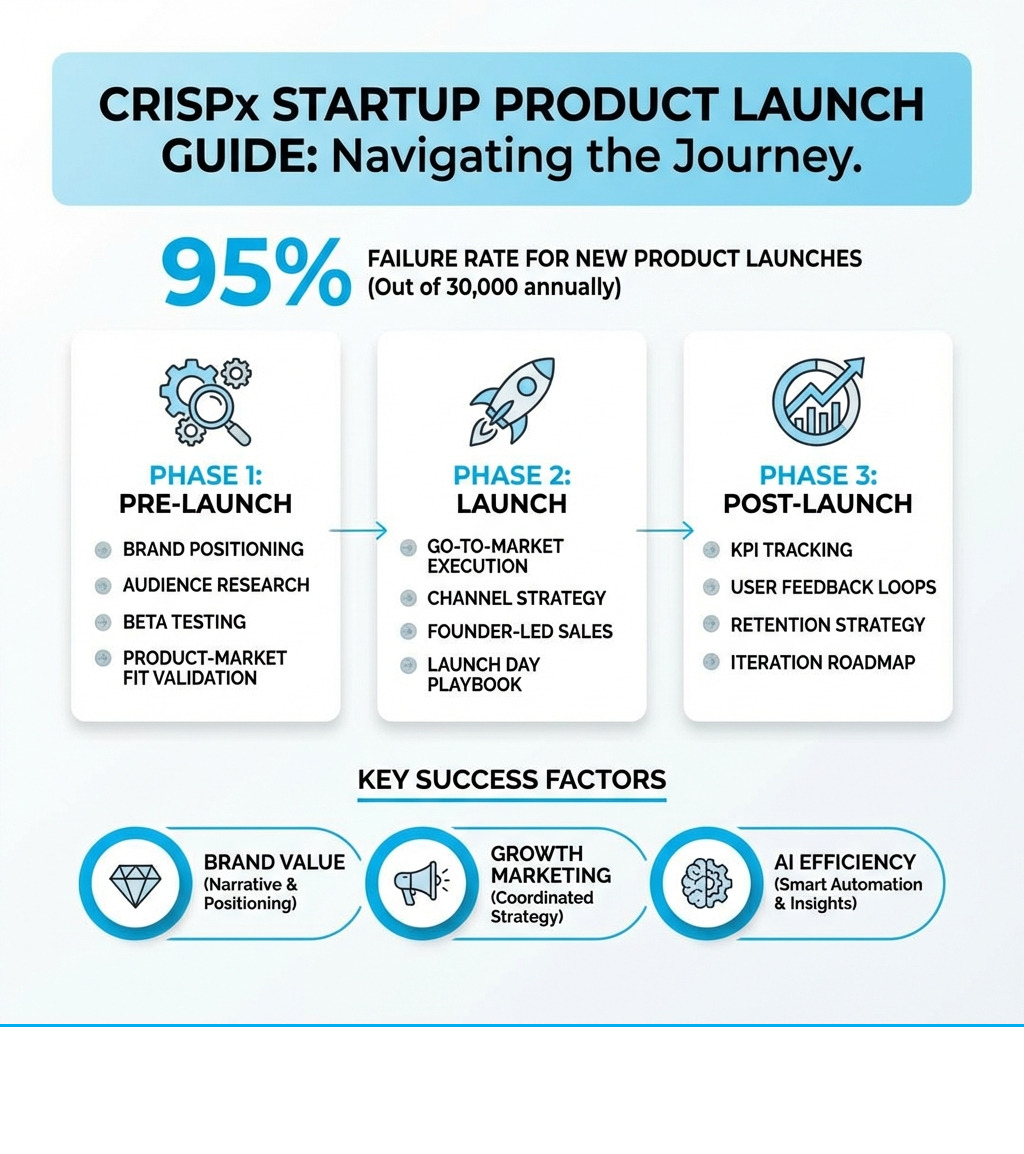
When we talk about a startup product launch guide, we aren't just talking about a "go-live" button. We are talking about building an asset that has inherent worth. At CRISPx, we use our LaunchX framework to move beyond just "releasing a tool" to building a brand that resonates.
Launching a successful product in today's competitive market is more challenging than ever. The statistics are sobering: out of 30,000 new consumer products launched annually, a mere 5% achieve success. This stark reality raises a critical question: What separates the winners from the losers?
The answer lies in Innovative Product Launch Strategies that prioritize brand value from day zero. LaunchX focuses on three core pillars:
A great example of this is the Syber M GRVTY Product Design and Launch. We didn't just launch a computer; we launched a high-performance experience that spoke directly to the gamer's desire for gravity-defying speed and aesthetics.

Before you spend a dime on billboards or influencer blitzes, you must validate. We believe market validation acts as an insurance policy. Without it, you’re just throwing spaghetti at the wall.
Effective validation involves:
If you try to launch to everyone, you launch to no one. Your startup product launch guide must include a laser-focused Ideal Customer Profile (ICP).
We use a multi-dimensional research methodology to segment the market:
Once the brand foundation is set, it’s time to move into OrbitX—our methodology for growth marketing fueled by human psychology. A successful Product Launch Marketing Plan isn't just about spending money; it’s about understanding cognitive biases.
We leverage psychological triggers like:
| Feature | Soft Launch | Hard Launch |
|---|---|---|
| Primary Goal | Feedback & Bug Squashing | Revenue & Market Share |
| Audience | Beta Testers / Early Adopters | The General Public |
| Risk Level | Low | High |
| Marketing Spend | Minimal | Significant |
| Success Metric | Retention & NPS | Customer Acquisition & ROI |
To truly stand out, you need Creative Product Launch Ideas. Think about Salesforce’s Marc Benioff, who hired actors to protest rival conferences with "Software is Obsolete" signs. It was bold, it was psychological, and it worked.
Choosing where to launch is just as important as how you launch. We advocate for mastering 2-3 channels deeply rather than spreading yourself thin.
In the early days of a startup product launch guide, the founder is the best salesperson. A common rule of thumb is that the founder should personally close the first 10 customers before even considering a full-time sales hire.
Founder-led sales are critical because:
The modern startup product launch guide is incomplete without an AI strategy. In 2025, we are using AI to increase both the quality and the speed of our marketing efforts.
During a Tech Product Launch, we leverage AI for:
Learning How to Launch a Tech Product today means treating AI as a team member that handles the "drudge work" so your human team can focus on high-level strategy and emotional connection.
What gets measured gets managed. Many teams overlook setting a clear Revenue target, yet without this, it's impossible to gauge success.
For a High-Tech Product Launch, we track these core KPIs:
Onboarding significantly impacts long-term engagement. If the first 90 seconds of using your product are confusing, the first 90 days will be a failure. We've seen startups accelerate onboarding by 29% simply by using better in-app guidance.
The right time is when your product is "ready enough" (it solves the core problem without major bugs) and market conditions align. Avoid launching during major holidays like Christmas or New Year's unless your product is specifically for those seasons. Consider seasonality—if you're a B2B tool, late August/early September is often better than mid-July when everyone is on vacation.
Product launches are about new value creation and acquiring new customers. They require a full GTM (Go-to-Market) strategy. Feature launches are usually about re-engaging your existing user base and boosting loyalty or retention. Product Launch Marketing Plans for features are typically more targeted and rely heavily on in-app notifications and email updates to current users.
A successful startup product launch guide isn't a secret formula; it’s a disciplined process. At CRISPx, we combine data-driven creativity with our unique DOSE Method™ to ensure your brand doesn't just enter the market—it leads it.
Whether you are in Newport Beach or operating globally, the fundamentals of a Startup launch remain the same: validate ruthlessly, build brand value, and execute with psychological precision.
Don't let your hard work end up in the 95% failure pile. By focusing on strategic leadership and long-term scalability, you can turn your beta into the next big time. Ready to get started? Check out our Case Studies to see how we’ve helped others, or reach out to us for your next Launch.




Accessibility: If you are vision-impaired or have some other impairment covered by the Americans with Disabilities Act or a similar law, and you wish to discuss potential accommodations related to using this website, please contact our Accessibility Manager at (949) 791-9150