

Scaling Hardware Commercialization Beyond Initial Launch Batches

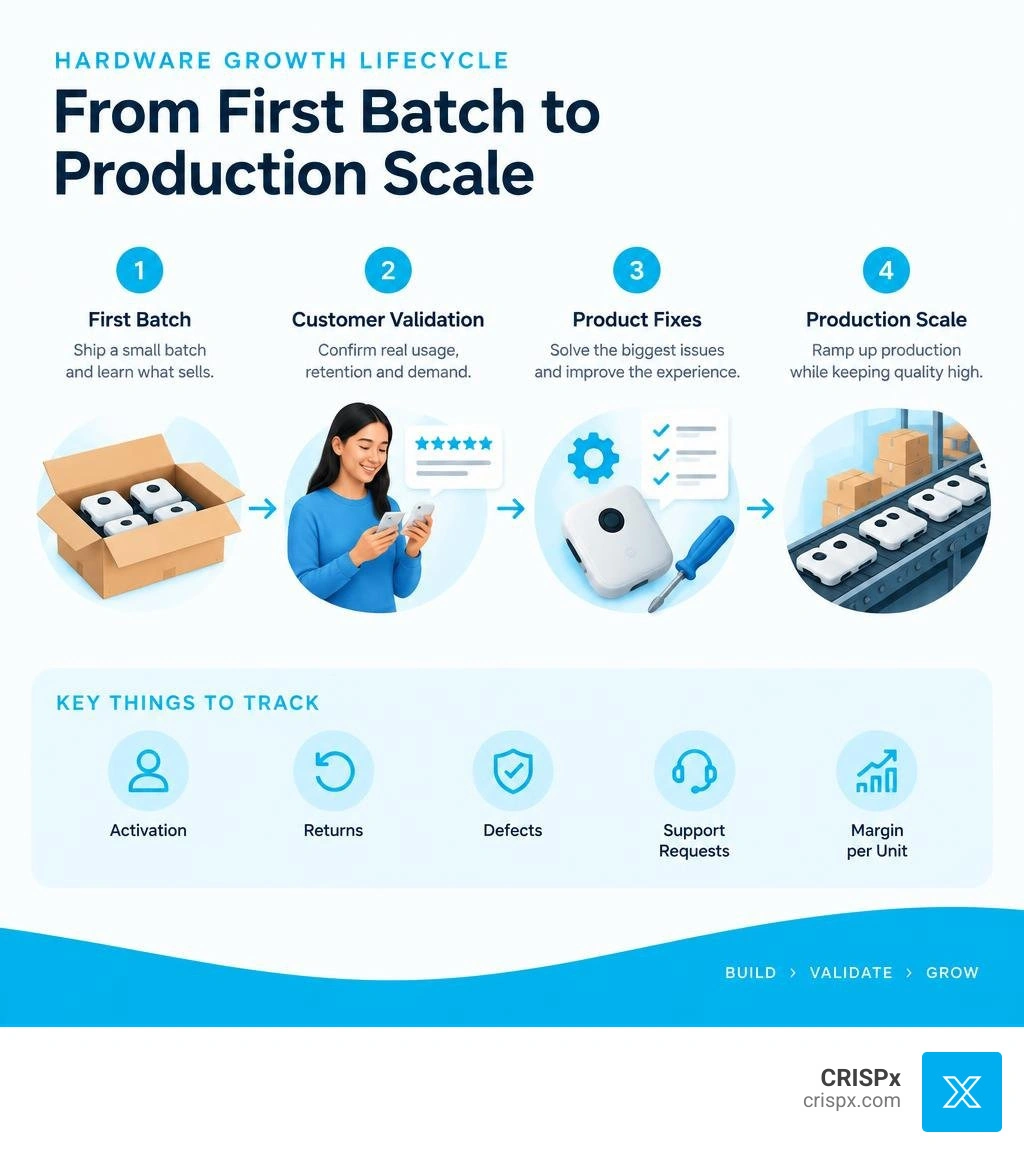
To grow hardware sales after launch, prove customers use and keep the product before building more. Track activation, returns, defects, support requests and margin, then fix the biggest problem first.
How to Grow Hardware Sales After the First Batch
To grow hardware sales after launch, prove that customers use and keep the product before building more of it. Track activation, returns, defects, support requests, and margin on each unit. Fix the biggest problem, then test clearer messaging and new sales channels while checking that production can keep up without hurting quality.
The first batch tells you what sold. The next 90 days tell you whether demand will last. That is when customer feedback, cash, and factory performance need to shape the next move.
CRISPx plugs in as your marketing and sales team so you don't need a head of marketing, with Launch, Grow, Grow + Ads, and Scale plans.
Core Drivers of Post-Launch Growth for Hardware Products
Nearly 30,000 new consumer products enter the market every year, and most fail. Research shows that lack of preparation is the most common cause of launch failure.
For engineer founders building consumer electronics, robotics, computers, or space and defense technology, launch day is often treated as the finish line. In reality, the initial shipment is just a test of your hypothesis. Sustainable post-launch growth for hardware products requires moving past initial excitement to build a repeatable commercial engine powered by data-driven product marketing.
When growth stalls, it usually traces back to three core issues:
- The launch falls flat: The product is manufactured and working, but the launch story failed to connect with the target buyer.
- Growth stalls: Sales spiked during the initial campaign or batch delivery, but orders quickly flattened out.
- People do not get it: The website and product pages read like an engineering spec sheet instead of showing the practical value to the customer.
Validating Problem-Solution Fit and Retention Benchmarks
Before committing capital to high-volume manufacturing, you must confirm that real buyers gain lasting utility from the device. As highlighted in Agilian's guide on manufacturing validation, scaling production too soon introduces massive financial risk.
To evaluate real customer sentiment, use clear quantitative thresholds:
- The Sean Ellis Benchmark: Survey your early buyers and ask how they would feel if they could no longer use your device. At least 30% to 40% of users should respond that they would be "very disappointed." If your score falls well below this mark, your device is an interesting novelty rather than an essential solution.
- Return Rate Limits: A return rate under 5% indicates healthy user adoption and satisfaction. A return rate exceeding 10% signals severe onboarding friction, hardware reliability defects, or broken product positioning.
- Organic Referral Velocity: When at least 20% of your new pipeline comes from word-of-mouth recommendations, your product creates genuine customer advocacy.
Structuring Unit Economics and Retention for Post-Launch Growth for Hardware Products
Hardware unit economics carry capital requirements that software businesses never face. Premature scaling can damage the balance sheet before the business locks in its fundamentals.
To maintain sustainable economics, monitor these key financial guidelines:
- LTV to CAC Ratio: Your customer lifetime value (LTV) must be at least three times higher than your customer acquisition cost (CAC).
- Gross Margin Targets: Target a baseline gross margin of at least 50% on hardware sales. This margin provides the safety buffer needed to absorb early component scrap, expedited freight, warranty claims, and customer onboarding expenses.
- Runway Discipline: Maintain 12 to 18 months of operating runway to navigate production runs, component lead-time shifts, and testing cycles.
- Revenue per Employee: Track workforce efficiency closely. Target revenue per team member at 2 to 5 times their loaded salary before adding full-time headcount.
Managing these commercial levers requires accurate hardware marketing ROI measurement so you know exactly which channels generate cash.
The First 90 Days: Early Metrics, Quality Control, and Operational Scaling
The initial 90 days following your first commercial delivery reveal whether your device works reliably in real-world conditions. Managing this period requires tracking both customer engagement metrics and manufacturing reliability data.
| Metric Area | First 30 Days Target | 90-Day Scaling Benchmark | Risk Warning Signal |
|---|---|---|---|
| Activation Rate | 80%+ unboxed and connected | 90%+ unboxed and connected | Under 70% completed setup |
| Return Rate | Under 5% total units | Under 3% total units | Exceeds 10% returns |
| NPS (Customer Sentiment) | 40+ Net Promoter Score | 50+ Net Promoter Score | NPS below 30 |
| First-Run Factory Yield | 85%+ pass rate on line | 95%+ pass rate on line | Yield below 80% |
| Support Resolution Time | Under 24 hours to resolution | Under 12 hours to resolution | Backlog growing weekly |
| MoM Revenue Growth | 10% month-over-month | 20%+ month-over-month | Flat or declining orders |
Critical Metrics: From Activation Velocity to Defect Rates
A successful shipment does not equal an activated customer. If a customer leaves the box on a shelf or abandons the device during onboarding, you risk product returns and negative reviews.
Track activation velocity: measure how many buyers complete account creation, connect the device to local networks, and run their first core command within 48 hours of delivery. Combine this with direct customer support ticket audits to categorize every issue by firmware bug, mechanical defect, or user interface confusion.
Maintaining multi-tier supply chain visibility allows engineering teams to trace field failures back to specific component batches or production lots before defects spread across subsequent runs.
Mitigating Scale Risks Across Manufacturing and Supply Chains
Scaling from a pilot run of a few hundred units to continuous production requires rigorous process discipline. Moving too quickly into hard steel tooling or massive inventory commitments without field data causes catastrophic rework expenses.

Applying a structured Lean Framework for New Product Introduction reduces operational risks:
- Design for Manufacturing (DFM) Reviews: Re-evaluate tolerance stack-ups, assembly cycle times, and part counts after analyzing initial assembly line bottlenecks.
- Supplier Audits: Confirm secondary suppliers for critical microcontrollers, power management ICs, and custom structural components.
- Working Capital Management: Structure phased supplier payment terms (such as 30% deposit, balance upon bill of lading) to match customer cash-collection cycles.
Iterative Product Improvement Without Compromising Brand Equity
Iterating on hardware is vastly different from updating pure software. If an early software release has a bug, a developer deploys a cloud patch within minutes. If a mechanical assembly or power regulator has a physical design flaw, the physical unit must be repaired or replaced.
Protecting brand equity for long-term success requires separating updates that can be delivered digitally from changes that require new factory tooling.

Balancing Agile Firmware Updates with Physical Design Iteration
Modern connected devices allow teams to improve product utility over the air. You can resolve operational bugs, optimize power efficiency, and unlock new software features via OTA updates without changing the underlying bill of materials.
For physical modifications:
- Establish Engineering Change Order (ECO) Controls: Formalize every physical component or supplier change with full revision tracking.
- Ring-Fenced Beta Cohorts: Test updated hardware revisions with private beta groups of 20 to 50 active users for 30 to 60 days before updating the main assembly line.
- Modular Architecture: Design internal sub-assemblies so minor adjustments do not require rebuilding the entire mechanical enclosure or recertifying wireless communications modules.
Transforming Support Feedback and Community Input into Growth Engines
Early hardware adopters are invested in seeing your company succeed. When issues arise, treat early customers as co-builders rather than passive consumers:
- Publish Regular Engineering Updates: Share weekly or bi-weekly technical notes explaining what your team is fixing and what improvements are coming.
- Transparent Defect Handling: If a batch exhibits a hardware failure, acknowledge the root cause directly, offer clear replacement pathways, and process refunds quickly.
- Community-Led Triage: Create dedicated user groups where advanced users can share troubleshooting tips, integration scripts, and custom workflows.
Commercial Expansion: From Early Adopter Crowds to Multi-Channel Scale
Early crowdfunding backers and tech enthusiasts purchase hardware because of its novelty and technical ambition. Mainstream buyers, however, purchase devices to solve immediate, practical problems. Expanding beyond your launch cohort requires an omnichannel distribution engine.

To drive sustainable volume, implement proven hardware demand generation tactics across owned direct-to-consumer storefronts, digital marketplaces, and targeted wholesale channels.
Navigating the Chasm: Transitioning to Mainstream Post-Launch Growth for Hardware Products
Mainstream customers will not read through complex spec sheets. When a website focuses entirely on processor clock speeds, sensor sensitivity ratings, and bus standards, mainstream buyers bounce.
To bridge this gap, structure communication around our technical product messaging framework:
- Lead with the Practical Outcome: Explain clearly what the device accomplishes for the user in their daily routine or work environment.
- Anchor the Emotional Payoff: Frame how the user's workflow or life improves once the problem is resolved.
- Support with Engineering Specs: Use technical specifications to substantiate the performance claims, proving that the hardware can reliably deliver that outcome.
Unlocking Recurring Revenue with Hardware Subscriptions and Ecosystem Expansion
Relying entirely on one-time hardware sales leaves startups vulnerable to production pauses and seasonal demand dips. Transforming a hardware product into a recurring revenue engine stabilizes cash flow and increases enterprise value.
As detailed in The Hardware Subscription Playbook, recurring software layers expand customer lifetime value:
- Feature Tiers: Offer premium cloud storage, automated operational analytics, advanced scheduling tools, or predictive maintenance alerts via paid subscription.
- Annual Billing Models: Default to annual subscription commitments at checkout to recover customer acquisition costs immediately and improve long-term retention.
- Consumables and Accessories: Develop official mounting kits, replacement batteries, filters, or carrying cases that provide natural upsell opportunities across the ownership lifecycle.
Frequently Asked Questions About Hardware Commercialization
How can hardware founders determine if their product solves a real problem post-launch?
Track real usage patterns rather than initial sales excitement. Measure how often users interact with the hardware each week, monitor your 30-day return rate (which should remain under 5%), and survey early users using the Sean Ellis benchmark. If at least 30% to 40% of surveyed users state they would be "very disappointed" without the device, you have confirmed genuine problem-solution fit.
What are the most vital financial metrics to track when scaling hardware manufacturing?
Maintain a customer lifetime value that is at least three times your customer acquisition cost (LTV to CAC ratio of 3:1 or higher), a minimum gross margin of 50% per unit, and at least 12 to 18 months of cash runway. Additionally, ensure each team member generates 2 to 5 times their salary in revenue to prevent premature hiring before production volume scales.
How do hardware startups balance rapid iteration without damaging brand trust?
Deliver rapid functional upgrades through over-the-air firmware updates while keeping physical hardware changes constrained to controlled engineering cycles. Never ship unvalidated hardware to mainstream customers. When testing physical design changes, deploy production-intent units to small, private beta cohorts of 20 to 50 users before updating your main manufacturing tooling.
Conclusion
Scaling hardware commercialization beyond initial launch batches requires moving from building a prototype to running a disciplined business. Sustainable growth happens when you validate that customers use the product daily, keep return rates below 5%, protect your gross margins, and transition your messaging from technical specs to customer outcomes.
CRISPx plugs in as the founder's marketing and sales team so you do not need a head of marketing, supporting hardware companies across four transparent plans: Launch, Grow, Grow + Ads, and Scale. We help engineer founders eliminate launch plateaus and build repeatable demand engines.
Tony Crisp has 30 years in branding, 100+ hardware launches and 8+ patents. Robosen Optimus Prime went from Kickstarter to CES, then Hasbro and Disney licenses. FuzeDrive ran a top 1% Indiegogo campaign. SecureCircle was acquired by CrowdStrike.
We apply The DOSE Method™ as a practical strategy framework to help hardware companies scale:
- Diagnosis: Find what's broken in your current marketing, messaging, or retention loops.
- Prescription: Fix the biggest bottleneck first, from product positioning to channel economics.
- Prognosis: Set measurable growth targets, track unit economics, and adjust continuously.
This framework aligns your commercial messaging with the key emotional drivers of your buyer:
- Dopamine: They want the outcome your product delivers.
- Oxytocin: They trust your engineering, build quality, and company integrity.
- Serotonin: They feel proud to own and showcase your technology.
- Endorphins: They feel genuine relief because their operational problem is solved.
If you are ready to identify the commercial bottlenecks in your product positioning, get a free DOSEscore™ brand checkup to review your website and story, explore our full range of commercialization services, or book a strategy call with our team today.
Get a free brand checkup.
We work like a brand doctor. The DOSE Method™ finds what's broken, fixes the biggest problem first, then tracks the results.
