

Step-by-Step Email List Building for Hardware and Gaming Creators

Build a high-converting crowdfunding email list with organic and paid strategies to drive Day 1 backers and campaign momentum.
Build a Crowdfunding Email List Before You Launch
To build a crowdfunding email list, start with a simple signup page that shows what your product does and why it matters. Invite people from your existing network, product demos, and relevant communities to opt in. Then send useful updates and ask which features and rewards they care about. Do not buy a list.
For a new controller, robot, or other hardware product, those replies help you test demand before asking for pledges. Track signups, email clicks, and backers so you can see whether your audience is ready for launch.
Why a Dedicated Crowdfunding Email List Matters Alongside Social Media
Many engineer founders fall into a common trap: they build an exceptional working prototype, post teasers across social media networks, and assume that platform algorithms will deliver a crowd on launch day. When the campaign goes live, the launch falls flat.
A permission-based email list gives a campaign a direct channel for sharing updates with people who chose to subscribe. Social posts can complement that communication, but their visibility depends on each platform’s distribution choices. Use both channels to keep potential backers informed, while treating subscriber consent and list quality as the foundation of email outreach.
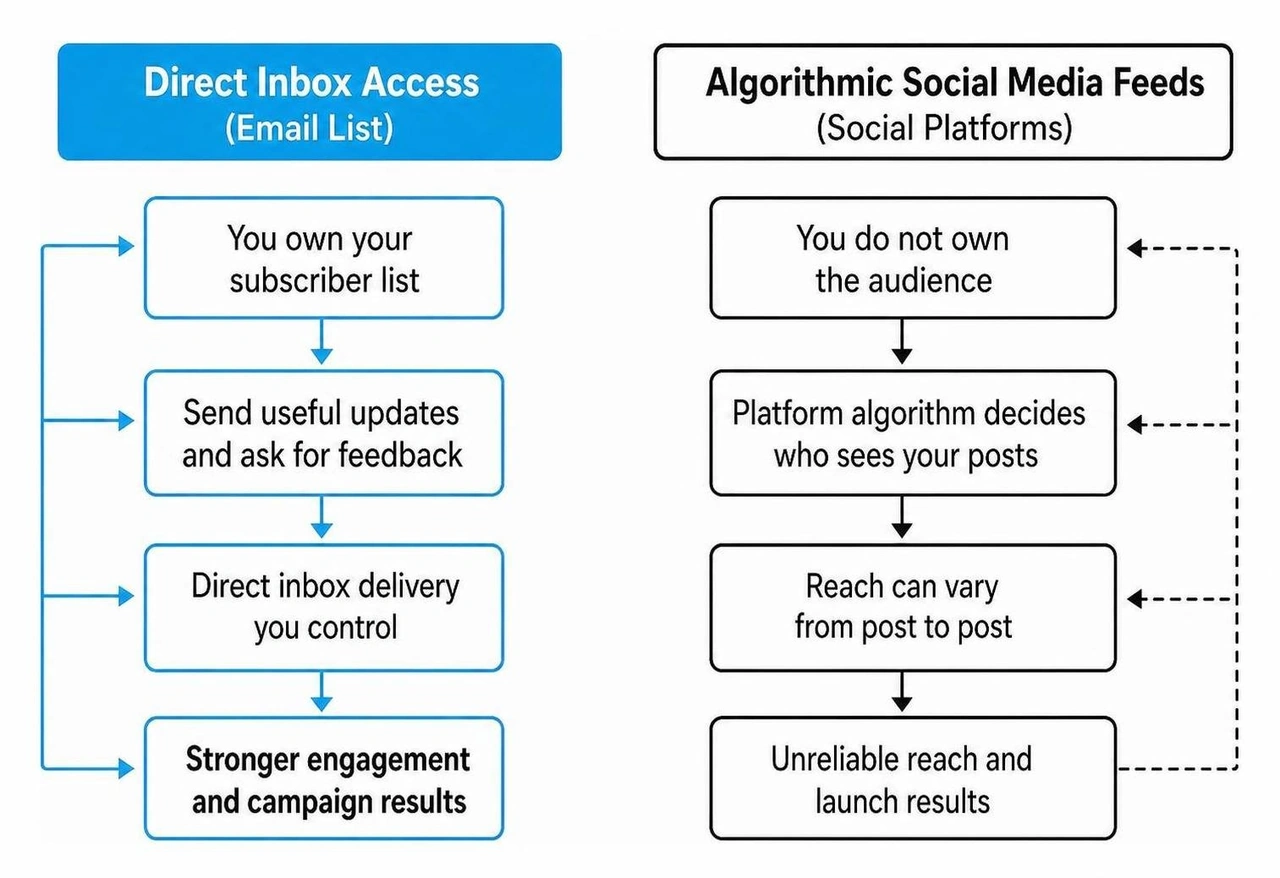
When launching technical products, an owned email audience bypasses third-party platform dependencies. If an ad account gets restricted or a social network changes its feed rules, your subscriber list remains your property. Following a structured startup product launch guide ensures you treat direct subscriber relationships as the primary engine of your commercial launch rather than relying on chance discoveries.
The Dangers and Legal Risks of Buying Cold Email Lists
Avoid purchasing third-party contact lists for campaign promotion. Marketing outreach should be built on permission, clear expectations, and a review of the consent requirements that apply to the campaign audience.
Beyond legal penalties, sending mass pitches to unverified spreadsheets (such as raw lists like contactsstringdata.csv) introduces severe technical damage:
- Spam Traps and Bounces: Scraping directories or buying contact databases injects dead addresses and honeypot spam traps into your list.
- Domain Blacklisting: When recipients flag unsolicited pitches as spam, internet service providers throttle your domain. Once blacklisted, your transactional updates, backer notifications, and customer service emails will go straight to junk folders.
- Zero Commercial Intent: Purchased lists produce abysmal engagement. An uninvited recipient who never asked for your hardware updates may be unlikely to pledge when the campaign launches.
A clean, opt-in list of genuinely interested backers can be more useful than a large purchased list of cold contacts.
Product Validation and Concept Testing Through Subscriber Signals
Your pre-launch email list is not just a promotional broadcast tool; it is an active validation laboratory. Before investing in injection molds or placing minimum order quantity (MOQ) component orders, your subscriber interactions confirm whether buyers actually want what you are building.
You can gather measurable validation signals by surveying your list:
- Feature Prioritization: Ask subscribers to vote on specific capabilities (such as choosing between USB-C fast charging or wireless charging).
- Pricing and Reward Validation: Share proposed reward tiers to see if your estimated retail price meets resistance or excitement.
- Industrial Design and Prototype Feedback: Share behind-the-scenes engineering trade-offs. Engagement with development photos can signal audience interest.
When subscribers actively reply to surveys, you solve the problem where "people don't get it" long before launch day. You refine your product positioning using the exact language your audience uses in their survey responses.
Sizing and Financial Modeling for Crowdfunding Success
A successful launch requires calculating your required audience size well before setting your public funding goal. Relying on gut feeling often leads to setting an arbitrary target that leaves a campaign underfunded. Evaluating your email marketing program performance helps you connect historical engagement rates to actual financial targets.
Sizing Your Crowdfunding Email List Using Conversion Assumptions
There is no universal Day 1 benchmark for crowdfunding. Set an early funding target that fits your campaign, then use it to estimate the audience and pledge activity needed to support your broader launch goal. Early momentum can help demonstrate interest to prospective backers.
Work backward from your early funding target to estimate the number of email leads you may need:
Start with your funding goal, expected pledge amount, and a conservative conversion assumption based on your own campaign data.
- Set an early funding target: Choose a realistic amount to aim for near launch.
- Estimate the backers required: Divide that target by the pledge amount you expect most supporters to choose.
- Estimate the lead requirement: Divide the estimated backer count by a conservative conversion assumption drawn from your own list and campaign history.
Use your actual lead-acquisition costs and conversion history to set a pre-launch budget, then revisit the model as your list grows.
Benchmark Conversion Rates Across Audience Tiers
Not every contact on your list converts at the same rate. Engagement levels vary dramatically depending on how an individual joined your audience.
| Audience Tier | Description | Likely Engagement | Planning Consideration |
|---|---|---|---|
| VIP Reservation Tier | Subscribers who made a deposit or completed a detailed onboarding survey. | Often high | Track separately because their intent may differ from general subscribers. |
| Warm Organic Leads | Opt-ins from product demos, content lead magnets, communities, and personal networks. | Often strong | Use your own engagement history to estimate likely support. |
| Standard Paid Leads | Email captures acquired through advertising and landing page opt-ins. | Varies | Compare performance by source before scaling spend. |
| Cold / Disengaged Leads | Subscribers who have stopped engaging with recent updates. | Often low | Consider re-engagement or suppression to protect deliverability. |
Maintaining these baseline benchmarks lets you build realistic financial models for your launch day rather than relying on optimistic guesswork.
Organic and Paid Strategies to Build Pre-Launch Momentum
Building an engaged subscriber base requires combining structured inbound funnels with direct community interaction. Applying proven hardware demand generation tactics balances paid lead acquisition with organic grassroots growth.
Setting Up Landing Pages for Your Crowdfunding Email List
Your landing page should clearly communicate what your product does early in the visitor experience. Engineer founders often list technical component specs at the top of the page. Instead, lead with the primary human benefit and follow up with technical validation.

Ensure your capture funnel follows this technical framework:
- Benefit-Led Headline: State the clear outcome your product creates (e.g., "The Open-Source Robotic Arm That Automates Desktop Soldering").
- High-Resolution Visuals: Show working physical prototypes in real environments. Avoid relying purely on 3D CAD renders.
- Single-Field Opt-In: Ask only for an email address to reduce signup friction.
- UTM and Tracking Tags: Tag every traffic source (such as paid ads, Reddit discussions, and organic referral links) so you can track your cost per lead (CPL) by channel.
- Immediate Welcome Trigger: Send an automated confirmation email immediately upon signup to set expectations and establish strong sender domain reputation.
To ensure your technical specs and marketing assets match platform requirements, review a detailed kickstarter checklist for hardware before driving paid traffic to your landing page.
Community Outreach, Forums, and Live Activations
Complement digital advertising by embedding your project into active communities:
- Niche Subreddits and Discords: Participate in developer and enthusiast groups. Share raw engineering challenges, bill-of-materials hurdles, and design decisions rather than dropping naked promotional links.
- Trade Shows and Maker Faires: Demonstrate physical prototypes in person and use QR codes linked to your landing page to collect in-person signups.
- Creator Cross-Promotions: Partner with complementary creators who serve your target demographic to run joint developer updates and newsletter features.
Full-Lifecycle Email Sequences and Segmentation
A successful email strategy requires a structured sequence that moves subscribers from early discovery through post-campaign fulfillment. Reviewing psychology-driven pre-launch sequences: priming waitlists and trust helps you design automated messages that build sustained anticipation.
Four-Phase Sequence Execution: Pre-Launch to Final Hours
Structure your campaign around four distinct operational phases:
- Pre-Launch Preparation: Use emails to share development milestones, reward details, and questions that invite useful feedback.
- Opening Announcement: Let subscribers know when the campaign is live, then provide an update that explains what is happening next.
- Ongoing Campaign Updates: Choose a consistent communication rhythm and use it to share relevant product news, supporter feedback, or campaign developments.
- Closing Reminder: As the campaign nears its end, send a clear reminder about the remaining opportunity to participate and any applicable introductory pricing.
Editorial promotion may bring additional attention during a campaign. Treat it as a possible supplement to a launch plan, while maintaining your own email sequences as a dependable way to communicate with interested subscribers.
Behavioral Segmentation and List Hygiene
Blasting identical messages to every contact damages inbox deliverability. Segment your database based on past behavior:
- VIP & Early Reservers: Send exclusive early-bird links before the public launch.
- Engaged Non-Backers: If a subscriber opens your launch emails and clicks through without pledging, trigger a follow-up addressing common technical concerns, warranty terms, or shipping timelines.
- Geographic Segments: Group contacts by region to send launch announcements at appropriate local times and provide localized shipping estimates.
- List Hygiene: Before launch, run a re-engagement flow for subscribers who have stopped opening recent emails. If they remain inactive, consider removing or suppressing them to help protect deliverability.
Post-Campaign Marketing and Pledge Manager Upsells
The utility of your subscriber database does not end when your public campaign timer reaches zero. Managing campaign data using standardized export pipelines (such as structuring your backer records like backers.csv) makes it easy to migrate supporter information into third-party pledge managers.
Post-campaign email workflows allow you to:
- Collect Backer Surveys: Gather shipping addresses, color choices, and technical configurations cleanly.
- Sell Add-Ons and Upgrades: Offer supplementary accessories, extra batteries, or extended warranties directly within the pledge manager workflow.
- Enable Late Pledges: Allow non-backing subscribers who missed the live campaign window to pre-order before public retail distribution.
Maintaining clean communication throughout manufacturing keeps repeat-backer retention high for your next product launch.
Frequently Asked Questions About Crowdfunding Email Lists
What should a pre-launch crowdfunding list be measured against?
Use campaign-specific signals rather than a universal conversion benchmark. Compare engagement and pledge behavior by acquisition source, audience segment, product offer, and campaign stage. A VIP reservation group may behave differently from the broader list, so review it separately.
What list size should a campaign have before launch?
There is no universal subscriber target for a hardware campaign. Set an early funding objective, estimate the backer activity needed to support it, and use a cautious planning assumption drawn from the campaign’s own audience and historical data.
How can a campaign re-engage inactive subscribers before launch?
Send a re-engagement message before launch that shares a meaningful product update or a clear reason to stay subscribed. Invite recipients to confirm their interest with one simple action, then consider suppressing contacts who remain inactive to help protect sender reputation.
Conclusion
An opt-in email list can support clearer pre-launch communication and give potential backers a place to receive campaign updates. For engineer founders, the useful next step is to connect the product story, signup experience, and follow-up messages to the questions prospective buyers need answered.
At CRISPx, we evaluate and execute hardware marketing using The DOSE Method™:
- Diagnosis: Pinpoint exactly where your pre-launch funnel breaks down, from unclear messaging to weak lead capture mechanics.
- Prescription: Address the most urgent bottlenecks first by refining your benefit messaging, rebuilding your landing pages, and setting up high-converting email workflows.
- Prognosis: Establish measurable performance targets, monitor conversion analytics across your subscriber tiers, and optimize your outreach as launch day approaches.
CRISPx plugs in as the founder's marketing and sales team so they do not need a head of marketing. Available plans are Launch, Grow, Grow + Ads, and Scale.
CRISPx's published case examples include Robosen Optimus Prime, which went from Kickstarter to CES, then Hasbro and Disney licenses; FuzeDrive ran an Indiegogo campaign; and SecureCircle, which was acquired by CrowdStrike.
To evaluate your pre-launch assets and ensure your messaging converts visitors into backers, request a free DOSEscore™ brand checkup of your website and story or book a strategy call today.
Get a free brand checkup.
We work like a brand doctor. The DOSE Method™ finds what's broken, fixes the biggest problem first, then tracks the results.