

How to Choose a Kickstarter Marketing Agency for a Hardware Product Launch

Find the right Kickstarter marketing agency for your hardware launch with proven strategies for crowdfunding success.
What to Look for in a Kickstarter Marketing Agency
To choose a kickstarter marketing agency for a hardware product launch, start by vetting three things: category expertise in physical tech products, a pre-launch reservation funnel that captures buyer intent, and a transparent ROAS track record from past hardware campaigns. The right agency should also be able to translate complex engineering into clear consumer benefits without overpromising prototype readiness.
When engineer founders design breakthrough hardware, the technical specs speak for themselves—or so it seems. In reality, converting complex microcontrollers, sensors, and bespoke firmware into an emotional crowdfunding story requires specialized execution. A successful tech product launch demands far more than basic digital ads; it requires a partner who understands hardware development cycles and the psychology of early adopters.
Before committing capital, run your prospective partners through a thorough branding agency due diligence checklist. A high-performing crowdfunding agency must demonstrate:
- Deep category fluency in electronics, consumer tech, robotics, or components.
- Proven pre-launch acquisition frameworks that generate verifiable buyer intent rather than empty clicks.
- The ability to articulate complex engineering into clear consumer benefits.
- Transparent reporting systems that link marketing spend directly to pledge velocity.
Core Services Provided by a Kickstarter Marketing Agency
A dedicated crowdfunding firm handles the heavy lifting across every phase of your raise. Rather than offering disjointed services, a full-funnel partner orchestrates a cohesive launch mechanism.
Key deliverables outlined in a comprehensive startup product launch guide include:
- Pre-Launch Reservation Funnels: Designing landing pages that collect emails and dollar deposits to build a high-intent VIP backer list.
- Video and Visual Production: Crafting an authentic narrative video, product renders, and feature GIFs that show working prototypes in real-world contexts.
- Copywriting and Campaign Page Design: Translating engineering schematics into benefits-driven copy, comparison tables, and reward tiers.
- Paid Media Management: Running and optimizing cost-per-lead and cost-per-pledge campaigns across Meta, Google, and TikTok.
- PR and Influencer Seeding: Placing physical pre-production units with trusted tech reviewers to establish third-party credibility.
- Live Campaign War Room Execution: Managing backer communication, community updates, mid-campaign stretch goals, and cross-promotions.
Evaluating Past Campaign Performance and Category Expertise
Not all crowdfunding success translates across categories. An agency that ran a multi-million-dollar board game campaign might struggle with the intricate validation required for consumer robotics or embedded hardware.
When evaluating past performance, look closely at their track record in high-tech product launch environments. Ask to see:
- Hardware-Specific Case Studies: Evidence of successfully funded physical products involving tooling, supply chains, and electronics.
- Return on Ad Spend (ROAS): Historical live-campaign ROAS figures and average cost per qualified lead.
- Average Pledge Value: How effectively the agency structures multi-tier rewards to maximize revenue per backer.
- Post-Campaign Transition: Proof that the agency helped creators transition into post-funding e-commerce rather than disappearing the moment the campaign timer ended.
The Strategic Marketing Mix for Hardware Crowdfunding
Marketing a hardware product on Kickstarter requires adapting traditional commercial frameworks to the high-stakes, time-compressed crowdfunding environment. Deploying innovative product launch strategies means blending hard technical data with human-centered storytelling.
By incorporating behavioral science in marketing, agencies leverage cognitive triggers like social proof, scarcity, and loss aversion to motivate early adopters to back an unreleased product.
| Marketing Mix Element | Traditional Retail Strategy | Crowdfunding Launch Strategy |
|---|---|---|
| Product | Finished goods ready for immediate shipping | Functional prototype, clear development roadmap, transparent risks |
| Price | Fixed MSRP based on retail distribution margins | Tiered reward pricing with aggressive early-bird discounts |
| Place | Multi-channel physical retail and DTC storefronts | Centralized campaign landing page (Kickstarter/Indiegogo) |
| Promotion | Long-tail brand awareness and always-on advertising | High-velocity, front-loaded hype and targeted pre-launch list warming |
Applying the 4 Ps to Crowdfunding Campaigns
Structuring a hardware launch requires aligning every element of your product mix with crowdfunding dynamics:
- Product: Showcase a working prototype. Hardware backers want to see functional hardware, circuit boards, and real software interfaces—not just polished 3D renders.
- Price: Design structured reward tiers. Successful product launch marketing plans offer deep discounts (e.g., 30–40% off anticipated MSRP) for Super Early Bird backers to drive rapid day-one momentum.
- Place: Direct all traffic to your dedicated campaign page. Keeping traffic concentrated maximizes your ranking on Kickstarter's internal discovery algorithms.
- Promotion: Synchronize your promotional push. Combine paid social acquisition, embargoed press releases, creator reviews, and email marketing to hit your funding goal within the first 24 to 48 hours.
Audience Segmentation and B2B vs B2C Positioning
Hardware crowdfunding campaigns often appeal to two distinct buyer personas: individual tech enthusiasts (B2C) and commercial buyers or developers seeking novel tooling (B2B).
Using data-driven marketing strategies, an experienced agency isolates these audiences:
- B2C Tech Enthusiasts: Motivated by novel utility, lifestyle enhancement, design aesthetics, and the excitement of being first. Marketing focuses on intuitive benefits, everyday applications, and emotional resonance.
- B2B / Developer Audiences: Motivated by efficiency, technical compatibility, open API access, and ROI. For products targeting commercial applications, agencies employ a structured B2B brand strategy complete guide framework to emphasize technical architecture, longevity, and workflow integration.
End-to-End Campaign Execution: Pre-Launch to Post-Funding
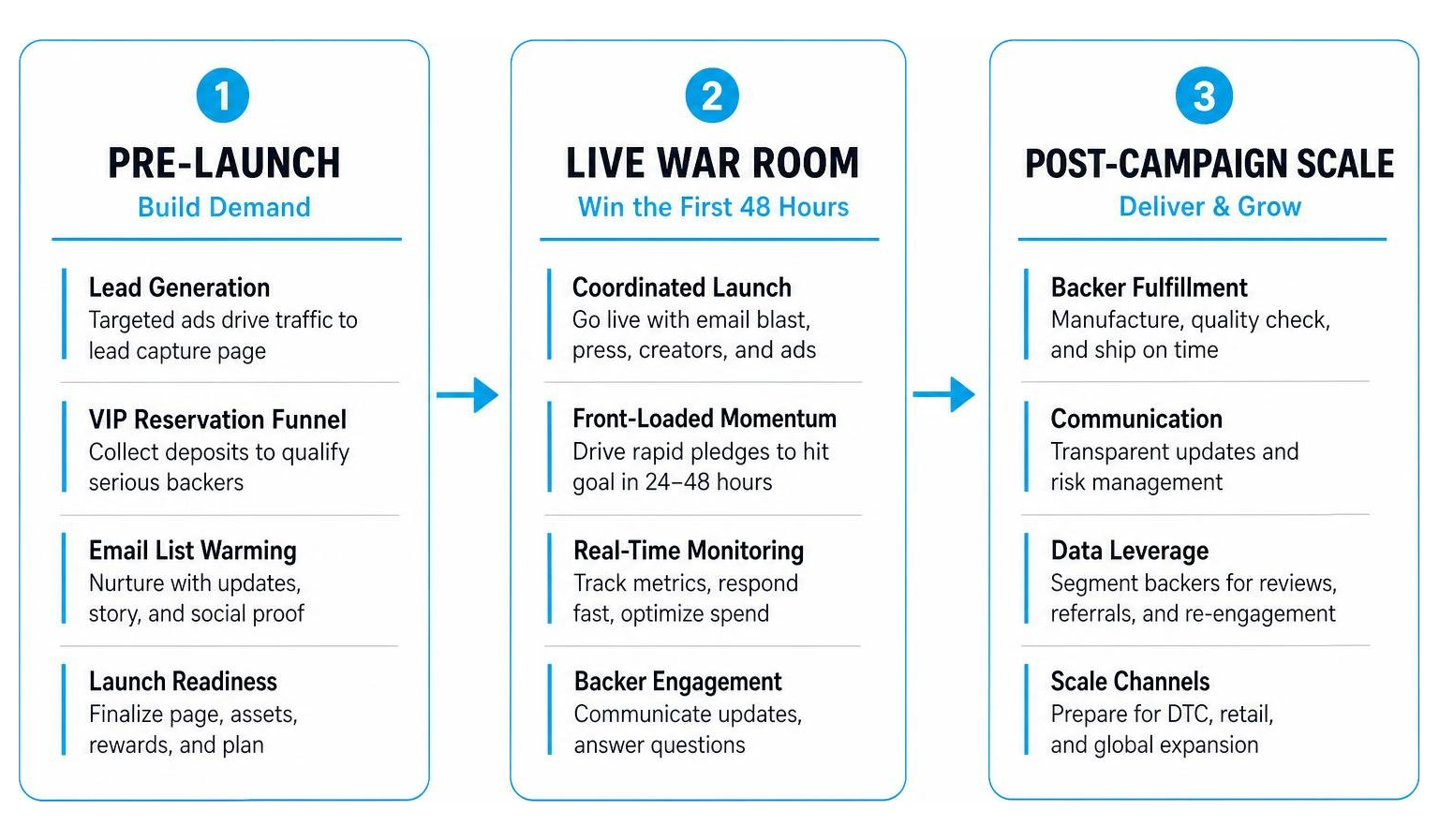
Executing a hardware launch is a phased discipline. A campaign’s success is largely decided weeks before the page ever goes live. By using story brand marketing, agencies position the backer as the hero of the innovation journey and the creator as the trusted guide.
Pre-Launch Lead Generation and Deposit Reservations
The pre-launch phase (typically 8 to 12 weeks) focuses entirely on building a qualified, ready-to-buy audience. Relying purely on standard email signups often yields low day-one conversion rates. Leading agencies frequently deploy a VIP reservation funnel:
- Traffic Generation: Paid ad campaigns on Meta and Google drive targeted traffic to a dedicated lead capture landing page.
- Email Capture: Visitors provide their email address in exchange for product updates and launch notifications.
- VIP Deposit Mechanism: Prospects are invited to place a small refundable deposit (e.g., $1 to $10) to lock in the absolute lowest Early Bird discount on launch day. Backers who place a deposit convert at significantly higher rates than standard email leads.
- List Warming: Monitoring email marketing program performance through segmented nurture sequences keeps subscribers engaged with behind-the-scenes engineering updates, founder stories, and live Q&A sessions.
Live Launch Execution, Paid Ads, and Content Storytelling
When the campaign launches, the goal is to trigger the platform's organic recommendation engine by funding rapidly.
- Day-One Blitz: The pre-launch email list is activated immediately to achieve 100% funding within hours.
- Paid Media Scaling: Once early conversion metrics stabilize, the agency scales lookalike and interest-targeted ad sets, keeping a close eye on cost-per-pledge.
- Content and Updates: Regular, detailed backer updates maintain community excitement and introduce stretch goals to unlock new features or colorways.
- Live War Room: Daily monitoring of ad fatigue, negative comment moderation, and real-time page optimization ensures steady mid-campaign performance.
Post-Campaign Transition to DTC and Ecommerce
Funding is the beginning of the brand journey, not the end. Once the countdown timer expires, your agency should facilitate the transition to long-term commercialization:
- Late Pledges & Indemand: Moving the campaign to late-pledge platforms or Indemand to continue capturing pre-orders while production is finalized.
- Backer Surveys: Deploying pledge management software to collect shipping fees, process add-ons, and finalize manufacturing quantities.
- Shopify & DTC Setup: Building a dedicated direct-to-consumer online storefront so prospective buyers landing on your site after the campaign can continue placing pre-orders.
Measuring ROI and Navigating Launch Challenges
Marketing physical hardware involves tangible supply chain dependencies and capital allocations. Measuring performance accurately ensures you maintain healthy unit economics while building sustainable market presence.

Key Performance Indicators and Tracking Metrics
Consistently tracking marketing performance allows teams to reallocate capital toward winning channels and creative variations.
Crucial marketing key performance indicators include:
- Cost Per Lead (CPL) & Cost Per Reservation (CPR): Pre-launch acquisition benchmarks to ensure ad spend efficiency.
- Pledge Conversion Rate: The percentage of campaign page visitors who complete a backing transaction.
- Blended Return on Ad Spend (ROAS): Total funds raised relative to total paid advertising spend.
- Funded Velocity: The speed at which milestone funding goals are achieved, directly impacting platform visibility.
- Customer Acquisition Cost (CAC): Total sales and marketing investment divided by total acquired backers.
Why Every Hardware Campaign Needs a Specialized Kickstarter Marketing Agency
Hardware development carries unique operational friction that generic marketing firms rarely appreciate. A specialized kickstarter marketing agency understands how to translate technical datasheets into compelling consumer stories while navigating component lead times, tooling investments, and functional prototype demonstrations.
When your marketing team understands the difference between an engineering validation test (EVT) and a production validation test (PVT), campaign communications remain authentic, protecting your reputation among savvy early adopters.
Ethics, Transparency, and Managing Launch Risks
Crowdfunding carries inherent market risks. Oversaturation, shifting digital ad costs, and economic factors mean no campaign is guaranteed to go viral. Ethical agencies uphold strict operating principles to protect both creator and backer:
- No Unrealistic Guarantees: Professional firms never promise arbitrary funding totals. They base projections on empirical pre-launch validation data.
- Accurate Prototype Representation: Marketing assets must clearly reflect the actual stage of product development, avoiding misleading CGI that misrepresents prototype maturity.
- Transparent Communication: If manufacturing or certification delays occur, guiding founders to post transparent, honest updates preserves long-term backer goodwill and prevents community backlash.
Frequently Asked Questions About Crowdfunding Agencies
How much do crowdfunding marketing agencies typically charge?
Crowdfunding marketing agency fee structures generally combine a fixed project retainer with a performance-based success commission. Standard engagements typically include a base fee to cover pre-launch asset creation, page design, video production, and funnel setup, paired with a commission (often 8% to 15%) on total funds raised during the campaign. Creators must also budget separately for their paid advertising spend, which is paid directly to ad platforms.
How far in advance should hardware marketing begin before launch?
For complex hardware, marketing preparation should begin at least 8 to 16 weeks prior to the target launch date. This window allows sufficient time to produce high-quality product photography and video, build and test pre-launch landing pages, distribute physical prototypes to tech press and influencers for review, and systematically build a high-intent VIP email list.
Can an agency guarantee a successful Kickstarter campaign?
No agency can honestly guarantee that a campaign will reach its funding target. Market reception depends on product-market fit, pricing, consumer sentiment, and competitive alternatives. However, an experienced agency mitigates risk by conducting rigorous pre-launch testing and building a deposit-backed audience before launching publicly.
Conclusion
Successfully launching a complex hardware product requires uniting exceptional engineering with disciplined, psychology-backed demand generation. By choosing a partner who understands the realities of hard tech, you protect your margins, validate real customer demand, and set the foundation for a sustainable hardware business.
At CRISPx, we act as the outsourced marketing and sales team for hardware companies run by engineer founders across consumer electronics, robotics, computers, and embedded components. You build the product; we build the demand.
To see where your current positioning and digital presence stand, request a free DOSEscore™ checkup of your website or explore our end-to-end hardware growth and launch services to prepare your product for market success.
Get a free brand checkup.
We work like a brand doctor. The DOSE Method™ finds what's broken, fixes the biggest problem first, then tracks the results.