The Complete Guide to Winning at B2B Brand Strategy
Master B2B brand strategy: Build equity, launch with LaunchX, scale via OrbitX, and measure ROI in the $32T market.


Master B2B brand strategy: Build equity, launch with LaunchX, scale via OrbitX, and measure ROI in the $32T market.
B2B brand strategy is the systematic approach to building reputation, trust, and recognition that drives revenue in business-to-business markets. At its core, it defines:
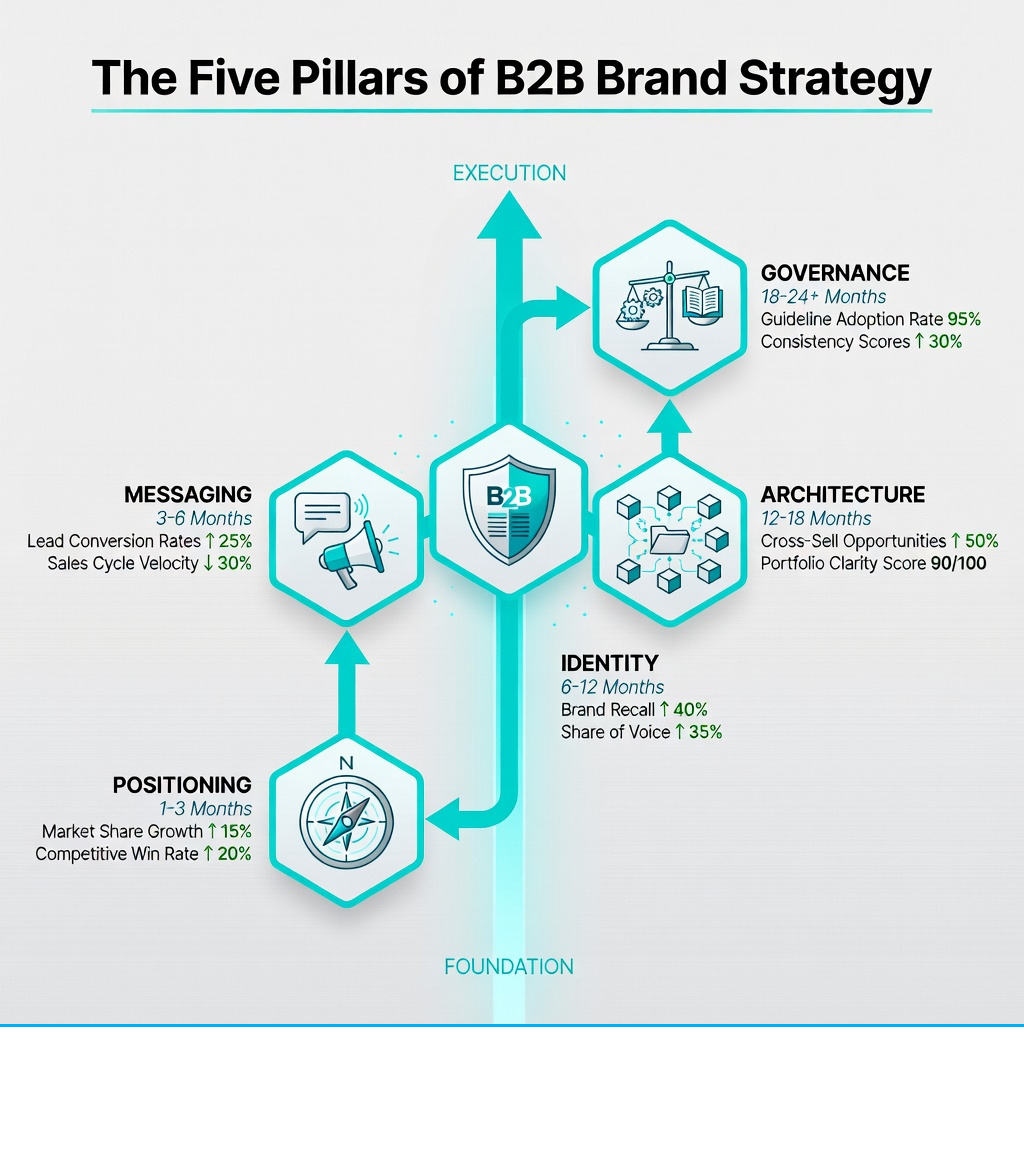
Key Components of B2B Brand Strategy:
| Component | Purpose |
|---|---|
| Positioning | Clarity about what makes you different and better |
| Messaging | The story that connects your value to buyer needs |
| Identity | Visual and verbal systems that build recognition |
| Architecture | How products and services relate under your brand |
| Governance | Rules that keep your brand consistent as you scale |
The stakes have never been higher. The global B2B eCommerce market is expected to hit $32.11 trillion in 2025, and the top 250 B2B brands now command a collective brand value of $3.34 trillion. Yet many B2B companies still underinvest in brand, with nearly one quarter spending less than 20% of their budget on it.
Here's what most people miss: B2B buyers are people too. They make decisions based on trust, not just spreadsheets. Complex B2B purchases involve six to ten decision makers, and most buyers describe their last purchase as difficult. Your brand strategy is what helps you get shortlisted before sales ever gets involved.
Strong B2B brands deliver materially higher operating margins and can represent a significant portion of enterprise value. Purchasers are more than 5x as likely to consider, 12x as likely to purchase, and 30x as likely to pay a premium for products with high brand connections than those with no brand connections.
The difference between a logo and a strategy is simple: a logo is what you look like. A strategy is how you win.
I'm Tony Crisp, and I've spent two decades building B2B brand strategies for technology companies ranging from startups to Fortune 500 clients like Nvidia, HTC Vive, and Element U.S. Space & Defense. I've seen how the right strategy transforms commoditized tech products into category leaders that command premium pricing and loyal customers.
Essential b2b brand strategy terms:
Building a b2b brand strategy is like constructing a skyscraper; if your foundation is shaky, the whole thing will eventually topple under the weight of market pressure. In the modern landscape, this foundation isn't just about a pretty logo—it’s about brand equity and how you occupy space in the buyer's mind.
One of the biggest hurdles we see is the "B2B Branding Ladder." Many companies are stuck on the bottom rung, focusing purely on functional attributes (price, specs, speed). To win, we must climb toward emotional and social values. This involves deeply understanding the B2B buyer's journey, which has shifted from a linear path to a complex web of digital research.
Successful global brands face a unique challenge: balancing global consistency with regional market customization. While your core mission and visual identity must remain steady to build trust, your execution—case studies, cultural references, and even specific value proofs—needs to feel local. A buyer in Newport Beach has different immediate pressures than one in London, even if they use the same software.
Positioning is the act of claiming a specific "territory" in your market. When the global B2B eCommerce market is exploding, standing out is no longer optional. According to B2B marketing statistics, the noise is deafening. To cut through it, you need building brand identity that isn't just "different," but "meaningfully different."
We start by asking: "Why should a customer choose us over a cheaper or more established alternative?" Your value proposition shouldn't be a list of features; it should be a promise of a transformed future state for the buyer. If your positioning is "we have the best AI," you've already lost. If it’s "we help you close audits 40% faster using automated intelligence," you have a competitive advantage.
As B2B companies grow, they often end up with a "house of brands"—a messy collection of acquired products and services that confuse the buyer. This is where brand architecture guide comes into play.
Effective architecture provides market recognition and clarity. Do you want a "Branded House" (like FedEx, where everything is under one name) or a "House of Brands" (like P&G)? For most B2B firms, a hybrid or sub-brand model works best, allowing new innovations to leverage the parent company's trust while maintaining their own specialized identity. Clarity here reduces the "brand defect rate" and makes cross-selling significantly easier.
At CRISPx, we use LaunchX to help tech companies build massive brand value from day one. This isn't just about aesthetics; it's about financial valuation. When NVIDIA doubled its brand value to $87.9 billion, it wasn't just because they made great chips—it was because they successfully repositioned as the engine of the AI revolution.
Creating brand strategy starts with a discovery phase that looks "outside-in." We interview customers to find out what they actually value, which is often different from what the CEO thinks they value. From there, developing your brand identity becomes an exercise in storytelling. Your mission shouldn't be a framed poster on the wall; it should be the "North Star" for every piece of content you produce.
We often joke that B2B stands for "Back to Boring," but that’s a recipe for failure. To foster genuine connections, we have to humanize the brand. This means moving away from "synergistic enterprise solutions" and toward a conversational tone.
Once the brand is built, OrbitX is our framework for scaling that brand using psychology-driven growth marketing. We don't just run ads; we build memory structures. This is critical because of the LinkedIn B2B Institute’s 95 to 5 rule: at any given time, 95% of your buyers are not in the market.
Your brand campaign strategy must therefore focus on being "top of mind" so that when that 5% does enter the market, you are the first name they call. This requires building messaging systems that scale, ensuring that whether a buyer sees a LinkedIn ad or talks to a sales rep, the core promise remains identical.
If you want to build authority fast, a B2B podcast is your ultimate content engine. It’s not just about the audio; it’s about a thought leadership strategy that feeds every other channel.
One 30-minute interview with an industry expert can be repurposed into:
This is b2b brand building on autopilot. It builds a community around your brand and positions your host (ideally a C-suite leader) as a trusted advisor in the space.
The question every CFO asks is: "What’s the ROI of this b2b brand strategy?" In the past, brand was seen as "fluff." Today, it's a data science. With the rise of agentic AI and 2025 AI and Digital Trends, we can now track brand impact with surgical precision.
We use a brand equity management system to track metrics that actually matter. While "likes" are nice, we focus on:
Why B2B Brand Marketing Matters is clear: mature brand marketing improves ROMI (Return on Marketing Investment) and reinforces everything your performance marketing team is doing. Without a measurement system for brand effectiveness, you're just guessing.
You’ll likely see some "early signs of life"—like improved internal alignment and higher social engagement—within the first 3-6 months. However, brand building is a long game. You should expect to see game-changing results, such as significant revenue lift and shorter sales cycles, after about 12 to 18 months of consistent effort. Leading indicators like organic search lift and sales team adoption usually appear around the 90-day mark.
Absolutely. In fact, small businesses are often more nimble. The key is niche positioning. Don't try to be everything to everyone. Find a specific "Tier 1" segment where you can be the undisputed expert. Use branding for small business tactics like heavy content repurposing and personal branding for the founders to punch way above your weight class.
Rebranding is risky, but necessary if your current brand is holding you back. The secret is gradual implementation and over-communication. Involve your key customers in the feedback process early. Explain why the change is happening and how it benefits them (e.g., "We're evolving from a tool to a platform to serve you better"). Use brand development services to ensure you keep familiar elements—like a core color or a evolved version of your logo—to maintain market recognition while signaling a new era.
In the high-stakes world of B2B, your brand is either an asset or a liability. There is no middle ground. At CRISPx, we believe that every tech company has a world-class story waiting to be told. Through our DOSE Method™, we combine data-driven creativity with strategic psychology to turn complex products into market leaders.
Whether you're looking to launch a new product or revitalize an existing identity, we're here to help you navigate the $32 trillion B2B landscape. Based in Newport Beach, CA, we have the local expertise and global vision to scale your brand predictably and profitably.
Ready to turn your reputation into revenue? Launch your brand with CRISPx today.
We work like a brand doctor. The DOSE Method™ finds what's broken, fixes the biggest problem first, then tracks the results.




Accessibility: If you are vision-impaired or have some other impairment covered by the Americans with Disabilities Act or a similar law, and you wish to discuss potential accommodations related to using this website, please contact our Accessibility Manager at (949) 791-9150