

Give Your B2B Website a Free Brand Checkup Today

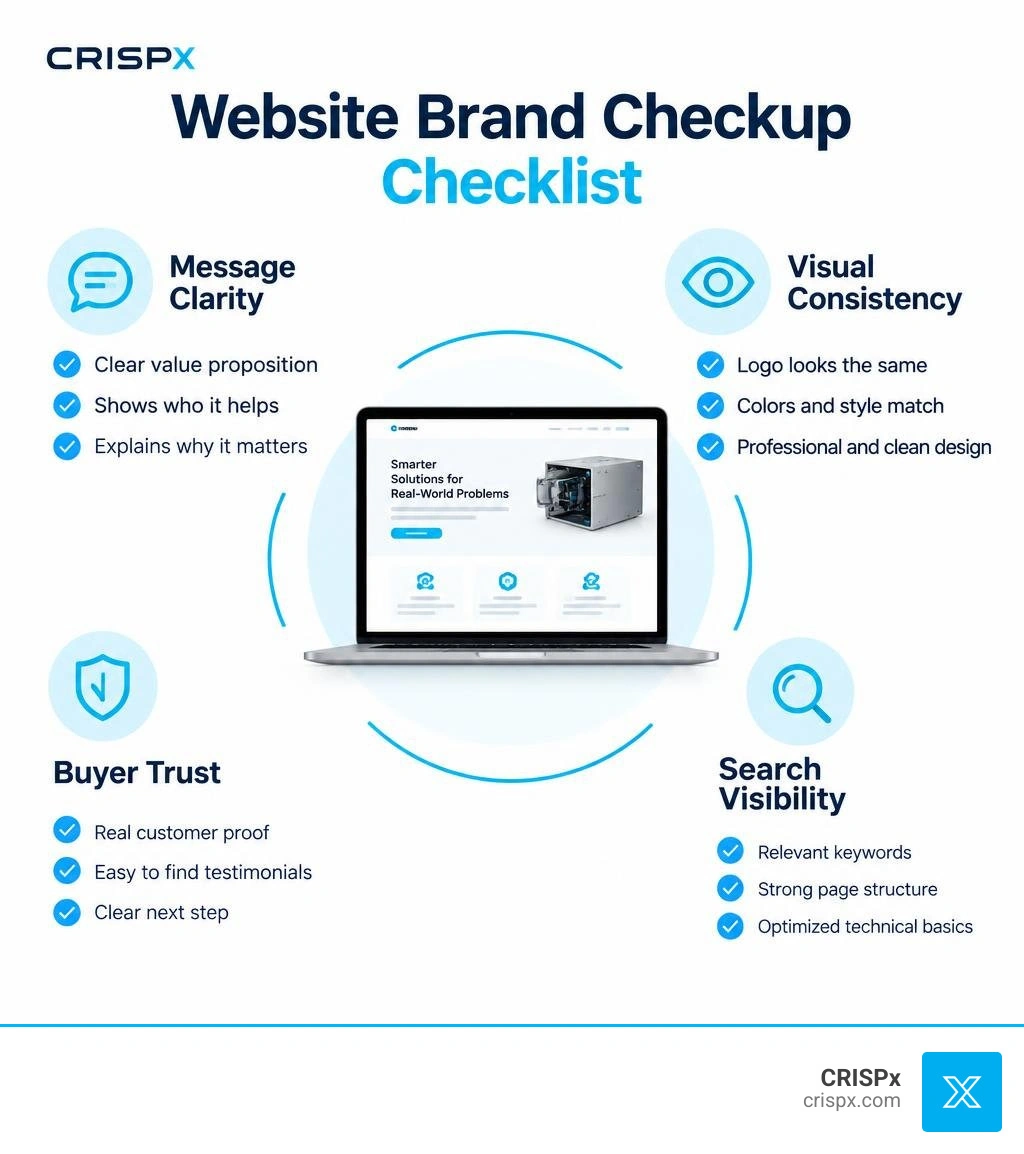
A website brand checkup shows whether buyers quickly understand what you sell, why it matters and why to trust you. Check message clarity, visual consistency, buyer trust and search visibility, then fix the biggest gap first.
How to Give Your B2B Website a Free Brand Checkup
To run a free website brand checkup, open your homepage and a key product page on your phone. Ask: Can a new buyer tell what you sell, who it helps, and why it matters within a few seconds? Then check whether your logo and message stay consistent, your proof is easy to find, and the next step is clear.
For a B2B hardware company, pay close attention to pages that read like spec sheets. Buyers need the specs, but they also need to understand the problem your product solves. A quick check can show where that story breaks down before you dig into search visibility and technical issues.
This guide walks you through what to check and how to decide what to fix first.
Why Every B2B Tech Company Needs a Free Website Brand Checkup
Most tech and hardware companies do not have a product problem. They have a translation problem. When an engineer builds an exceptional device, whether it is a robotics platform, an industrial sensor, or a defense-grade component, the instinct is to explain how it works. But buyers do not purchase architecture diagrams; they purchase solutions to painful problems.
When your online presence fails to communicate that value instantly, your conversion rate drops. Marketing leadership shifts constantly, but the foundational need for clear b2b brand building remains constant. When positioning drifts across product updates, potential buyers hesitate and bounce.
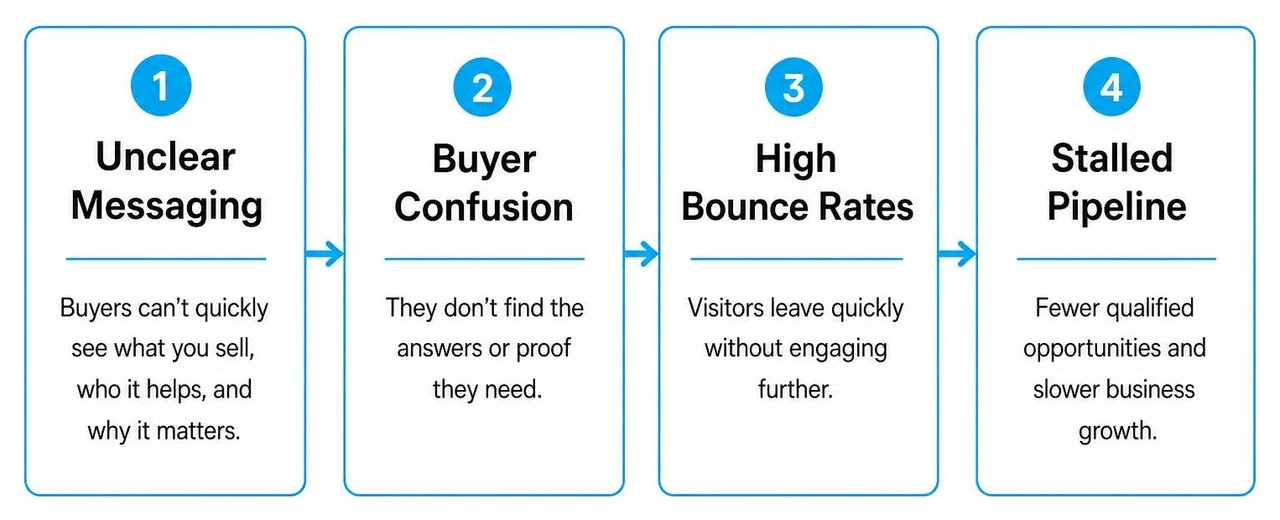
A comprehensive brand health check evaluates whether your digital front door builds confidence or creates confusion. If your site lacks external validation, clear differentiation, and crisp positioning, buyers will leave before reading your data sheets.
Brand Health Audits Versus Traditional Technical SEO Audits
Founders often confuse a search engine optimization (SEO) audit with a brand audit. Traditional SEO tools check for crawl errors, broken backlinks, and metadata lengths. Those are useful plumbing checks. However, ranking on Google does not mean visitors will trust your business. Technical SEO tools cannot measure whether your value proposition makes sense or whether your brand identity inspires confidence.
| Diagnostic Area | Traditional Technical SEO Audit | Holistic Brand Health Audit |
|---|---|---|
| Primary Focus | Crawlers, indexability, metadata, site speed | Buyer perception, clarity, trust, value story |
| Key Metrics | 404 errors, Core Web Vitals, backlink profile | Message comprehension, visual cohesion, proof density |
| Search Readiness | Classic keyword rankings on Google/Bing | AI search citations (ChatGPT, Perplexity) & human intent |
| Emotional Driver | Machine compliance | Trust, authority, relief, and perceived risk reduction |
| Outcome | Site indexation and technical health | High conversion rates and sustained brand equity |
A complete brand health check looks beyond raw keywords to assess message clarity, visual polish, and user trust.
Human Experience Versus AI Engine Visibility
Search habits have shifted. Modern tech buyers do not just scroll through ten blue links; they prompt large language models (LLMs) like ChatGPT, Claude, and Perplexity for vendor recommendations.

If your website lacks clear entity structure and unambiguous copy, AI tools cannot summarize what you do. Optimizing for machine readability requires implementing ai engine optimization for tech. Clear entity definitions and machine-readable data help you get cited by chatgpt when engineers search for components in your category.
Core Dimensions Evaluated in an Online Brand Health Audit
A thorough brand evaluation examines three core pillars: visual identity, narrative positioning, and proof architecture. When these three elements align, your site creates instant clarity.

Establishing this foundation is essential when building brand identity. It ensures that every page reinforces your company's authority and market position.
Visual Identity and Design System Cohesion
Visual execution forms a visitor's first impression within milliseconds. A brand checkup evaluates your design elements across several standards:
- Logo Clarity: Does your logo scale cleanly on high-density mobile screens, favicons, and social cards without pixelation?
- Color Discipline: Are you using a focused palette of three or fewer primary brand colors, or does every subpage introduce arbitrary accent colors?
- Typography Hierarchy: Do header tags (H1, H2, H3) follow a consistent typographic scale that makes complex technical information scannable?
- Accessibility and Contrast: Does your body text comply with WCAG AA contrast ratios against light and dark backgrounds?
- Speed and Responsiveness: Visitors abandon pages that take more than 3 seconds to load. Performance directly shapes visual trust.
Value Proposition and Positioning Clarity
Engineer-led companies often suffer from what we call "spec sheet syndrome." A visitor lands on the homepage and sees clock speeds, pin configurations, or bus protocols, but zero context on the operational outcome.
Use a structured technical product messaging framework to organize your page hierarchy:
- The Core Problem: Name the exact friction, bottleneck, or system failure your customer faces today.
- The Solution Mechanism: Explain how your hardware or software eliminates that bottleneck without added complexity.
- The Business Outcome: Highlight the speed, reliability, or cost advantage gained.
- The Technical Validation: Provide deep specifications, documentation, and mechanical drawings for the engineering team vetting the purchase.
Trust Signals and Social Proof Architecture
Trust deficits stall B2B sales cycles. If your website does not prove that other teams rely on your hardware in mission-critical environments, enterprise buyers look elsewhere. Managing buyer skepticism requires understanding the dose framework trust stress customer experience dynamic. When you eliminate perceived risk, you remove hesitation.
Transparent communication helps enterprise buyers evaluate risk. Clear documentation and timely updates make it easier for buyers to understand how a company responds when problems arise.
Your website must demonstrate this same transparent authority through customer logos, third-party validation, clear warranty guidelines, and deep technical white papers.
How to Interpret Audit Scores and Address Vulnerabilities
Across 312 brand audits analyzed in our benchmark research, the average overall brand health score was just 47 out of 100. Most technical websites suffer from severe messaging blind spots that the founders walk past every day.
Decoding Score Brackets from Critical Risk to Market Leader
- Score 0–49 (Critical Friction): The website reads like an internal engineering wiki. Bounce rates are high, visual elements drift across subpages, and there are no customer logos or third-party proof points. Visitors cannot determine what you make within five seconds.
- Score 50–69 (Baseline Functionality): The site explains the product category, but relies on buzzwords ("next-generation," "disruptive," "seamless"). It provides specs but lacks an emotional hook or clear ROI justification for procurement teams.
- Score 70–84 (Strong Competitor): Clear messaging, clean responsive layout, and solid social proof. The main gaps are missing structured data for AI search discovery and minor typography or contrast inconsistencies.
- Score 85–100 (Market Leader): Crisp narrative, flawless cross-device design, verified client case studies, and complete schema architecture for LLM citation.
How a Free Website Brand Checkup Uncovers Technical Messaging Blind Spots
When founders build a breakthrough technology, they assume the market understands why it is superior. A brand checkup reveals common blind spots:
- The "Curse of Knowledge": Using internal acronyms that mean nothing to an external buyer.
- Feature-First Headlines: Leading with "12-Core ARM Architecture" instead of "Process Sensor Data at the Edge with Zero Latency."
- Buried Proof: Hiding customer case studies in a hidden PDF instead of featuring quotes next to the primary call to action.
- Missing Clear Next Steps: Forcing visitors to "Contact Us" through a generic form rather than offering direct CAD downloads, evaluation kits, or a strategy call.
Turning Your Free Website Brand Checkup into a 90-Day Growth Roadmap
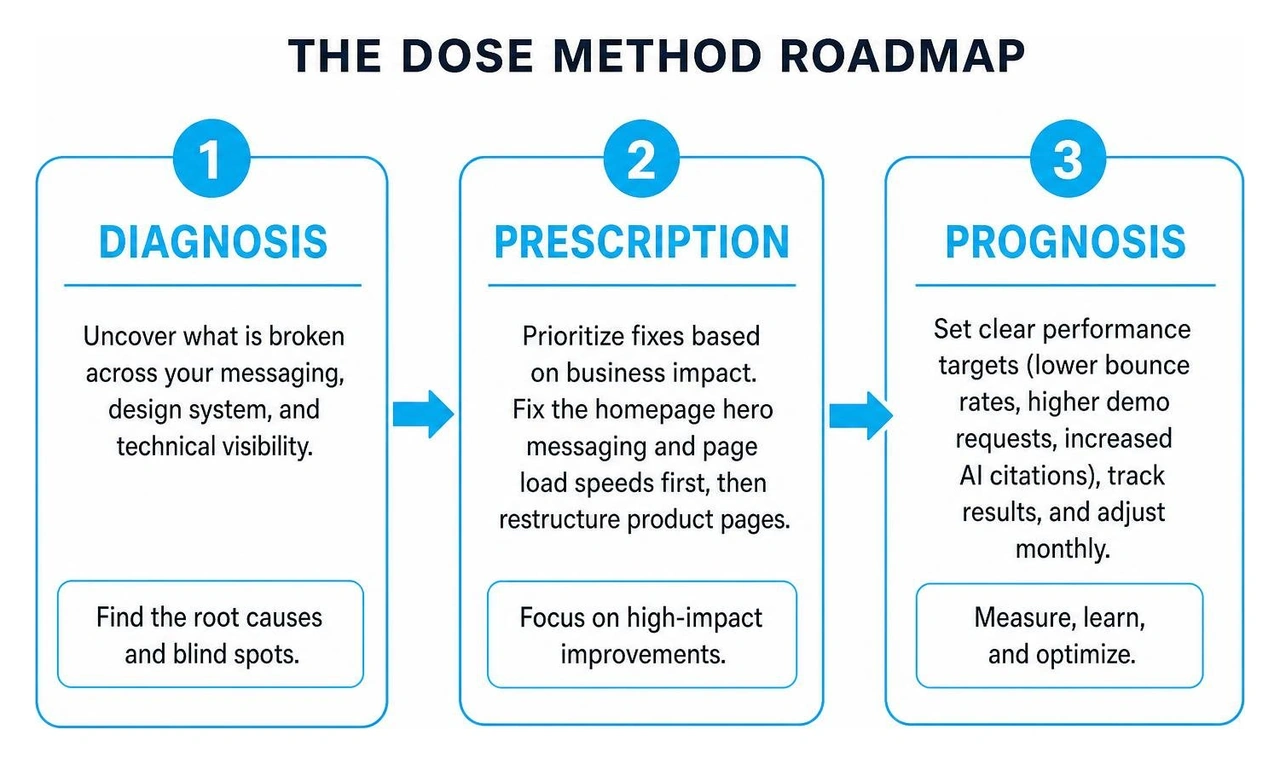
We evaluate brand health using the DOSE Method™:
- Diagnosis: Uncover what is broken across your messaging, design system, and technical visibility.
- Prescription: Prioritize fixes based on business impact. Fix the homepage hero messaging and page load speeds first, then restructure product pages.
- Prognosis: Set clear performance targets (lower bounce rates, higher demo requests, increased AI citations), track results, and adjust monthly.
By balancing the core emotional drivers, Dopamine (they want the solution), Oxytocin (they trust your data), Serotonin (they feel proud deploying it), and Endorphins (they feel relief that the problem is solved), your website shifts from a passive brochure to an active demand engine.
Frequently Asked Questions About Website Brand Perception
How often should a B2B business run an online brand health check?
You should conduct a brand checkup quarterly. Products evolve, new firmware or hardware revisions roll out, and marketing teams create new landing pages. Without regular reviews, design systems drift and value propositions become disjointed across your catalog.
What is the difference between human brand trust and AI agent readiness?
Human trust relies on visual polish, clear writing, and recognizable social proof. AI readiness depends on structured entity schema, clear definitions, accessible robots.txt rules, and authoritative third-party references that LLMs can extract and summarize.
When should a company seek expert help beyond a self-serve checkup?
Self-serve checkups are ideal for spotting surface-level errors. However, if your launch fell flat, growth has stalled post-launch, or your engineering team cannot distill complex specs into a story that closes deals, partnering with an outsourced marketing team like CRISPx is the most efficient path forward.
Conclusion
Your website is your most valuable commercial asset. If it reads like an engineering spec sheet or fails to project credibility, potential buyers will click away to competitors who tell a clearer story.
CRISPx plugs in as the founder's marketing and sales team, so you do not need a head of marketing. We offer four straightforward plans tailored to your stage: Launch, Grow, Grow + Ads, and Scale. Tony Crisp has 30 years in branding, 100+ hardware launches and 8+ patents. Robosen Optimus Prime went from Kickstarter to CES, then Hasbro and Disney licenses. FuzeDrive ran a top 1% Indiegogo campaign. SecureCircle was acquired by CrowdStrike.
Stop guessing how the market perceives your technology. Get a free DOSEscore™ brand checkup of your website and story today, or book a strategy call with our team to turn your technical innovation into sustained commercial demand.
Get a free brand checkup.
We work like a brand doctor. The DOSE Method™ finds what's broken, fixes the biggest problem first, then tracks the results.
