

Anatomy of a High-Impact Crowdfunding Press Release

Learn the anatomy of a high-impact crowdfunding press release to earn media coverage and attract backers before and during your campaign.
How to Write a Crowdfunding Press Release Journalists Can Use
A crowdfunding press release should give journalists a clear story they can check quickly. Hardware founders should lead with what the product does, who built it, when the campaign opens, and why it matters. They should then show proof of a working prototype, explain how funds will be used, and state a realistic delivery window and the main production risks.
The release is only one part of the pitch. A short, personal email and an easy-to-access press kit help journalists decide whether the story fits their readers. Sending the right angle before launch, at launch, or when the campaign reaches a meaningful milestone gives them a timely reason to cover it.
Simple guide to crowdfunding press release terms:
Why Every Hardware Campaign Needs a Crowdfunding Press Release
Crowdfunding is a crowded space, and earned media can provide the social proof that helps turn casual visitors into backers.
Media coverage creates external trust. When an engineer founder launches an innovative product on Kickstarter or Indiegogo, prospective backers look for validation beyond the campaign page. Coverage from reputable tech and trade publications shows readers that third-party experts have evaluated the hardware. This external validation lowers buying hesitation, lifting conversion rates across both platform pages and external landing pages. A solid plan detailed in a crowdfunding campaign guide balances direct response advertising with strategic press outreach.
Platform algorithms reward rapid pledge spikes. When an article goes live in an established industry outlet, the resulting traffic surge triggers platform ranking engines. Crowdfunding discovery algorithms prioritize campaigns with high velocity, placing them on trending lists and category landing pages. Furthermore, high-authority media features generate direct search engine backlinks, building domain authority that drives organic search discovery long after the campaign ends.
Momentum builds when campaign milestones give outlets a clear reason to cover the story, as shown in this campaign announcement.
The Core Structure of a Crowdfunding Press Release
A working prototype and a list of journalists are not enough on their own. Tech reporters receive many pitches and need to assess incoming materials quickly. An effective press release relies on the inverted-pyramid structure endorsed by professional journalism standards, such as Associated Press (AP) style.
The inverted pyramid places the most critical details at the top of the page. Secondary technical context, development milestones, and supporting founder quotes follow in descending order of importance.
Every paragraph must serve a distinct purpose:
- Header and Dateline: Identifies the city of origin, release date, and immediate distribution status.
- Lead Paragraph: Answers the core journalistic questions without fluff.
- Supporting Proof: Presents the verified mechanism of the hardware and third-party validation.
- Founder Quote: Adds strategic vision rather than repeating technical specs.
- Risk and Fulfillment Disclosure: Outlines manufacturing steps, component sourcing, and delivery schedules.
- Boilerplate and Media Assets: Supplies background details and a direct link to a media kit.
Leading industry resources, such as the PRSA guide on writing publishable releases, emphasize clarity and factual precision over marketing spin.
How to Write a Crowdfunding Press Release Headline and Lead
Your headline must clearly state the product's primary mechanism and platform rather than using vague promotional claims. Journalists avoid vague adjectives like "revolutionary," "disruptive," or "world-changing." A functional headline highlights the concrete problem the hardware solves, the engineering architecture it uses, and where it is launching.
The lead paragraph must answer the classic Five Ws within 50 words:
- Who: The company name and core engineering team.
- What: The specific hardware device and its practical utility.
- When: The exact launch date, time, and embargo terms.
- Where: The crowdfunding platform (Kickstarter, Indiegogo, or Wefunder).
- Why: The problem it solves or the market gap it fills.
Pairing an informative lead with an embargo notice gives journalists time to test prototypes or review materials before the public launch. Founders preparing consumer electronics or computing projects should review a Kickstarter checklist for hardware to verify all specifications before sending materials to the media.
The Five Verifiable Lines Journalists Check First
Reporters scan for five specific, checkable facts in the first third of a press release before reading the broader pitch:
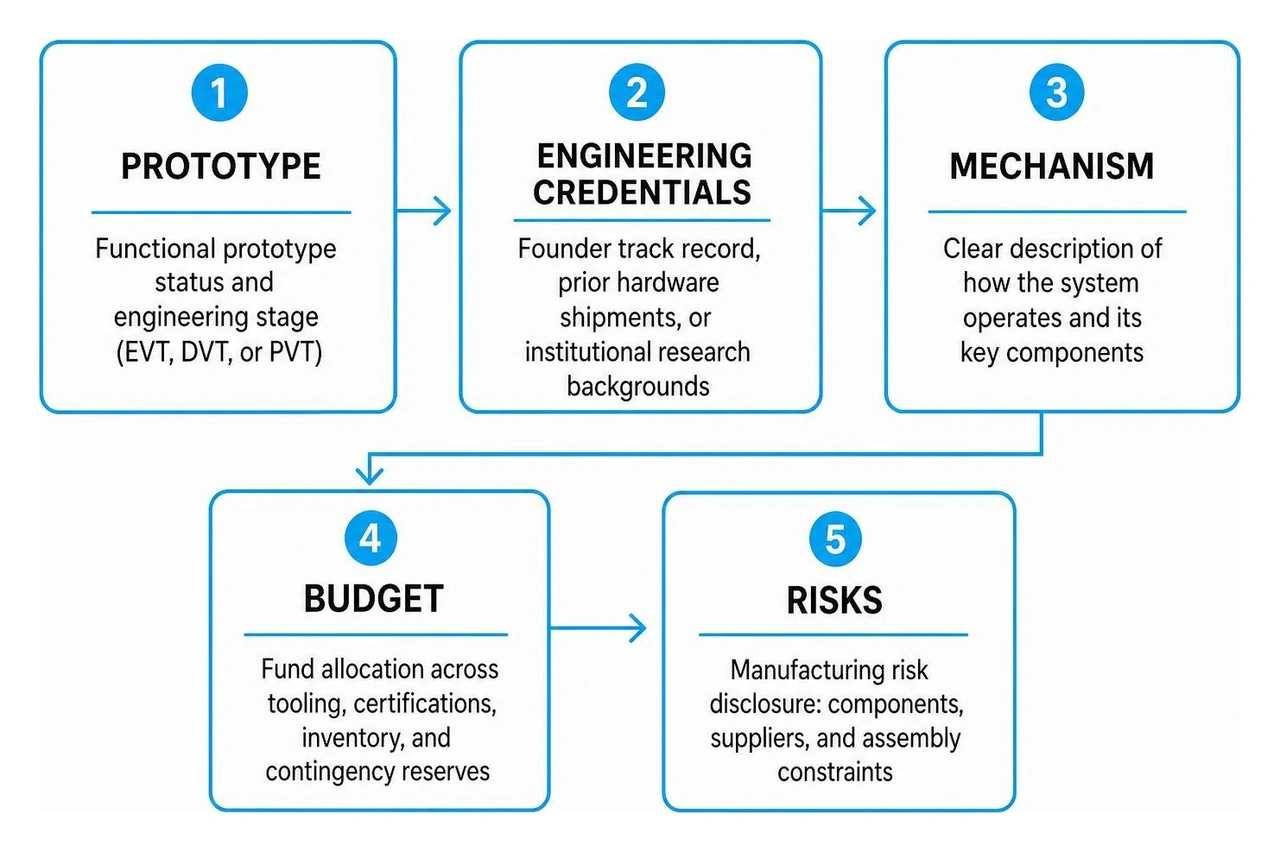
- Functional Prototype Status: Confirmation of working physical hardware, current engineering stage (EVT, DVT, or PVT), and active testing status.
- Engineering Credentials: Relevant founder track records, prior hardware shipments, or institutional research backgrounds.
- Technical Mechanism: A clear description of how the system operates, including its microcontroller, sensor array, or custom mechanical design.
- Fund Allocation Breakdown: A clear explanation of how backer capital will be distributed across tooling, certifications, initial inventory runs, and contingency reserves.
- Manufacturing Risk Disclosure: A straightforward statement addressing component lead times, single-source suppliers, or assembly constraints.
Addressing manufacturing risks early builds trust. Hardware campaigns face real-world supply chain challenges. Acknowledging single-source components or tooling lead times upfront protects credibility and prevents negative press if production timelines adjust later.
Strategic Timing: Pre-Launch, Live Launch, and Milestone Releases
Releasing a media pitch requires strict timing tied to campaign milestones. A single blast on launch day is rarely enough to drive sustainable coverage.
| Stage | Target Window | Primary Goal | Recommended Media Angle |
|---|---|---|---|
| Pre-Launch Embargo | 7 to 10 days before launch | Secure day-one reviews and features | Exclusive access, engineering specs, review units |
| Launch Day Push | Morning of public go-live | Drive immediate pledge velocity | Campaign launch, early-bird pricing, platform link |
| Milestone Release | 24 to 48 hours after milestone | Maintain mid-campaign momentum | Funding targets hit, stretch goals, production updates |
Pre-launch outreach operates under a strict embargo. Pitching journalists 7 to 10 days before go-live gives them adequate time to review technical documentation, interview engineering leads, and draft content. The embargo lifts the exact moment the campaign goes live, triggering synchronized coverage that drives initial pledges. This works alongside psychology-driven pre-launch sequences designed to build active waitlists.
When a campaign crosses a meaningful funding threshold or introduces a new stretch goal, a milestone press release can re-engage media contacts. A timely update gives reporters a concrete development to cover, as shown in this campaign announcement.
Examples from the Kickstarter Culture Fund and Curefundr illustrate how developments can extend a campaign's news cycle. Milestone news works best when tied to a concrete achievement, such as a funding target, a product update, or a confirmed manufacturing step, rather than a routine schedule notice.
Building Targeted Media Lists and Media Kits
Relevance outperforms volume when building a media list. Pitching targeted writers who routinely cover your specific hardware vertical is more useful than sending an untargeted blast to generic contacts.
Segment media contacts into three focused tiers:
- Tier 1 (Core Tech Verticals): Journalists covering specific beats like robotics, consumer electronics, or components.
- Tier 2 (General Tech & Gadgets): Writers covering consumer hardware trends, new designs, and notable crowdfunding campaigns.
- Tier 3 (Local & Regional Press): Business reporters covering regional startups, university spinouts, and local manufacturing.
Journalists need friction-free access to media assets. Provide a direct link to an ungated, single-page digital press kit. Never attach heavy ZIP files or require reporters to fill out access forms.
A professional press kit includes:
- High-Resolution Photography: Studio shots with transparent backgrounds, lifestyle photos in natural environments, and detailed close-ups of internal PCB boards and connectors.
- B-Roll Video Footage: High-definition video showing the hardware operating in real-world conditions without promotional music or voiceovers.
- Technical Fact Sheet: A single-page PDF containing dimensions, weight, battery capacity, processing specs, materials, and safety certifications.
- Founder Bios and Headshots: Concise bios focusing on engineering achievements and previous hardware products.
- Full Press Release: Downloadable PDF and plain-text versions of the release.
Integrating press outreach into a comprehensive product launch marketing plan keeps all promotional assets aligned throughout the launch.
Personalized Email Pitching and Follow-Up Protocols
Keep the body copy concise so reporters can scan it quickly.
Keep subject lines concise so they display clearly on mobile screens. State the product name, core mechanism, and embargo details directly.
If a journalist does not respond within three to five business days, send a single polite follow-up. Do not simply forward the old pitch asking if they saw it. Instead, offer a new detail, such as an updated benchmark test, an unreleased demo video, or a new manufacturing milestone. If they do not respond to the second email, remove them from that campaign cycle.
Common Mistakes That Ruin a Crowdfunding Press Release
Many hardware press releases fail to generate coverage due to simple, avoidable errors:
- Vague Delivery Dates: Promising an unrealistic delivery window without showing a production schedule damages credibility. State realistic delivery estimates backed by your tooling and manufacturing milestones.
- Unsubstantiated Hype: Using phrases like "world's first" or "revolutionary" without third-party validation or technical benchmarks causes reporters to delete the pitch.
- Missing Prototype Evidence: Announcing a hardware campaign using only 3D CAD renders leads journalists to pass. Reporters require clear photos or video of an operating physical prototype.
- Gated or Restricted Media Kits: Requiring journalists to request access, create accounts, or download large ZIP files creates unnecessary friction. Host assets on an open, fast-loading web page.
- Mass Blind-Carbon-Copy (BCC) Blasts: Sending generic emails can make a pitch feel untargeted and may increase the risk of spam complaints.
Campaigns outside consumer electronics can also use structured releases to communicate clear value. For example, HEROSAN's crowdfunding announcement uses a structured release to explain its campaign. Sticking to clear, verifiable facts builds trust across crowdfunding categories.
Frequently Asked Questions About Crowdfunding Press Releases
When is the best time to send a press release for a Kickstarter or Indiegogo campaign?
The best time to pitch your primary press release under embargo is 7 to 10 days before your campaign goes live. This window gives tech journalists, gadget reviewers, and trade editors enough time to inspect your physical prototype, review your press kit, ask technical questions, and write their articles.
Set your embargo lift date and time to match your public launch. On launch morning, send a brief notification to your media list confirming that the campaign is live and public links are active. For equity crowdfunding campaigns on platforms like Wefunder or StartEngine, send an initial release when the community round opens, followed by milestone releases when key funding targets are reached.
What should be included in a crowdfunding press kit?
A crowdfunding press kit should be hosted on a single, fast-loading, ungated web page. It must contain high-resolution photography, video assets, founder information, and technical specifications:
- Product Photography: Clean studio shots on neutral backgrounds alongside lifestyle photos showing real-world use.
- Video Content: B-roll footage of the working prototype in operation, free of background music or watermarks.
- Spec Sheet: A one-page document detailing dimensions, weight, battery capacity, wireless protocols, materials, and certifications.
- Founder Information: Concise professional biographies highlighting relevant engineering, design, or manufacturing experience.
- Campaign Fact Sheet: Platform name, funding goal, campaign duration, early-bird pledge tiers, planned retail pricing, and projected shipping dates.
How do you measure the ROI of crowdfunding PR outreach?
Track PR return on investment by combining referral analytics, custom parameters, and platform pledge data:
- Custom UTM Parameters: Generate distinct tracking links for each journalist and media outlet to track incoming sessions, bounce rates, and page engagement.
- Crowdfunding Platform Referral Dashboards: Kickstarter and Indiegogo provide built-in referral dashboards that track which external links generate backer pledges.
- Conversion Tracking: Compare conversion rates between PR-driven referral traffic and paid advertising traffic. PR traffic often converts higher because third-party reviews build trust before the user clicks.
- Domain Authority and Backlinks: Track the long-term SEO impact of earned media backlinks to measure how editorial coverage improves organic search visibility over time.
Conclusion
Securing earned media coverage requires a well-structured press release, verified technical specifications, and organized media assets. For engineer founders building advanced hardware, public relations bridges the gap between technical functionality and commercial market demand.
CRISPx plugs in as the outsourced marketing and sales team for hardware companies run by engineer founders, removing the need to hire an internal head of marketing. Available subscription tiers include Launch, Grow, Grow + Ads and Scale.
Our team applies The DOSE Method™ as a strategic growth framework:
- Diagnosis: Identify narrative disconnects, technical messaging gaps, and campaign obstacles.
- Prescription: Fix the biggest messaging and distribution bottlenecks first.
- Prognosis: Set concrete backer acquisition goals, monitor performance metrics, and adapt the strategy.
Notable client milestones include Robosen Optimus Prime going from Kickstarter to CES, then securing Hasbro and Disney licenses; FuzeDrive ran an Indiegogo campaign; and SecureCircle was acquired by CrowdStrike.
Explore our comprehensive marketing and growth services to plan your next product announcement. Request a free DOSEscore™ brand checkup of your website and product narrative, or schedule a strategy call to turn your hardware campaign into an industry success story.
Get a free brand checkup.
We work like a brand doctor. The DOSE Method™ finds what's broken, fixes the biggest problem first, then tracks the results.