

How to Plan a Kickstarter or Indiegogo Hardware Launch

Plan a hardware crowdfunding launch in three stages: test demand and build a reservation list before launch, run a focused live campaign, then manage backer surveys and delivery after it closes.
Core Phases of a Hardware Crowdfunding Campaign
A hardware campaign must solve three problems: the product is ready but its story is not; sales jump at launch, then fade; and buyers see specifications without understanding the benefit. Start by showing what the product does for the buyer. Then support that benefit with technical specifications and plan three phases: testing demand before launch, reaching backers in the first 48 hours, and delivering rewards afterward. Build a list of interested buyers before launch. Ask that list to pledge in the first 48 hours to help your campaign gain visibility. Then collect backer details, offer optional accessories, and manage manufacturing against your delivery schedule. A comprehensive startup product launch guide covers the work before, during, and after launch, not just launch day.
Good engineering alone does not make a hardware campaign ready to launch. Crowdfunding needs more than fundraising: it needs a clear story, a demand plan, and a delivery plan. Before launching, test whether buyers understand the product's benefit and are willing to pledge. Build an audience rather than relying on people to discover the campaign after it opens.
First, choose the right funding model.
| Campaign Model | Core Mechanism | Platform Rules | Best Use Case | Operational Risk |
|---|---|---|---|---|
| All-or-Nothing (e.g., Kickstarter) | Funds are collected only if the total goal is met or exceeded. | No fees charged if target is missed. Backers are protected from partial funding shortfalls. | Hardware with high fixed tooling, injection molds, and strict Minimum Order Quantities (MOQs). | If you fall short, you collect $0 and must absorb pre-launch marketing spend. |
| Keep-it-All (e.g., Indiegogo Flexible) | All pledged funds are retained, regardless of reaching the target goal. | Platform takes fees immediately on raised totals. Creators remain legally obligated to deliver. | Digital products, modular accessories, or products with small minimum orders and production volumes that can change with demand. | Missing your goal leaves you with production obligations but insufficient capital to manufacture. |
The Three-Stage Hardware Lifecycle: Validation, Live Campaign, and Fulfillment
Every reliable crowdfunding campaign strategy moves through three distinct operational phases:
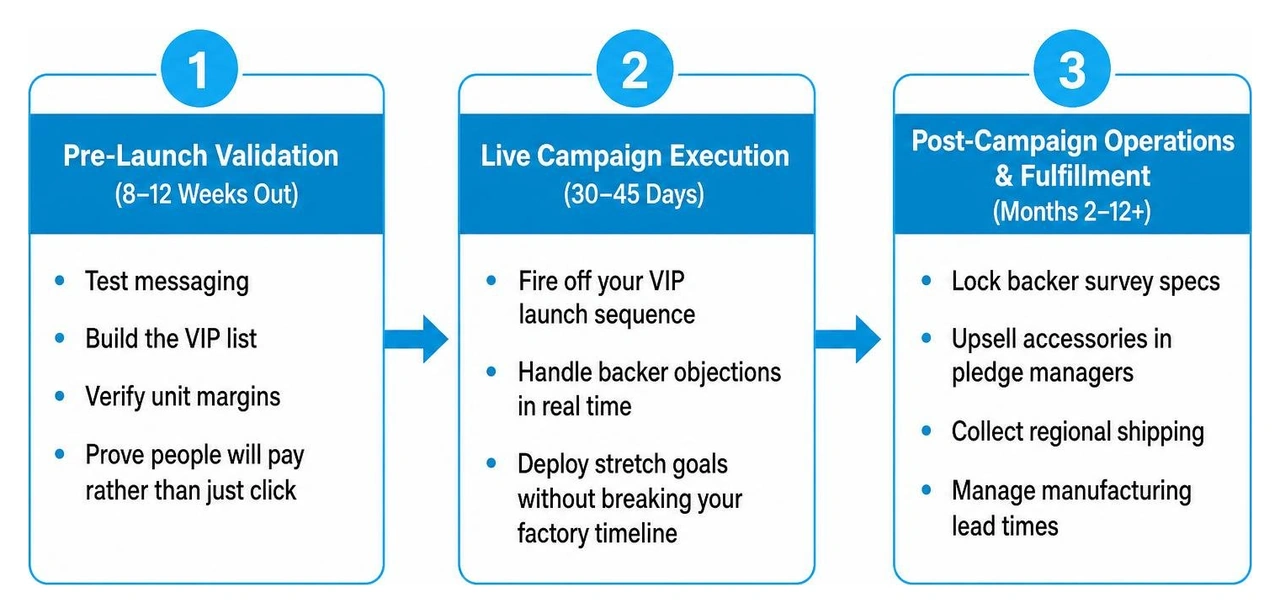
- Test Demand (8–12 Weeks Before Launch): Test your message, build a priority-backer (VIP) list, check profit per unit, and test whether people will pay rather than just click.
- Run the Campaign (30–45 Days): Send your launch emails, answer backer questions, and offer extra rewards at higher funding milestones without delaying production.
- Manage Orders and Delivery (Months 2–12+): Confirm backers’ product choices, offer optional accessories, collect shipping charges by region, and manage manufacturing lead times.
Bottom-Up Financial Modeling and Target Goal Economics
Set a funding goal based on costs, not on what would sound impressive in a press release. A $100,000 goal is not useful unless it covers what you need to produce and deliver the hardware. Build the goal from your actual costs. In the formula below, landed freight means the cost of getting goods to their destination:
Target Goal = (Fixed Tooling Costs + (Unit Production Cost × MOQ) + Landed Freight) / (1 - Platform Fees - Payment Processing Fees - Buffer Margin)
Kickstarter charges a platform fee plus payment processing fees. Check the official fees page for current rates. Always budget a 10% to 15% contingency buffer for component cost fluctuations, prototype revisions, and freight adjustments.
Building a Pre-Launch Audience Ready to Back Your Product
Launching before building an audience puts your campaign at risk. Build a pre-launch list so you have people to contact when the campaign opens, rather than relying only on new visitors.
Use pre-launch email sequences to show what your hardware does for buyers, demonstrate that it works, and build trust before asking them to back it.
Use this formula to estimate the audience size you need. Page conversion rate means the share of campaign-page visitors who pledge:
Target Audience Size = (Target Funding Goal / Average Pledge Value) / Expected Page Conversion Rate
For a planning example, assume an average pledge of $45 and a page conversion rate between 1% and 3%. Use a higher pledge value if that fits your hardware's price. The formula estimates how many campaign-page visitors you need; it does not tell you exactly how many email signups will visit or pledge. Replace these assumptions with your own test results as you collect them.
Reservation Deposits and Priority-Backer Lists
An email signup shows interest. A paid reservation also shows a willingness to pay. Track how many people in each group pledge when your campaign opens, rather than assuming a fixed conversion rate.
A $1 to $5 reservation deposit tied to an early-bird discount or exclusive accessory bundle helps identify people willing to pay. Invite these backers to pledge when the campaign opens.
Integrating the DOSE Framework into Your Crowdfunding Campaign Strategy
When explaining your hardware, lead with what it does for the buyer. Then show the technical specifications that support that benefit. The DOSE Method™ is a strategy framework: Diagnosis (find what’s broken), Prescription (fix the biggest problem first), and Prognosis (set targets, track, adjust). The emotional drivers below help connect technical value to consumer psychology in marketing:
- Dopamine (They Want It): Show the main buyer benefit within the first five seconds of your video. Then demonstrate the capability, design, or workflow that delivers it.
- Oxytocin (They Trust It): Address technical doubts with working, unedited prototype demos, factory visits, printed circuit board (PCB) test benches, and founder credentials.
- Serotonin (They’re Proud of It): Show why early adopters would be proud to support the product and help bring new technology to life.
- Endorphins (They Feel Relief): Show how the product solves a problem. Compare an existing workaround with your solution so buyers can see the difference.
Launch Week: Reaching Backers in the First 48 Hours
Plan how you will reach backers in the first 24 to 48 hours. Strong early backing gives you an initial measure of demand, but it does not guarantee platform placement or campaign success. Track pledges and traffic sources so you can see which outreach brings backers.

A structured product launch marketing plan keeps your messaging focused during the first 48 hours.
Launch-Day Emails, Ads, and Backer Support
- Hour 0 (T-0:00): Email your VIP reservation list with private backer links so they can claim reserved early-bird rewards and pledge.
- Hour 2 (T+2:00): Send your main announcement to the broader waitlist. Share early funding milestones to show that others are backing the project.
- Hour 4–12: Run ads for people who previously visited your page. Post updates to creator communities and social channels.
- Hours 24–48: Review backer comments and support tickets. If multiple backers ask the same technical question, update the campaign FAQ and address it in a project update.
Structuring Reward Tiers, Early-Bird Perks, and Progressive Stretch Goals
Use a short list of clearly different rewards:
- Early-Bird Single Unit (Limited to First 100 Backers): Priced at 20% to 25% below retail to reward your VIP list and encourage early pledges.
- Kickstarter Special Single Unit: Priced at 10% to 15% below retail for standard backers.
- Double Pack / Creator Bundle: Combines two units or popular accessories to increase the average amount each backer pledges.
- Developer / Commercial Tier: Premium bundle with access to a software development kit (SDK), tools and documentation for building software for the device, or commercial licensing.
Reveal stretch goals only after earlier milestones are reached. If you plan milestones 25% to 50% above your base goal, check that each one covers the added production and delivery costs. Set a schedule of 2 to 3 useful updates per week, adjusting it to the news you have to share. In the final 48 hours, remind interested buyers about the deadline. Add a stretch goal only if you can deliver it within your budget and schedule; do not count on it to produce a fixed revenue increase.
Post-Campaign Operations: Surveys, Pledge Managers, and Fulfillment
Hitting 100% of your funding goal is not the finish line. The post-campaign phase determines whether your launch turns a profit or runs into costly fulfillment delays.
Using Backer Surveys to Gather Details and Sell Optional Extras
Use post-campaign surveys to gather delivery details and offer relevant extras. Pledge management tools handle backer orders, add-ons, and shipping details. They let backers select extras while completing a survey. Options can include extra consumables, carrying cases, and premium finishes. Check the cost and production impact of each add-on before offering it; extra revenue does not guarantee extra profit.
Surveys also protect your margins by calculating regional shipping rates, value-added taxes (VAT), and customs duties after funding, safeguarding you against carrier rate increases.
Keeping Hardware Sales Going After the Campaign
After the campaign, direct backers and interested buyers to your online store. Use late-pledge tools, such as Indiegogo InDemand, to accept orders during production. Use ongoing paid advertising to support retail sales.
Campaign Metrics and Common Hardware Launch Mistakes
Track the metrics that matter to your hardware campaign each day. Our guide to tracking marketing results explains how to choose and monitor them.
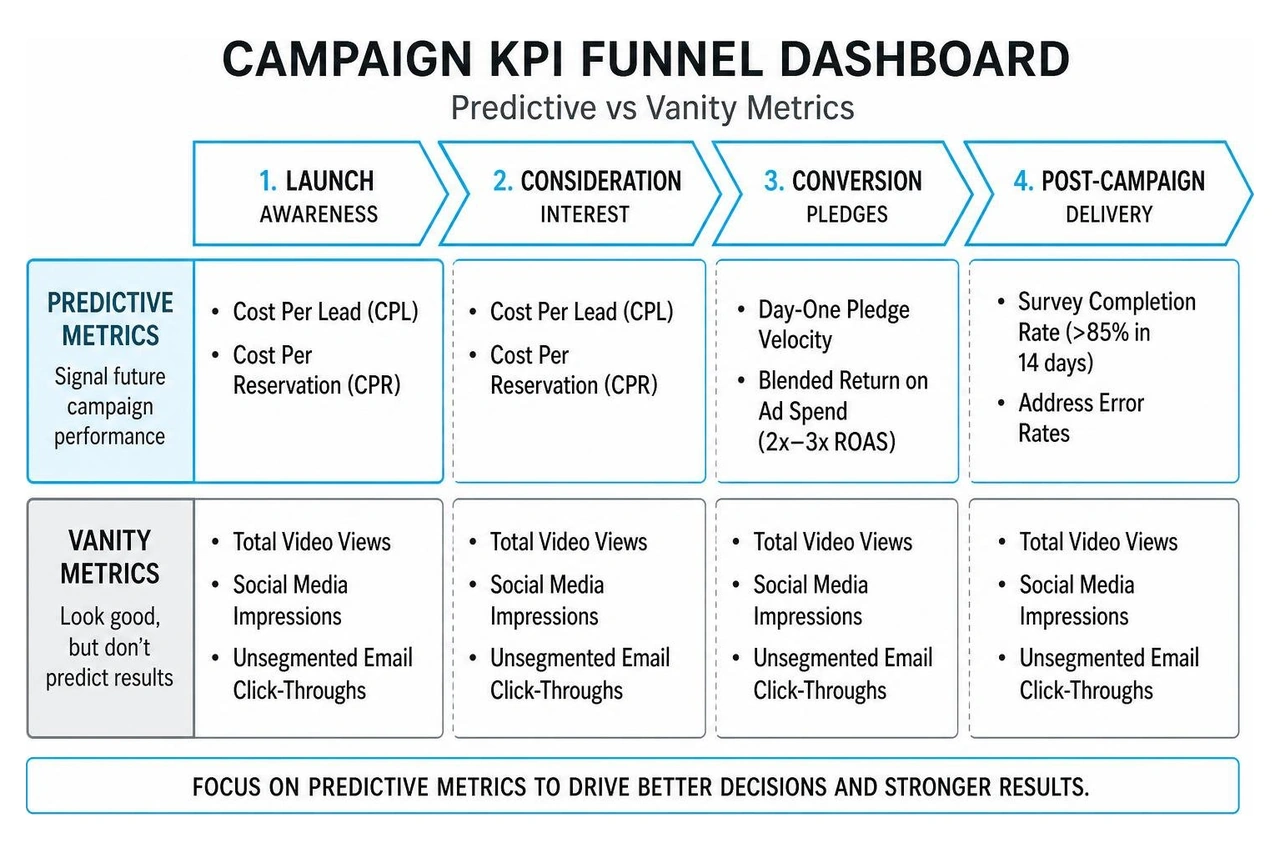
Predictive Metrics vs Vanity Metrics from Launch to Delivery
- Vanity Metrics: Total video views, social media impressions, and email clicks that are not grouped by audience or source. These counts alone do not show who will pledge.
- Predictive Metrics: Cost Per Lead (CPL), Cost Per Reservation (CPR), Amount Pledged on Launch Day, Revenue per Dollar Spent Across All Ads, Survey Completion Rate, and Address Error Rates. Use 2–3 times ad spend and more than 85% survey completion within 14 days as planning targets, not guaranteed results. Check whether your advertising target covers production and fulfillment costs.
Seven Operational Pitfalls That Derail Hardware Launches
- Launching Without an Audience: Expecting people to discover your campaign through the platform without an existing waitlist.
- Underestimating Landed Freight Costs: Failing to budget for ocean freight, warehousing, and regional fulfillment.
- Offering Too Many Complex Reward Tiers: Creating dozens of product variants that slow factory production.
- Mid-Campaign Silence: Failing to post updates during the middle of the campaign, causing backer interest to fade.
- Premature Stretch Goals: Offering complex hardware revisions that require complete circuit board redesigns or new tooling.
- Inadequate Manufacturing Buffers: Promising delivery dates without allowing extra time for tooling and regulatory testing. Use a 25% timeline buffer as a planning assumption, then check it against supplier estimates and testing requirements.
- Ignoring Backer Support Tickets: Neglecting comment threads and backer concerns during the live campaign.
Track these metrics and address these risks to help maintain backer interest, protect margins, and keep delivery on schedule.
Frequently Asked Questions About Crowdfunding Launches
How long should the pre-launch phase run before going live?
Plan for 8 to 12 weeks as a starting point. Use that time to test ads, improve landing pages, and build a reservation list while keeping early signups engaged. Adjust the schedule based on what your tests show and whether your product is ready.
What funding percentage should a campaign hit in the first 48 hours?
Target hitting at least 30% to 50% of your funding goal within the first 48 hours. Reaching this milestone signals strong demand to platform algorithms, boosting your rank on category discovery pages.
How do reservation deposits compare with standard email waitlists?
An email signup shows interest. A $1 to $5 reservation deposit also shows a willingness to pay. Neither guarantees a pledge. Track the share of each group that backs your campaign and use your own results to plan future outreach.
Conclusion
A hardware crowdfunding launch needs planning, a clear understanding of revenue and costs per unit, and steady work across all three phases. Test customer demand before building the page, ask priority backers to pledge on launch day, and manage delivery after the campaign. These steps can help turn early backers into customers who recommend your product.
At CRISPx, we plug in as your complete marketing and sales team so you do not need to hire a head of marketing. Whether you are validating a prototype or ramping up factory lines, we support technical founders across our Launch, Grow, Grow + Ads, and Scale plans.
Our hardware experience includes:
Tony Crisp has 30 years in branding, 100+ hardware launches and 8+ patents. Robosen Optimus Prime went from Kickstarter to CES, then Hasbro and Disney licenses. FuzeDrive ran a top 1% Indiegogo campaign. SecureCircle was acquired by CrowdStrike.
Ready to build momentum for your hardware launch? Get your free DOSEscore™ brand checkup to review your website and story, or book a strategy call with our team today.
Get a free brand checkup.
We work like a brand doctor. The DOSE Method™ finds what's broken, fixes the biggest problem first, then tracks the results.
