

Ultimate Checklist for Comparing Branding Packages for Startups

Learn how to compare branding packages for startups with this checklist covering strategy, deliverables, pricing, and IP terms.
How Do You Define Your Business Problem Before Comparing Branding Packages?
Knowing how to compare branding packages for startups starts with evaluating each proposal against four criteria: strategic foundations, normalized deliverables, pricing model risk, and intellectual property terms. Start by defining the exact business problem you need to solve. Most founders begin by reviewing agency portfolios, but evaluating aesthetic appeal without clear commercial criteria leads to poor decisions. A flashy visual package will not fix a product narrative that customers fail to understand.
At CRISPx, we approach this through the lens of Diagnosis in The DOSE Method™: you must find what is broken before prescribing a solution. In technical hardware and engineering-led ventures, the breakdown usually falls into one of three core problems:
- The launch falls flat: The product is built and ready to ship, but the story is missing, prelaunch waitlists are empty, and early campaigns lack momentum.
- Growth stalls: Sales spike during an initial crowdfunding or press push, but ongoing demand drops because the brand lacks long-term positioning.
- People don't get it: The website and pitch decks read like dense spec sheets rather than compelling commercial solutions.
To evaluate proposals effectively, map the emotional drivers your brand must unlock across your buyers and investors:
- Dopamine (they want it): Anticipation and desire sparked by bold market differentiation and clear product benefits.
- Oxytocin (they trust it): Credibility established through professional design systems, cohesive messaging, and transparent reliability.
- Serotonin (they're proud of it): Status and validation that make early adopters and enterprise champions eager to associate with your technology.
- Endorphins (they feel relief): The reduction of friction and cognitive load when complex engineering is translated into simple, intuitive outcomes.
Structuring your foundational brand strategy before commissioning visual assets ensures that creative teams design around commercial positioning rather than subjective taste. Running structured branding exercises for startups with your founding team clarifies your competitive green space and target audience well before design production begins.
Clarifying the Core Commercial Need
Differentiate between launch enablement, category repositioning, and customer acquisition support. If your goal is securing seed funding, your package must focus heavily on investor pitch deck templates, concise messaging frameworks, and clean digital credibility. If you are preparing for direct-to-consumer pre-orders or enterprise pilot deployments, your scope must prioritize website UI components, sales enablement collateral, and packaging specifications.
Document this single primary commercial objective at the top of your evaluation sheet. If a vendor proposal fails to address your primary commercial bottleneck directly, it is the wrong package regardless of how polished its visual portfolio appears.
Strategy-First Methodology vs. Production-Only Design
A common mistake is buying production assets without strategic discovery. A logo alone cannot clarify an ambiguous value proposition or identify which customer segment delivers the highest lifetime value.
A strategy-first package includes stakeholder interviews, competitor messaging audits, customer perception mapping, and value proposition testing. Establishing these strategic pillars first helps reduce the risk of costly rebrands later.
What Is the Difference Between a Logo and a Full Brand Identity System?
Founders often assume that hiring a designer for a logo checkmark completes their branding. In practice, buying an isolated graphic creates immediate design debt.
Design debt occurs when your team possesses a logo mark but lacks rules for layouts, typography, interface states, or marketing collateral. Every time an engineer builds a landing page or a sales lead crafts a proposal, they are forced to invent design rules on the fly. Within months, your public touchpoints become disjointed and unprofessional.
To build lasting commercial value, founders must stop buying logos and start hiring a tech branding agency that builds scalable systems. Systematic logo and brand identity design delivers an interconnected toolset that guides internal teams and external partners on how your brand looks, speaks, and behaves. When developing your brand identity, you ensure every technical spec sheet, product badge, and web page reflects consistent engineering precision.
Core Components of a Complete Visual Identity System
When comparing proposals, verify that the visual identity scope contains the following foundational assets:
- Comprehensive Logo Suite: Primary logo, secondary horizontal and stacked orientations, responsive sub-marks for small digital displays, and dedicated app or hardware icon files.
- Typography Hierarchy: Primary headline typefaces, functional body fonts, monospace technical styling rules, web-safe fallback fonts, and licensing guidance.
- Semantic Color Palette: Primary brand hues, secondary accent tones, background neutrals, and functional UI tokens (success green, warning amber, error red) with complete HEX, RGB, CMYK, and Pantone values.
- Living Brand Guidelines: A digital style system covering clear space rules, minimum reproduction sizes, improper usage examples, and real-world hardware or software application mockups.
Verbal Identity and Messaging Hierarchy
Visual assets represent only half of a complete brand system. Technical founders often struggle with websites that read like spec sheets rather than customer solutions. A complete brand package must supply a verbal identity system that translates technical features into buyer value:
- Positioning Statement & Taglines: Clear, defensible definitions of what you build, who it serves, and why your approach wins.
- Elevator Pitches: short, medium, and detailed narrative summaries for sales calls, investor meetings, and press inquiries.
- Feature-to-Benefit Translation Matrix: A structured framework converting processing capabilities, sensor tolerances, and firmware performance into commercial customer outcomes.
- Voice and Tone Rules: Specific parameters defining how your brand communicates across technical documentation, investor updates, marketing campaigns, and customer support.
What Essential Deliverables and Strategic Assets Should Every Startup Package Include?
To evaluate branding packages objectively, assess deliverables by practical operational utility rather than proposal page counts. A slide deck filled with abstract brand mood imagery may be less useful than a lean, functional Figma component library and production-ready marketing assets.
When evaluating brand identity deliverables, explore end-to-end scope options in our ultimate branding packages guide startups and review how structured brand development services support rapid market deployment.
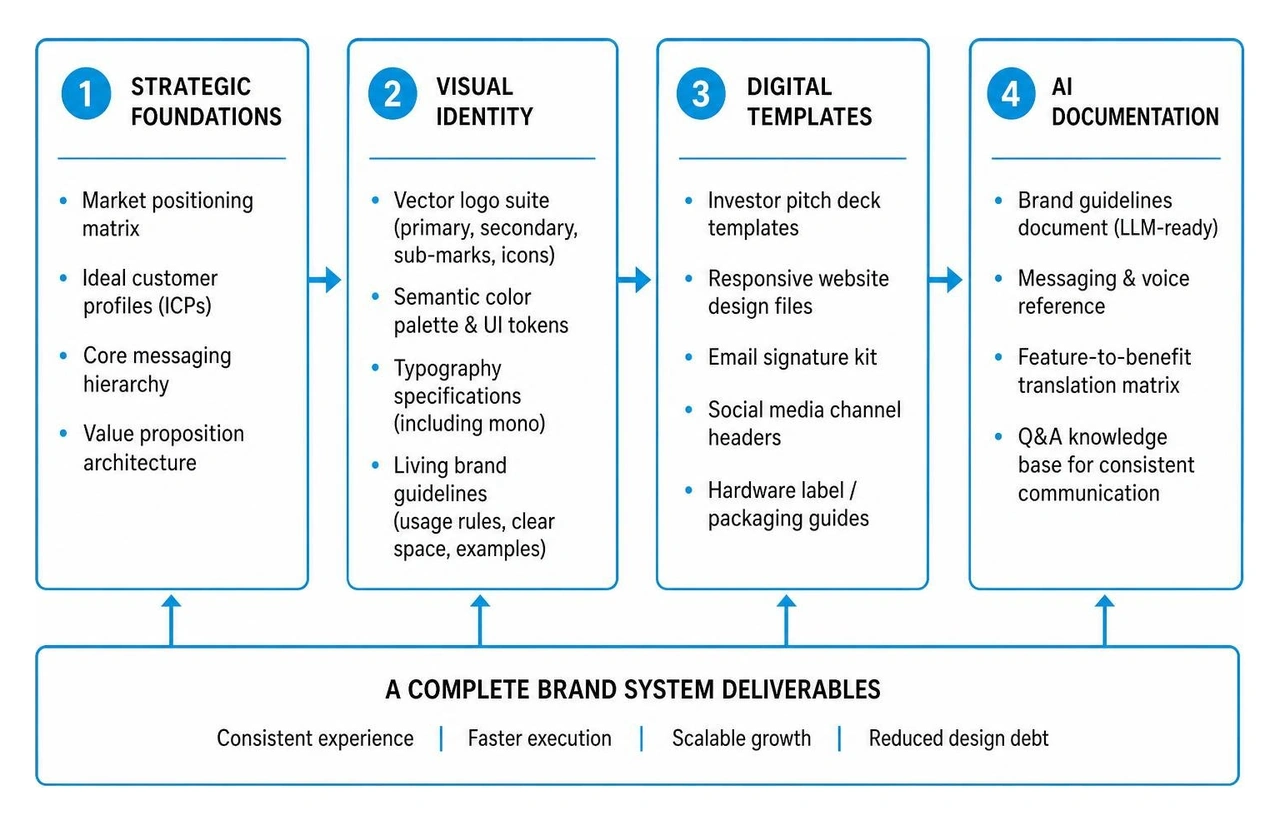
A comprehensive startup branding package should provide tangible assets across four distinct tiers:
- Strategic Foundations: Market positioning matrix, ideal customer profiles (ICPs), core messaging hierarchy, and value proposition architecture.
- Core Visual Assets: Vector logo package, semantic color library, typography specifications, and brand guideline documentation.
- Go-To-Market Collateral: Investor pitch deck templates, responsive website design files, email signature kits, social media channel headers, and hardware label or packaging guides.
- Machine-Readable Documentation: AI-ready data files, structured product summaries, and prompt instructions that ensure generative search engines index your brand accurately.
Production-Ready File Formats and Component Libraries
Ensure your proposals explicitly state which file formats and digital environments will be delivered at handoff. For modern startups, deliverables should include:
- Vector Master Files: Scalable AI, EPS, and SVG source files that allow infinite scaling from PCB silkscreens to trade show booths.
- Digital & Web Exports: High-resolution transparent PNGs, web-optimized WebP files, and favicon suites.
- Figma UI Libraries: Shared Figma component files organized with auto-layout, color tokens, and typographic styles that developers can immediately inspect and implement.
- CSS-Ready Tokens: Formatted style variables (JSON or CSS) that software teams can drop straight into front-end repositories.
AI-Ready Brand Assets and Technical Documentation
In modern go-to-market environments, buyers increasingly discover hardware and software solutions through AI search platforms and conversational models. Your branding package should prepare your startup for this reality by delivering structured brand data.
This includes building a dedicated BRAND.md file, standardized company overviews, and structured prompt instructions. These assets ensure that AI agents, search algorithms, and content generators describe your product specifications, category positioning, and technical capabilities with complete accuracy.
How Do You Normalize Scope and Evaluate Pricing Models Across Proposals?
When reviewing proposals from multiple creative firms or independent teams, you will likely encounter vastly different terminology, timeline estimates, and fee structures. Normalizing scope across a standardized matrix is the only reliable way to compare proposals side by side.
Use a structured branding agency due diligence checklist to evaluate every vendor against identical criteria.
| Pricing Model | Budget Predictability | Scope Flexibility | Strategic Depth | Startup Risk Level | Best Suited For |
|---|---|---|---|---|---|
| Fixed Project Fee | High | Low | Moderate to High | Low to Moderate | Defined, one-off brand identity projects with clear initial scopes |
| Phased Fixed-Fee | High | Moderate | High | Low | Early-stage startups managing capital across defined milestones |
| Subscription / Embedded | High | High | High | Low | Fast-moving startups needing continuous marketing and demand generation |
| Hourly / Day Rate | Low | High | Variable | High | Open-ended exploration or minor ad-hoc production tasks |
Pricing Models: Fixed Project, Phased Fixed-Fee, Subscription, and Retainer
Understanding how a partner bills reveals what their operational model optimizes for:
- Fixed Project Fee: You pay a single pre-agreed sum for a defined deliverable checklist. This protects your budget, but any mid-project adjustments or scope expansions will trigger formal change orders and additional fees.
- Phased Fixed-Fee: The project is split into distinct stages (e.g., Phase 1: Strategic Positioning, Phase 2: Visual Identity, Phase 3: Launch Collateral). This reduces early capital risk by allowing you to review strategic outputs before committing to production design.
- Subscription or Embedded Marketing Model: An outsourced team integrates directly into your operations on a recurring basis. This model eliminates the gap between design handoff and real-world execution, providing ongoing support across sales collateral, web updates, and marketing campaigns.
- Hourly and Day Rates: You pay purely for hours spent. This model creates substantial financial uncertainty for early-stage companies, as unexpected creative iterations can rapidly drain available runway.
Identifying Hidden Costs and Missing Line Items
Low initial proposals frequently exclude critical items required to bring a brand to life. When auditing proposals, check whether the following items are included or billed separately:
- Commercial Font Licensing: Commercial web and desktop font licenses can add significant annual software overhead if custom boutique typefaces are specified without disclosure.
- Stock Photography & 3D Assets: Custom 3D CAD rendering, motion graphics, and stock photography libraries are often excluded from base creative fees.
- Trademark Screening: Pre-screening brand names or visual marks against trademark registries such as the United States Patent and Trademark Office is rarely included in basic design proposals.
- Developer Implementation Support: Clarify whether the agency will coordinate directly with your web developers to resolve visual bugs and inspect asset implementation.
What Red Flags, Handoff Terms, and Feedback Mechanics Should You Audit Before Signing?
The commercial terms within a branding contract protect your runway, intellectual property, and go-to-market timeline. Auditing these operational details before signing prevents project delays and disputes.

A comprehensive brand protection strategy begins by building corporate identity on rock-solid contractual terms.
Contractual Revision Rules and Feedback Consolidation
Unclear revision policies are the leading cause of creative friction and timeline slippage. Examine the contract for how iterations are structured:
- Number of Iteration Cycles: Packages may include a defined number of formal revision rounds per phase. Ensure the contract defines what constitutes a revision (refining an approved concept) versus a scope change (demanding entirely new conceptual directions).
- Consolidated Feedback Windows: Contracts should specify a single point of contact on your founding team who consolidates internal stakeholder input into one clear brief. This prevents conflicting feedback from engineering, sales, and investors from stalling the creative workflow.
- Turnaround Expectations: Ensure the agreement outlines clear delivery windows for how quickly the creative team must return updated assets following feedback submissions.
IP Ownership, Source Files, and Warranty Terms
Verify that your agreement grants full, unencumbered ownership of all deliverables upon final milestone payment:
- Complete Copyright Assignment: The contract must explicitly state that full intellectual property, copyright, and commercial usage rights transfer to your startup upon invoice settlement.
- Native Source File Delivery: Ensure you receive fully editable master files (e.g., layered Figma files, native Illustrator vectors) rather than flattened, read-only exports.
- Technical Warranty: Negotiate a post-handoff warranty window. If your development team discovers corrupt vector files, missing export dimensions, or color rendering errors during implementation, the agency must correct them promptly at no additional cost.
How Do You Match a Branding Package to Your Startup's Stage and Execution Model?
Selecting the right branding package requires matching scope to your current funding, operational maturity, and commercial milestones. Investing in enterprise-tier brand architecture before validating product-market fit wastes capital; conversely, launching a complex hardware product with a generic freelance logo undermines investor and customer trust.
Stage-Based Scope Matching
- Pre-Seed / Prototype Stage: Focus on core positioning, a clean primary logo, semantic color definitions, and an investor-ready pitch deck template. The goal is establishing basic market credibility for angel and venture conversations.
- Seed / Prelaunch Stage: Expand your scope to include full verbal messaging systems, responsive web design files, waitlist conversion pages, trade show booth graphics, and packaging guidelines. Review our framework for branding startups to align visual identity with launch execution.
- Series A / Scaling Stage: Implement complete multi-tier design systems, comprehensive sales enablement collateral, automated marketing templates, and a complete b2b brand strategy complete guide designed to support multi-channel expansion.
Embedded Marketing Team vs. One-Off Agency Engagements
Traditional creative agencies produce static brand books and deliver them as one-off projects. For fast-moving hardware and engineering startups, static handoffs often break down the moment live marketing, crowdfunding, or sales execution begins.
CRISPx (Newport Beach, CA, since 1992) operates differently. We plug in as the founder's dedicated, outsourced marketing and sales team, eliminating the immediate need to hire an internal head of marketing. Our core positioning is simple: "You build the product. We build the demand."
We offer one subscription across four clear plans: Launch, Grow, Grow + Ads, and Scale.
CRISPx cites experience across hardware, electronics, robotics, and defense:
- Robosen Optimus Prime went from Kickstarter to CES, then Hasbro and Disney licenses.
- XFX became an NVIDIA graphics card partner.
- FuzeDrive launched an Indiegogo campaign.
- SecureCircle was acquired by CrowdStrike.
The DOSE Method™ combines Diagnosis (find what's broken), Prescription (fix the biggest problem first), and Prognosis (set targets, track, adjust) with hands-on demand generation to guide work from prelaunch through long-term scale.
Frequently Asked Questions About Startup Branding Packages
How Many Branding Proposals Should a Startup Compare Before Deciding?
Startups should review several structured proposals to compare market rates, creative approaches, and scope. Reviewing too many can create decision paralysis and administrative friction without improving the final strategic outcome.
What Is the Biggest Risk of Choosing a Low-Cost Logo Package?
The primary risk is accumulating design debt. An isolated logo mark lacks typography rules, color tokens, and layout systems, forcing your team to improvise design decisions across sales decks and web pages. This leads to disjointed customer touchpoints and often requires an emergency rebrand within twelve months, costing far more in lost momentum and replacement fees.
How Does a Comprehensive Branding Package Impact Seed-Stage Fundraising?
A professional, cohesive brand identity establishes immediate operational credibility. Investors understand that how you present your company reflects how you build your technology. Clear positioning and polished design reduce cognitive friction, helping venture partners grasp your value proposition and market opportunity within seconds.
Conclusion
Comparing branding packages requires moving past subjective visual portfolios and evaluating proposals with operational rigor. By defining your core commercial challenge upfront, normalizing deliverable scopes across a standard matrix, auditing pricing models for hidden costs, and securing full intellectual property ownership, you ensure your startup partners with a team that builds measurable demand.
At CRISPx, we act as your outsourced marketing and sales team across our Launch, Grow, Grow + Ads, and Scale plans, translating complex engineering breakthroughs into market leadership.
Ready to see how your current brand positioning and digital presence perform? Get your free DOSEscore™ brand checkup to evaluate your website and story, or book a strategy call with our team today.
Get a free brand checkup.
We work like a brand doctor. The DOSE Method™ finds what's broken, fixes the biggest problem first, then tracks the results.