

Position Your Technical Product for Enterprise Deals
Enterprise hardware deals need proof for each buyer: business outcomes for executives, technical evidence for engineers, and easy setup for end users. Position your product so each group finds it fast.
Core Pillars of Brand Strategy for Technical Companies
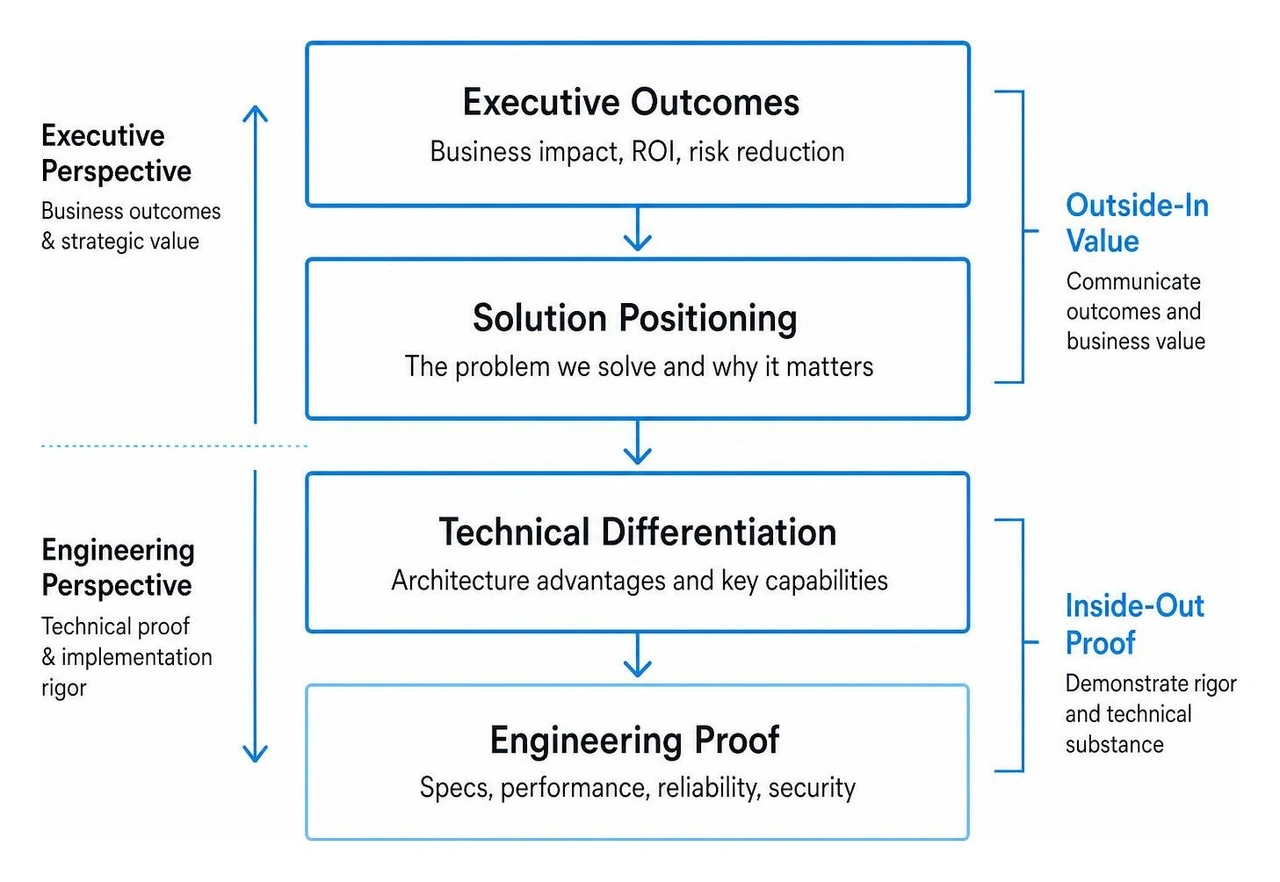
When an enterprise considers your technology, features are just the cost of admission. True differentiation comes from how clearly you communicate the problem you solve and the rigor behind your claims.
A clear B2B brand strategy connects how your product works to why buyers should choose it.
Inside-Out Specs vs Outside-In Value
Most technical founders build from the ground up, so they naturally explain their products the same way: microcontrollers, throughput rates, and clock speeds. This inside-out perspective creates a classic disconnect where people don't get it because the site reads like a spec sheet.
Outside-in positioning flips this dynamic. It starts with the buyer's day-to-day problems and presents your technical features as the direct solution to those problems.
Instead of burying buyers under raw specifications, lead with the operational outcome and back it immediately with your engineering data. This approach respects the intelligence of technical buyers while giving business stakeholders a clear reason to approve the purchase.
Establishing Evidence-First Technical Credibility
Engineers are naturally skeptical of marketing language. Buzzwords like "revolutionary" or "next-generation" read as red flags that suggest a lack of substance. To earn credibility, use evidence-first messaging that treats technical facts as the foundation of your brand.
When building brand identity, your core visual and written assets should highlight concrete data, clear schematics, and verifiable benchmarks.
| Element | Feature-Led Messaging | Evidence-First Positioning |
|---|---|---|
| Headline | "Ultra-fast robotic control platform" | "Sub-2ms loop closure for multi-axis robotic arms" |
| Primary Proof | Abstract bullet points and marketing claims | Published step-response benchmarks and raw test data |
| Visual Language | Stock photos of circuit boards and blue light trails | Unedited hardware photography, wiring pinouts, and architecture diagrams |
| Validation | Generic claims of enterprise readiness | Documented mean time between failures (MTBF) and third-party laboratory certifications |
Clear diagrams and transparent testing protocols prove your product works as advertised, turning technical depth into a competitive advantage.
Navigating the Multi-Stakeholder Buying Committee
Enterprise hardware and technical software purchases are rarely made by a single person. They involve a buying committee with different roles:
- The Economic Buyer (CFO / VP Operations): Focuses on total cost of ownership, deployment speed, and risk reduction.
- The Technical Evaluator (VP Engineering / Lead Architect): Evaluates integration limits, architectural safety, and documentation depth.
- The End User (Embedded Engineer / Line Technician): Cares about daily ergonomics, software toolchains, and clear error logging.
Map what each buying committee member needs, then build pages and documents for all three groups. Your homepage should explain the business value for executive buyers. Give engineers a clear path to the detailed technical documentation they need to evaluate your product.

Stage-by-Stage Evolution: Seed to Scale
A technical brand is not static. As your company grows from early validation to enterprise expansion, your positioning must shift to match your commercial goals.
Pre-Seed and Seed: Minimal Viable Positioning
At the earliest stages, founders often spend time creating detailed brand guidelines before confirming that buyers want the product. When branding startups, focus on a clear, basic explanation of your product:
- The Core Problem: Define the single operational bottleneck you solve.
- The Mechanism: Clearly state the technical mechanism that makes your solution possible.
- The Early Adopter: Focus squarely on the specific engineering teams willing to test an early-stage solution.
Your early brand should center on founder credibility and technical honesty. Avoid complicated corporate posturing; focus on building a direct, peer-to-peer connection with your earliest adopters.
Series A to Series B: Keeping Product Names, Design and Evidence Consistent
Once you secure product-market fit, enterprise scale brings new challenges. Your marketing must move beyond early adopters to conservative enterprise buyers who require proof of company stability and long-term support.
At this stage, define your brand architecture: how your company name and product names fit together. You also need:
- A consistent design system across your marketing pages and physical product interfaces.
- Clear setup steps and developer documentation that help engineers build their first prototype.
- Consistent sales documents that give people recommending your product the data they need to justify the purchase to their CFO.
Growth and Scale: Managing Names and Design Across Products
As your product line expands, acquisitions and new product versions can clutter your core message. Without clear product names and groupings, buyers can struggle to find the product that matches their technical requirements.
Use regular brand reviews to keep the relationship between your company, product lines and sub-assemblies clear. Consistent names and interface designs help buyers recognize your products. They also help buyers in other departments understand which products fit their needs.
Adapting Your Message to Different Hardware Markets
Different technical sectors carry distinct buyer mindsets, regulatory hurdles, and proof requirements.
Implementing Brand Strategy for Technical Companies Across Deeptech and Hardware
Deeptech products rely on advanced scientific or engineering research. Like robotics and embedded systems, they can take years to develop. Without working demonstrations or test data, early claims can sound like promises of products that do not yet work.
When executing a tech product launch, build your narrative around tangible evidence:
- Physical Product Quality: Use real photos showing exact enclosures, connectors and mounting points rather than polished 3D concept images.
- Developer Experience (DX): Treat command-line interface (CLI) output, application programming interface (API) endpoints and hardware setup guides as key parts of how developers experience your product.
- Evaluation Hardware: Give development kits the same care as the finished product, with clear quick-start guides and helpful error messages.
Explaining Software, AI and Security in Hardware Products
For hardware with software, AI or security features, show buyers what those features do. Support each claim with specific evidence.
- Cybersecurity: Go beyond compliance checkboxes and fear-based messaging. Show how your product addresses daily security problems, such as reducing the alerts a security team must review.
- Artificial Intelligence: Avoid vague claims about "intelligent automation." Explain your model architecture, limits when running on the device, time to return a result, and data privacy boundaries.
- Embedded Software: Show how reliably the software runs, whether it behaves predictably under the same conditions, and how it fits existing development workflows. Explain these benefits in your software marketing.
Measuring Brand Impact and Avoiding Rebranding Pitfalls
A clear, trusted hardware brand can help buyers evaluate your product, shorten sales discussions and understand its price.
How to Measure Whether Your Brand Helps Sales
To track brand performance over time, use marketing analytics to look for early signs of sales progress:

- Time from Demo to Approval: How quickly qualified technical opportunities move from initial demo to proof-of-concept (POC) sign-off.
- Request-for-Proposal (RFP) Win Rates: The percentage of competitive proposals won without relying on discounting.
- Searches for Your Brand and AI Mentions: Track how often buyers search for your company by name and how often AI search tools mention it in relevant answers.
- Engineering Hiring Speed: Track how long it takes to hire senior engineers, the qualifications of applicants and the share who move through each hiring stage.
The Most Common Traps in Brand Strategy for Technical Companies
When technical firms invest in rebranding, they frequently fall into a few common traps:
- Futuristic Visual Effects: Overusing dark-mode neon gradients, floating digital particles and abstract geometric shapes. These effects do not show buyers whether your hardware works reliably.
- Copying Big Tech: Adopting the minimalist, lifestyle-focused marketing of consumer tech giants. Large consumer companies already have widely recognized brands. An emerging B2B brand needs immediate clarity and concrete proof.
- Planning Too Much Too Soon: Spending months refining product-line names and detailed design rules before confirming that buyers want the product.
- Neglecting Developer Tools and Documentation: Polishing the corporate website while leaving documentation, API references and error messages unorganized and outdated.
A specialized branding agency for tech companies can help you avoid these traps by explaining what your hardware does instead of following design trends.
Frequently Asked Questions About Tech Brand Strategy
Why do engineering-led companies struggle with differentiation?
Engineering teams are trained to focus on objective functional specifications. This inside-out mindset leads companies to describe how a system is built rather than what problem it solves for the enterprise.
When every competitor lists similar technical specifications, buyers may negotiate on price or choose the most established supplier. To stand out, start with the buyer's problem and show how your technical specs support a useful business result.
What is the role of developer experience in brand perception?
For technical products, developer experience shapes how engineers judge your brand. A polished marketing site cannot make up for a buggy software development kit (SDK), incomplete documentation or vague command-line interface (CLI) error codes. Give engineers tools and instructions they can rely on.
Give code samples, setup workflows and GitHub repositories the same care you give the public marketing site.
How do technical brands optimize for Answer Engine Optimization (AEO)?
Enterprise buyers increasingly evaluate new hardware and infrastructure tools using large language models and conversational search engines.
Publish structured, factual documentation and detailed comparison guides to help AI tools describe your products accurately. Maintain clear BRAND.md reference files that explain how your technology works, list system specifications, and state exact integration requirements for automated tools to read.
Conclusion: Help Buyers Understand and Trust Your Hardware
A great technical product is only half the battle. If your marketing leads with an unstructured list of features, the launch falls flat because the story isn't ready. If you rely entirely on early tech enthusiasts, growth stalls after launch as mainstream buyers fail to understand your value.
Scaling an enterprise technical brand requires treating your positioning with the same engineering discipline you bring to your product.
At CRISPx, we use The DOSE Method™ as a strategy framework to connect what your hardware does with what buyers need:
- Diagnosis: Find where your message breaks down, whether the launch fell flat, growth stalled or the site reads like a spec sheet.
- Prescription: Fix the biggest problem first. Connect each technical claim to a buyer benefit you can demonstrate.
- Prognosis: Set clear performance targets, track how quickly deals progress and adjust your pages and sales materials over time.
Use these four emotional drivers to plan what each buyer needs to see:
- Dopamine (They Want It): Lead with a clear business outcome that shows executives why the product matters.
- Oxytocin (They Trust It): Provide data sheets and schematics with concrete evidence engineers can check.
- Serotonin (They're Proud of It): Give people recommending your product the data and evidence they need to present the business case to their executive team.
- Endorphins (They Feel Relief): Provide clear developer setup steps and documentation that help engineers work through integration problems.
Tony Crisp has 30 years in branding, 100+ hardware launches and 8+ patents. Robosen Optimus Prime went from Kickstarter to CES, then Hasbro and Disney licenses. FuzeDrive ran a top 1% Indiegogo campaign. SecureCircle was acquired by CrowdStrike.
We plug in as your marketing and sales team, handling marketing and sales for engineer founders so you do not need an internal head of marketing. Our plans are Launch, Grow, Grow + Ads and Scale. We help buyers understand what your hardware does and why it matters.
Evaluate how your technical positioning performs with prospective buyers. Get your free DOSEscore™ brand checkup to audit your website and brand narrative, or book a strategy call with our team today.
Get a free brand checkup.
We work like a brand doctor. The DOSE Method™ finds what's broken, fixes the biggest problem first, then tracks the results.
