The Definitive Guide to Digital Marketing for Technology Companies
Discover the ultimate marketing strategy for software development companies. Build brands, generate leads, and scale growth with expert SEO, PPC, and AI tactics.


Discover the ultimate marketing strategy for software development companies. Build brands, generate leads, and scale growth with expert SEO, PPC, and AI tactics.


A marketing strategy for software development companies must address several interconnected challenges:
Building software is one thing. Selling your services is entirely different.
The software development market faces a unique paradox. While demand for custom software, apps, and digital platforms continues to surge—with the global independent software vendors (ISVs) market estimated to grow by $2.05 trillion from 2024-2028—standing out has never been harder.
The traditional approach of relying on word-of-mouth and basic brochure websites no longer works. Research shows that 83% of shoppers use online research before making purchasing decisions, and tech buyers are even more rigorous in their evaluation process.
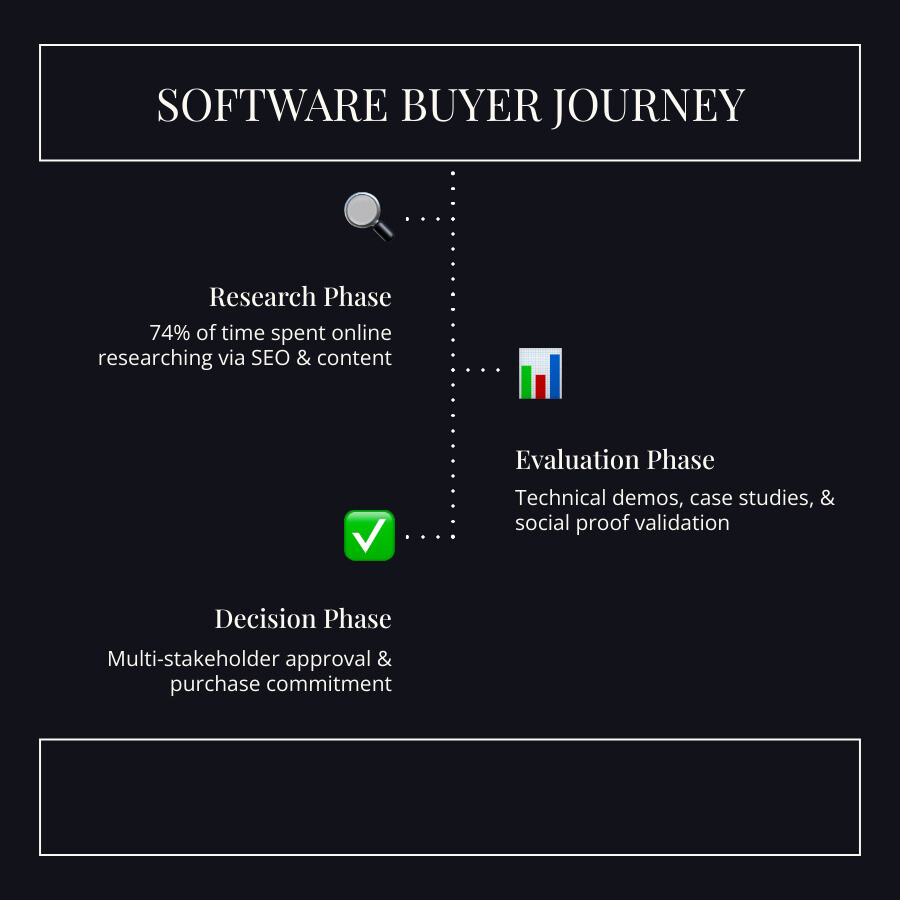
The buyer journey in B2B software isn't obvious. The person using your software often isn't the one approving the purchase. You need to simultaneously target developers who will use your solution, technical influencers who recommend tools, procurement managers who compare vendors, and C-suite executives who sign contracts.
Most software development companies make the same mistake: they try to be everything to everyone. They describe themselves with generic phrases like "we build custom software" or "full-stack development services"—language that blends into a sea of identical competitors. Without a clearly defined niche or unique value proposition, you're forced to compete primarily on price.
Digital marketing enables what traditional methods cannot: real-time measurement, precise audience segmentation, and the ability to reach geographically dispersed decision-makers. But success demands an integrated system of marketing techniques, not isolated tactics. High-growth software firms don't just run ads or post on social media—they build comprehensive marketing engines where content marketing, SEO, paid advertising, community engagement, and social proof work together.
Another critical challenge: conveying technical complexity without overwhelming prospects. Software products are intangible and complex by nature. Your marketing must clearly communicate value propositions in simple language while maintaining the technical credibility that developers demand. Overly technical jargon alienates business decision-makers, while oversimplified messaging loses the trust of technical evaluators.
The market moves fast. Automation and AI create a two-sided impact: they enable faster service delivery and better offerings, but they also lower barriers to entry for new competitors. What worked last year may not work today.
I'm Tony Crisp, founder of CRISPx, and I've spent over two decades developing marketing strategy for software development companies ranging from tech startups to Fortune 500 organizations including Nvidia, HTC Vive, and NTS Element U.S. Space & Defense. This guide distills what actually works based on real-world results, industry research, and proven frameworks.
In the tech world, your brand isn't just a logo; it's the sum of your technical authority and the trust you build with your audience. At CRISPx, we use our LaunchX framework to help companies move from being "just another dev shop" to becoming a recognized industry leader. The foundation of any successful marketing strategy for software development companies is B2B brand building that balances emotional resonance with technical precision.
Technical credibility is the "ante" to get into the game. Developers and CTOs are your primary gatekeepers, and they have a built-in radar for "marketing fluff." To win them over, you need to build a robust developer marketing plan that prioritizes documentation, clean code examples, and transparent processes. Your Developer Experience (DX) is actually a marketing asset. If your API documentation is messy or your onboarding is friction-heavy, no amount of clever advertising will save your conversion rate.
Brand storytelling in software isn't about making things up; it's about humanizing the complex. Instead of listing "Java, Python, and AWS" as your primary features, tell the story of how you helped a healthcare startup scale to handle a 500% increase in patient data without a second of downtime. This moves the conversation from "what you do" to "the impact you create." For more specialized insights, check out our branding agency for tech companies page.
Trying to sell to everyone is a recipe for being ignored by everyone. To stand out, you must define your Total Addressable Market (TAM), Serviceable Addressable Market (SAM), and Serviceable Obtainable Market (SOM). By narrowing your focus—for example, becoming the premier MVP development company for Fintech startups—you drastically reduce your competition.
A compelling Unique Value Proposition (UVP) is what makes a prospect choose you over a cheaper offshore alternative. Are you faster? More secure? Do you have deep domain expertise in HIPAA compliance? Statistics show that 86% of buyers are willing to pay more for a great customer experience and specialized expertise. When you solve a specific, painful problem better than anyone else, you move away from price-wars and into value-based partnerships. This is a core component of a successful tech product launch.
Once your brand foundation is solid, it's time to scale. Our OrbitX methodology focuses on growth marketing that leverages psychology to turn visitors into long-term partners. We don't just look at traffic; we look at the psychological triggers that move a B2B decision-maker through the funnel.
The data is clear: tech shoppers spend 74% of their time researching online versus only 26% offline. This means your digital footprint must be meticulously designed to answer their questions before they ever pick up the phone. A key part of this is the freemium vs. free trial debate. For software services, this might look like offering a free architectural audit or a "lite" version of a tool you've developed. Offering a freemium model can result in a 33% increase in website visitor conversion rates because it lowers the barrier to entry.
In B2B software, you aren't selling to a "company"—you're selling to a group of people with different fears and motivations.
Understanding that 83% of shoppers use online research means your content must speak to all these personas. We focus on performance marketing for startups to ensure that every ad and landing page is optimized for the specific psychological needs of these decision-makers.
AI isn't just a buzzword; it’s a force multiplier for your marketing team. In the deep programming field, AI can help you personalize content at scale. We use AI to analyze customer behavior data, allowing us to predict which leads are most likely to convert and what content they need to see next.
AI-driven digital marketing for tech allows us to automate repetitive tasks—like initial lead qualification or social media distribution—freeing up your team to focus on high-level strategy and relationship building. It’s about data-driven creativity: using hard numbers to fuel better, more relevant stories.
A successful marketing strategy for software development companies requires a presence where your clients live. For B2B tech, that starts and ends with LinkedIn.
Forrester research confirms that relevant LinkedIn is king of B2B social media. It’s not just for posting job openings; it’s a platform for sharing case studies, participating in industry dialogues, and running highly targeted account-based marketing (ABM) campaigns.
Organic search is your long-term engine. By investing in marketing strategies for tech, you can capture high-intent traffic from people searching for terms like "custom software development services" or "offshore dev teams." While SEO takes time, PPC (Pay-Per-Click) provides instant visibility. The trick is to use PPC to test offers and keywords before committing to a long-term SEO play.
Don't overlook the power of the inbox. Forbes reports that email marketing can yield an ROI of up to 4400% ($42 for every $1 spent). For companies looking to scale their outreach, using the right cold email software can make a significant difference, allowing you to send personalized, targeted messages to potential partners without being "spammy."
Content is the bridge between being a vendor and being a partner. Successful software companies don't just sell; they educate. This involves:
This comprehensive approach is vital for a high-tech product launch, where you need to build momentum across multiple platforms simultaneously.
In a market where products are intangible, trust is your most valuable currency. You build trust through social proof: testimonials, case studies, and third-party validation.
Start by optimizing your presence on industry marketplaces. Platforms like Clutch, GoodFirms, and UpCity are often the first stop for B2B buyers. A verified profile with high-quality client reviews can be the difference between getting the RFP or being ignored. For developers specifically, being listed on Techreviewer or the Microsoft Marketplace provides a level of institutional "stamp of approval" that is hard to replicate.
Your case studies should follow a strict structure:
The biggest mistake is using overly technical jargon that business decision-makers don't understand. Other common errors include neglecting mobile optimization (even for B2B), failing to define a specific niche, and relying solely on word-of-mouth without a scalable lead generation system. Additionally, many firms treat social media as an afterthought, often handing it to interns rather than using it as a strategic communication tool.
You should track both leading and lagging indicators. Leading indicators include website traffic, LinkedIn engagement, and newsletter sign-ups. Lagging indicators—the ones that really matter—include Marketing Qualified Leads (MQLs), Sales Qualified Leads (SQLs), Cost Per Acquisition (CAC), and Customer Lifetime Value (CLV). High-growth firms are 60% more likely to track these metrics tied directly to specific campaigns.
LinkedIn is designed for professional networking. It allows you to target users by job title, industry, company size, and even specific tech stacks. Unlike Facebook or Instagram, the intent on LinkedIn is business-oriented, making it the perfect place to share white papers, technical articles, and case studies with the people who actually have the power to hire your firm.
Creating a marketing strategy for software development companies isn't about following a static plan; it's about building a dynamic engine. At CRISPx, we combine data-driven creativity with our proprietary DOSE Method™ to help tech brands scale from invisible to in-demand. Whether you are launching a new startup or looking to rebrand an established agency, your success depends on your ability to bridge the gap between technical excellence and market-driven storytelling.
Ready to stop guessing and start growing? Start your growth journey with CRISPx and let’s build a marketing engine that works as hard as your code.
We work like a brand doctor. The DOSE Method™ finds what's broken, fixes the biggest problem first, then tracks the results.




Accessibility: If you are vision-impaired or have some other impairment covered by the Americans with Disabilities Act or a similar law, and you wish to discuss potential accommodations related to using this website, please contact our Accessibility Manager at (949) 791-9150