

The B2B Robotics Lead Generation Field Guide for Complex Sales Cycles

Learn how robotics companies can reach target accounts, explain technical value, and help buying teams evaluate a purchase.
How to Generate Leads for a Robotics Company
To generate qualified leads for your robotics company, start with the right accounts, not a broad contact list. Pick companies with a clear use for your system. Map the operations, engineering, and finance people involved in the purchase. Reach them through useful email, LinkedIn, and phone outreach, then give each person the proof they need: a workflow example, technical validation, or a payback model. Track progress from first reply to qualified meeting, pilot, and deal.
A robotics buyer may be interested long before they are ready to request a quote. The goal is to help their team assess risk and build a case for change, not just book a demo.
This guide explains how to build that process and measure whether it moves sales forward.
Why Inbound Falls Short: Building Demand for Robotics Companies
Most hardware founders run into three distinct growth traps: the launch falls flat because the story is missing, growth stalls after an initial burst of early adopters, or people simply do not get it because the website reads like a technical spec sheet. When selling high-value robotics, waiting for prospective buyers to stumble across a blog post and submit a contact form can leave your sales team with too few prospects.
Industrial automation buyers rarely make impulse purchases. These systems can require substantial capital expenditure (CapEx), integration with the factory floor, safety certifications, and approval from several teams. Do not rely only on buyers finding you. Contact likely customers early and help the buying team assess its needs before it writes a formal Request for Proposal (RFP).
Build outreach around the facilities and teams that could use your system. Reach out to likely buyers and help them assess the purchase instead of waiting for them to find you through search.
| Dimension | Passive Inbound Marketing | Proactive Demand Generation |
|---|---|---|
| Buyer Engagement | Waits for buyers to realize their problem and search online. | Finds facilities that could use the system and shows how it could improve their work. |
| Buying Committee Coverage | Captures one individual researcher (often junior engineering). | Contacts people in operations, engineering, and finance. |
| Sales Cycle Duration | Extended; prospect controls timeline without structured milestones. | Technical documents and business cases help address objections early. |
| Pipeline Predictability | Highly volatile; dependent on search volume and seasonal traffic. | Repeatable and measurable; driven by account-based targeting and outreach. |
| Buyer Fit | Often attracts low-budget inquiries or unqualified student traffic. | Targets enterprise facilities with verified budgets and high throughput needs. |
Multi-Channel Marketing vs Passive Inbound
Relying on a single inbound channel limits your reach across industrial facilities. Manufacturing buyers gather information online and in person. A plant manager might spend mornings on the production floor, afternoons reviewing LinkedIn industry updates, and evenings catching up on operational emails.
A proactive approach combines:
- Direct Email Outreach: Send targeted, role-specific messages about operational downtime or throughput limits.
- Social Posts: Share field deployment videos, robot motion and reach, and reliability metrics on professional networks.
- Trade Shows and Integrator Partnerships: Meet buyers at trade shows, follow up on specific needs, and work with system integrators.
By coordinating these activities, robotics companies can help buyers move from initial awareness to qualified meetings. Track which activities lead to relevant inquiries and which help buyers take the next step.
Account-Based Marketing for Enterprise Automation Buyers
Account-Based Marketing (ABM) focuses outreach on specific companies that could buy your automation hardware. Instead of casting a wide net, choose a list of companies that fit your product, such as tier-one automotive suppliers, consumer packaged goods (CPG) plants, or logistics networks.
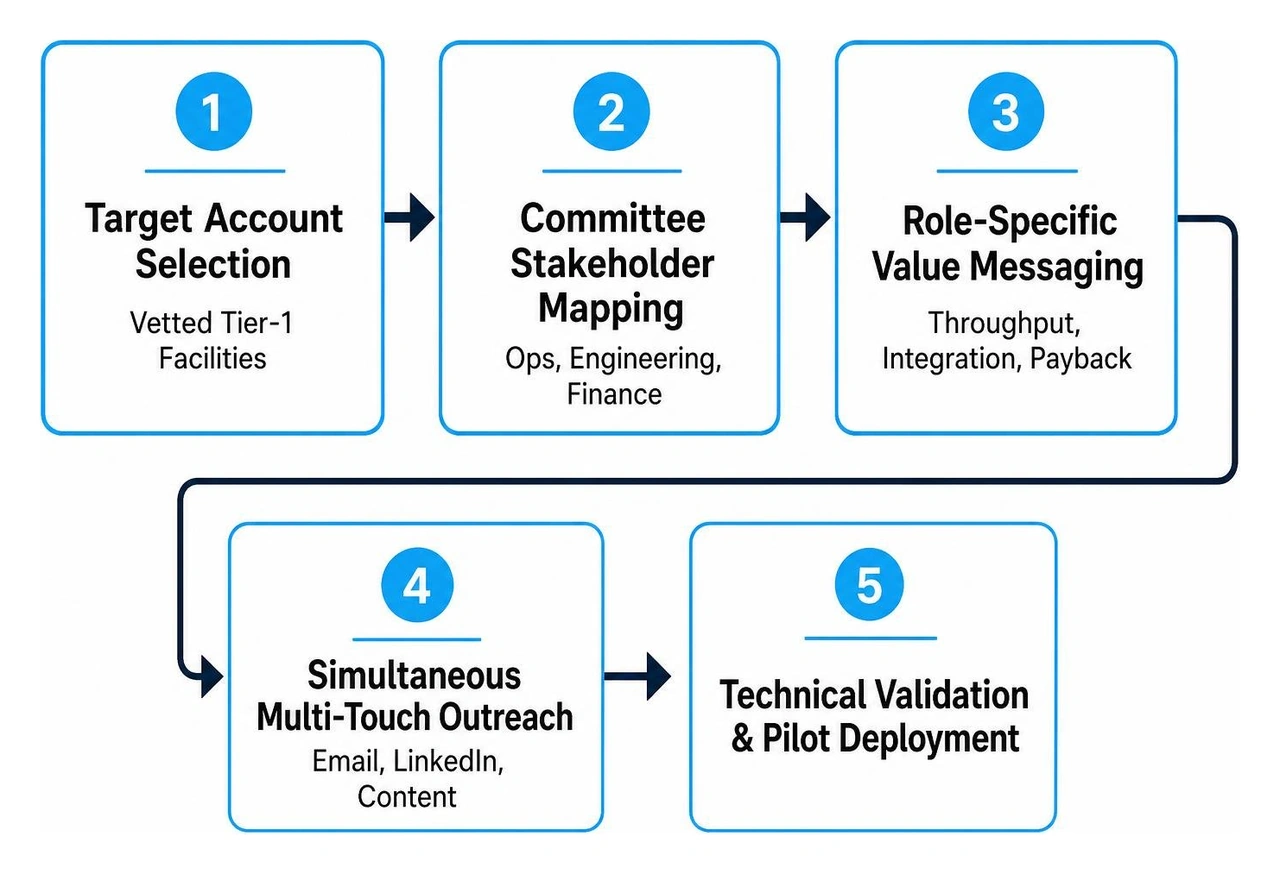
For each target account, identify the operations, maintenance, and finance leaders involved in the purchase. Coordinate personalized outreach so each member of the buying team can evaluate the system's fit, integration needs, and costs.
Mapping Decision-Makers and Pain Points Across the Industrial Floor
In complex B2B automation sales, there is rarely a single buyer. Buying teams include people with different priorities. Explain how your hardware addresses each person's needs. You can explore structured hardware marketing services to explain your product's value to each person involved in the purchase.
Operational Roles and Automation Buying Committees
To build an effective pipeline, match your messages and sales materials to each person on the buying team:
- Chief Operating Officer (COO) & VP of Manufacturing: Focused on overall facility throughput, operational risk, labor stability, and production output. Lead with business continuity, then support it with relevant technical specifications.
- Director of Automation / Robotics Engineering Manager: Focused on integration complexity, software architecture, maintenance needs, simulation accuracy, and safety compliance. They need to verify that your system works inside their existing line without causing excessive downtime.
- Plant Manager: Accountable for daily quotas, floor space use, changeover times, and worker safety. They want minimal disruption during deployment.
- Director of Continuous Improvement / Lean Manufacturing: Focused on reducing cycle times, eliminating bottlenecks, and improving overall equipment effectiveness (OEE).
- Chief Financial Officer (CFO) & Procurement: Focused on capital expenditure (CapEx) versus operating expenditure (OpEx), upfront investment versus ongoing operating costs, as well as payback periods, internal rate of return (IRR), and the vendor's ability to support the system over time.

Differentiating Messaging for Robotics Company Lead Generation
Hardware founders often lead with mechanical specs instead of business outcomes. Show buyers how your system addresses their operating problems:
- Labor Volatility and Staffing Shortages: Show how your robotics platform handles repetitive work on shifts with high staff turnover. Support reliability claims with test or deployment data.
- Floor Space and Throughput Constraints: Demonstrate how compact footprints or layouts that fit collaborative robots into limited space can increase output per square foot.
- Capital Constraints and Payback: Provide financial models showing return on investment (ROI), estimated payback time, and changes in unit costs. State the assumptions behind each estimate.
Explain the buyer benefit, then support it with technical evidence. For an example of bringing a robotics product to market, Robosen Optimus Prime went from Kickstarter to CES, then Hasbro and Disney licenses.
Building a Multi-Stage Pipeline: Technical Content and Buyer Education

Give technical buyers specific evidence rather than broad marketing claims. Show industrial buyers, controls engineers, and plant executives how the system performs before asking them to attend a demonstration. Create educational materials for each stage of evaluation to help buyers assess implementation risks.
Educating Technical Stakeholders with Sim2Real Gap Analysis
One of the largest hurdles in selling advanced robotics is the "Sim2Real" gap: the difference between how an autonomous system performs in simulation versus its reliability on a messy, physical factory floor.
Provide technical whitepapers, step-by-step integration reviews, and Sim2Real validation reports so engineering teams can assess your product:
- Simulation Fidelity Benchmarks: Publish data on sensor accuracy, physics modeling, and handling of unusual conditions. Explain where simulation results differ from physical tests.
- Pilot Integration Case Studies: Show step-by-step how another facility integrated your hardware with programmable logic controllers (PLCs, which control industrial equipment), conveyor belts, or warehouse management systems (WMS).
- Failure Mode & Effects Analysis (FMEA): Document potential failures and their effects. Explain how your system detects and recovers from problems, including when human intervention is needed.
When marketing to technical teams, lead with what the system achieves for the facility, then back it up immediately with rigorous engineering data.
How to Reach More Robotics Buyers
To reach more buyers, combine useful technical content with targeted ads and direct outreach. Keep technical solution pages clear and current. Use schema markup, structured labels that help search engines interpret a page, where appropriate, and aim ads at specific buyer groups. Track cost per lead (CPL) alongside lead quality to assess what works.
Use software to add relevant company details to your prospect records, then tailor your outreach to each account. AI-assisted prospecting can help flag factory expansions or job listings for automation specialists. Treat these as possible signs of an automation project to investigate before reaching out, not proof that a company is ready to buy.
Measuring Sales Progress: Metrics and Team Options
To assess growth and report progress to investors, track more than website visit counts alone. For a long sales cycle, measure how many prospects move from one stage to the next and where they get stuck.
Core Metrics: Cost-Per-Lead, Conversion, and Pipeline Value
Industrial robotics leaders should monitor six core performance metrics:
- Cost Per Lead (CPL): Total marketing spend divided by new leads generated across paid and outbound channels.
- Qualified Lead Conversion Rate: The percentage of raw inquiries that meet your technical and financial Ideal Customer Profile (ICP). Define those requirements before comparing results across channels.
- Time from Marketing-Qualified Lead (MQL) to Sales-Qualified Lead (SQL): Track how long a lead takes to move from meeting your marketing criteria to meeting your sales team's qualification criteria. Define the criteria, such as reviewing technical documentation and agreeing to an engineering discovery call.
- Appointment-to-Pilot Ratio: The percentage of discovery calls that turn into an on-site feasibility evaluation or paid proof-of-concept (POC).
- Sales Cycle Duration: The average days required to move from first contact to signed contract.
- Pipeline Value & Closed Revenue: Compare the value of potential deals with signed business. Track which campaigns contributed to each, without treating potential deals as earned revenue.
Outsourced Marketing and Sales Teams vs In-House Hiring
Building an internal marketing and sales development team is expensive and time-consuming. Hiring an in-house Head of Marketing, technical copywriters, digital campaign managers, and Business Development Reps (BDRs) can take substantial recruiting and onboarding time, delaying pipeline growth.
An outside team can handle marketing and outreach while founders focus on the product. Look for a team that understands automation buyers, can explain technical products, and can manage email, ads, and other outreach. For founders refining their market strategy, reviewing specialized hardware founder resources can help them plan how to bring their product to market without managing every task themselves.
Frequently Asked Questions About Industrial Robotics Sales
How long is the typical sales cycle for enterprise robotics?
Enterprise robotics sales cycles can be lengthy. The timeline depends on system complexity, integration requirements, CapEx approval schedules, and safety reviews. Providing clear technical documentation and ROI payback models early helps shorten the evaluation period.
What is the most effective outreach channel for automation buyers?
Test a mix of channels and track which ones produce qualified meetings. Combining targeted email outreach, LinkedIn direct messaging, phone follow-ups, and informative technical content gives decision-makers several ways to hear from you and respond.
How can technical content help buyers evaluate robotics systems?
Technical content, such as application programming interface (API) documentation explaining how software connects to the system, Sim2Real data, and integration diagrams, helps buyers assess engineering concerns early. Answering technical questions early can leave more time in discovery calls for commercial terms and deployment plans.
Conclusion
To build a steady flow of qualified robotics leads, go beyond product demos and spec sheets. Choose target accounts, address each buyer's priorities, and provide technical evidence at each stage of the purchase.
CRISPx plugs in as the founder's marketing and sales team so you do not need a head of marketing. We help hardware companies explain their products and reach likely buyers. Our available plans include Launch, Grow, Grow + Ads, and Scale.
Our hardware experience includes:
- Robosen Optimus Prime went from Kickstarter to CES, then Hasbro and Disney licenses;
- XFX became an NVIDIA graphics card partner;
- FuzeDrive ran an Indiegogo campaign;
- SecureCircle was acquired by CrowdStrike.
If you are ready to clarify your message, find where sales get stuck, and plan your next steps, take our free DOSEscore™ brand checkup to review your own website and story, or book a strategy call with our team.
Get a free brand checkup.
We work like a brand doctor. The DOSE Method™ finds what's broken, fixes the biggest problem first, then tracks the results.