

Hardware Brand Positioning: How to Compete with Large Platforms

Build a hardware product positioning strategy to compete against industry giants, respond to platform-owned alternatives, and plan a launch around clear buyer value.
The Core Mechanics of a Hardware Product Positioning Strategy
A hardware product positioning strategy defines the buyer you serve, the urgent problem your device solves, and the measurable outcome that justifies a higher price than basic alternatives. Define that buyer, problem, and outcome before finalizing schematics, tooling, or launch messaging. A working device still needs a clear reason to buy. Non-recurring engineering (NRE) costs are one-time development expenses. These costs can use up cash before the first chips arrive, so a mistaken view of demand can put the business at risk.
When engineer founders map out a new device, they often fall into three predictable traps:
- The launch falls flat: The product ships on time, but nobody shows up to buy because the story was never defined.
- Growth stalls: An initial wave of early adopters buys the product, but momentum vanishes because the value proposition fails to connect with a broader market.
- People don't get it: The website, packaging, and product pages read like an engineering spec sheet. Buyers see clock speeds, sensor tolerances, and pinouts instead of the real problem the device solves.
Clear positioning helps address these problems before launch. It connects what your device can do with why a buyer would choose it. Developing an intentional brand strategy does not mean wrapping specs in marketing slogans. It means making hard trade-offs about what your hardware will do, what it will deliberately ignore, and why a specific customer will pay a premium for it.
When you clarify your hardware product positioning strategy early, you can better connect the cost of each unit to its selling price and profit. Instead of competing only on component cost, show buyers a useful outcome that low-cost copies cannot easily match.
Why Early Hardware Product Positioning Strategy Supports Product Planning
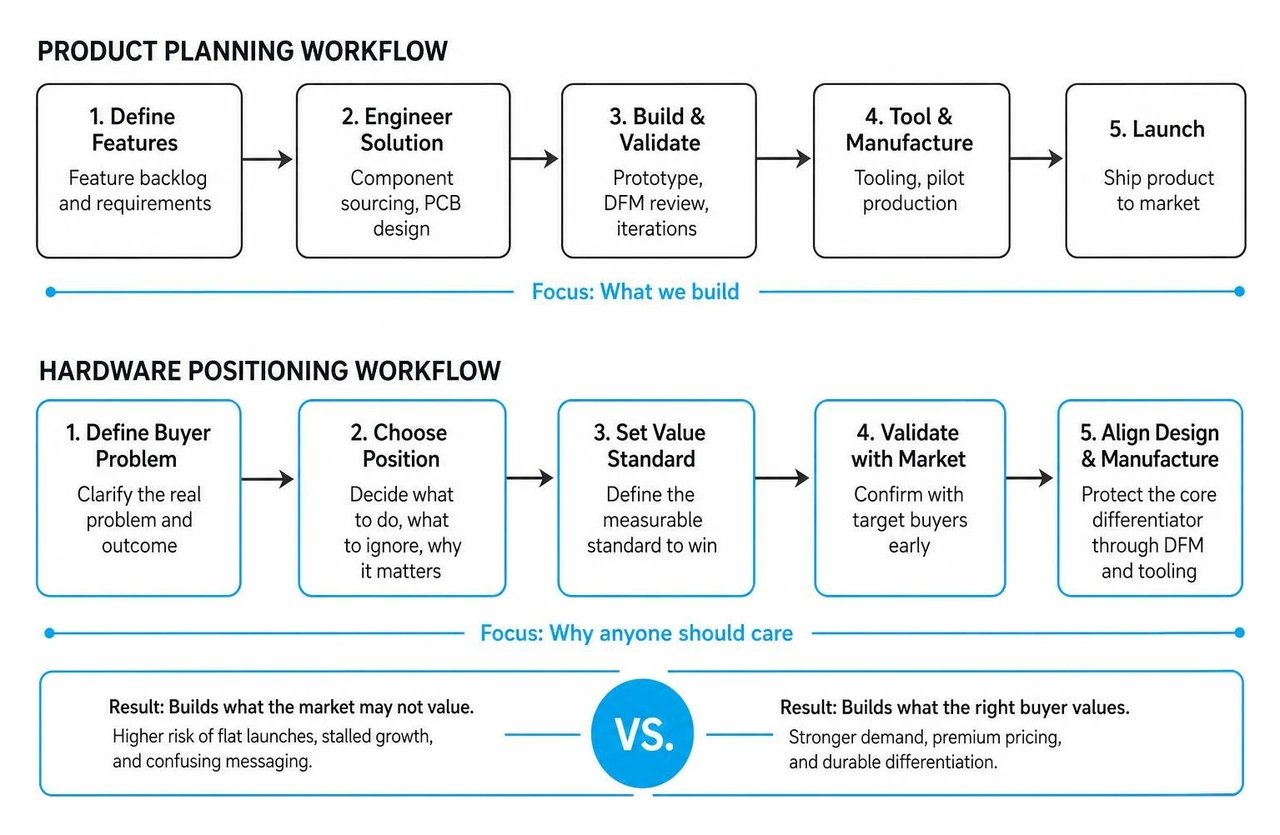
Product planning organizes what you build: feature backlogs, component sourcing, PCB layouts, and delivery schedules. Positioning decides why anyone should care and sets measurable targets for the buyer outcomes your product needs to deliver.
In software, you can update messaging or push a patch without changing physical parts. In hardware, design changes can require new parts, tooling, and production work. Altering a 3D-printed rapid prototype is usually simpler than modifying hardened steel injection-mold tooling after pilot production, which can be expensive.
Use your positioning statement during early Design for Manufacturing (DFM) reviews to make these decisions:
- Feature Selection: Use early positioning to cut "nice-to-have" features that increase your bill of materials (BOM) without adding value for the buyer.
- DFM Checkpoints: During Design for Manufacturing reviews, check more than cost. Ask whether each manufacturing choice protects the feature or benefit that sets your product apart.
- Tooling Protection: Agreeing on the main buyer benefit before cutting tooling can reduce late-stage engineering change orders (ECOs).
A disciplined product development strategy can help you avoid spending money on problems your target buyer does not value.
Essential Components of a Validated Positioning Statement
A positioning statement is not an external tagline or ad copy. It gives hardware engineering, firmware development, industrial design, and marketing teams one shared definition of the buyer, problem, and promised value.
An actionable hardware positioning statement requires five core components:
- The Target Buyer: The specific person who can approve the purchase and has budget for an urgent need (not simply "consumers" or "enterprise robotics teams").
- The Core Problem: The main task, delay or frustration your buyer struggles with today.
- The Novel Attribute: The distinctive physical, architectural, or software-enabled capability that sets your product apart.
- The Cost of Doing Nothing: The money, time or safety the customer risks by continuing with their current approach.
- The Clear Value Proposition: The measurable result your device delivers for the buyer.
Define these five components before finalizing your schematics. They can help limit unnecessary features and keep development focused on customer needs you have tested.
Navigating Platform Encroachment: Vertical vs. Horizontal Differentiation
Hardware founders can face competition from the platforms where they sell. Platform owners can track sales, identify profitable categories, and introduce their own private-label alternatives, such as Amazon Basics.
When a platform copies your product’s physical design and undercuts your price, competing only on basic hardware specifications becomes harder. Two ways to stand out are vertical positioning, offering higher quality, and horizontal differentiation, offering features suited to a particular use.
| Strategic Dimension | Vertical High-End Quality Positioning | Features for Specific Uses |
|---|---|---|
| Primary Mechanism | Superior components, industrial durability, measurably higher performance. | Unique form factors, proprietary embedded firmware, custom industrial design. |
| Hard-to-Copy Advantage | High manufacturing complexity and strict quality tolerances that platforms cannot replicate cheaply. | Connections to specialized software systems, plus shapes and controls designed for a specific task. |
| Commercial Leverage | Can support a premium-market position when the product delivers distinctive value. | Can reduce direct comparisons by meeting needs standard platform products overlook. |
| Platform Encroachment Risk | Can be lower when the product requires high NRE and serves a specialized premium tier. | Depends on how distinct the industrial design, embedded software, and buyer workflow remain over time. |
Vertical Positioning: Competing Head-to-Head vs. Serving Specialized Buyers
Vertical positioning relies on clear quality tiers. If you operate at the high end, every customer agrees your product outperforms the baseline: the only question is whether they can justify the higher cost.
When facing platform giants, selling higher-quality products at higher prices can be one way to compete. Standardized, high-volume products compete heavily on unit cost. A low-volume, high-precision device may instead stand out through engineering support, tight quality-control tolerances, and specialized materials.
A high-end brand strategy design can support higher prices when buyers value the added quality. If those prices leave enough profit after production costs, you can reinvest in research and development. This approach is explored in How to Position Your Innovation in the Marketplace and the Premium Hardware Launch Playbook - Archetypes. Starting with enthusiasts willing to pay for higher quality can help fund operations. Brands may then be able to offer lower-priced products in related categories.
Horizontal Differentiation: Making Hardware Harder to Copy Through Features and Form Factors
Horizontal positioning does not claim your product is universally "better" on raw specs; it shows that your hardware is designed for a specific job or setting. Two devices might use the same microcontroller, yet one succeeds because its industrial design, ergonomic layout, or software layer directly addresses an unmet customer workflow.
Features that can make a product harder to copy include:
- Proprietary Firmware and Edge Processing: Processing data on the device can reduce response delays and keep more data on the device rather than sending it to a remote service.
- Ergonomic and Modular Industrial Design: Develop enclosures and mounting systems tailored to specialized environments, such as rugged field operations or cleanrooms.
- Ecosystem and Data Interoperability: Make the device work with specialized enterprise tools or restricted data environments.
Using innovative product launch strategies built around features for specific uses can make your hardware harder to copy. As detailed in Tangibles: Build Hardware Competitors Cannot Copy, connecting a physical product with software can help protect your margins from copycat manufacturers.
Market Research Framework: 4 Critical Questions to Define Your Position
Before cutting initial prototypes or writing purchase orders for long-lead electronic components, founders must stress-test their assumptions against real buyer behavior.

To build a defensible position, structure your customer discovery around these four fundamental questions:
- Which group of buyers needs this device now and has the budget to buy it? Avoid broad demographic labels. Identify the exact professional setting, operational environment, or technical workflow where existing solutions fail.
- Who has the problem, and who can approve the purchase? Find out who deals with the problem each day and who controls the purchasing budget.
- What is the real cost of their current workaround? Measure the time lost, safety risks and replacement costs caused by the current workaround.
- How does your device solve the problem differently from the buyer's current workaround? Clarify the physical, electrical, or software mechanisms that deliver a measurable performance gain.
Understanding these answers before you learn how to launch a tech product ensures your commercial messaging highlights customer value rather than unformatted hardware specs.
Aligning Engineering, DFM, and Messaging Across Teams
Growing hardware companies can struggle when engineering, operations, sales and marketing work toward different goals. Engineering builds for peak technical performance, operations looks for ways to make the device at a lower cost, and marketing struggles to explain why buyers should choose it.
To keep teams aligned throughout development, use these checkpoints:
- Cross-Team Positioning Reviews: Schedule periodic reviews where hardware engineers, firmware developers, and marketing and sales teams compare the bill of materials with the positioning statement. Cut features that add manufacturing complexity without supporting the main reason buyers choose the product.
- Small Engineering Tests: Run rapid, low-cost engineering experiments to test whether a new feature can be manufactured reliably before committing to full tooling runs.
- Go/No-Go Reviews: Set clear criteria for engineering validation testing (EVT), design validation testing (DVT), and production validation testing (PVT). If a planned feature makes each unit too costly to sell profitably or weakens the main buyer benefit, modify or remove it before moving forward.
Use these reviews to connect engineering priorities with buyer needs during a high-tech product launch.
Go-to-Market Execution: Turning Your Hardware Product Positioning Strategy into Demand
Positioning needs a clear sales and marketing plan behind it. Once you have defined your position, use it to reach likely buyers, secure pre-orders, and support repeat hardware sales.
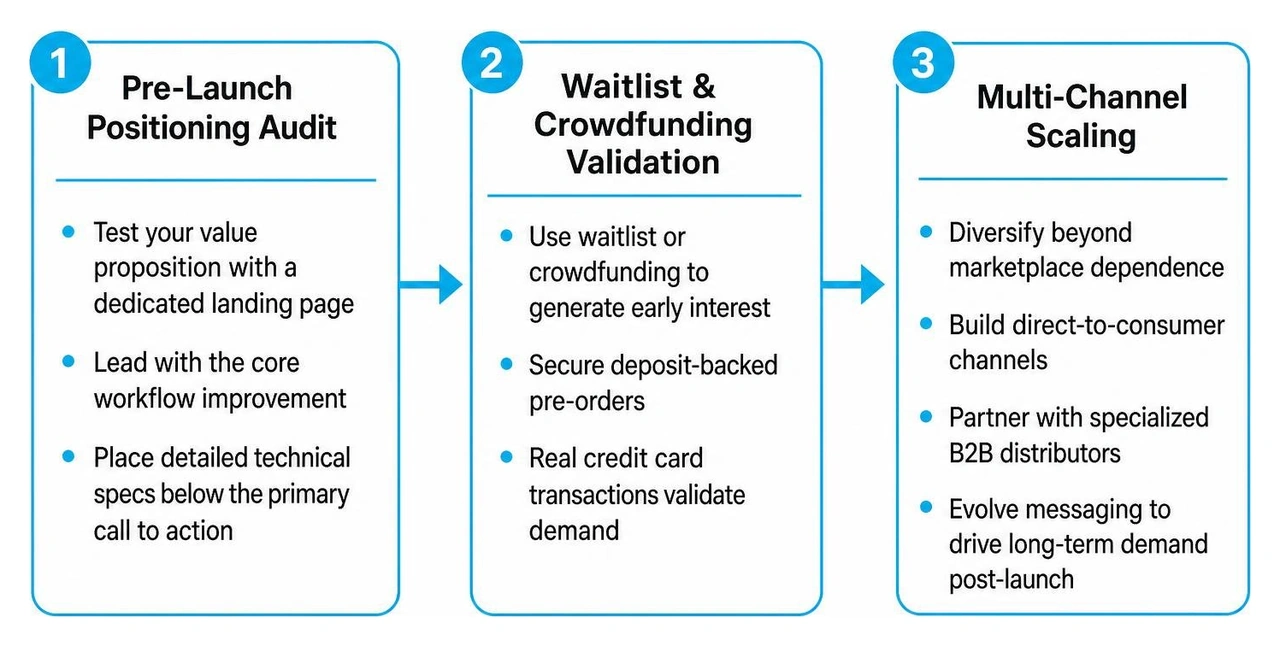
- Review Positioning Before Launch: Build dedicated pre-launch landing pages to test your value proposition before opening sales. Lead with the core workflow improvement, and place detailed technical spec sheets below the primary call to action.
- Test Demand with Waitlists and Crowdfunding: Use crowdfunding platforms or a reservation process that collects deposits to secure pre-orders. A payment is stronger evidence of willingness to buy than a casual survey response.
- Build More Than One Sales Channel: Do not rely exclusively on centralized e-commerce marketplaces where you compete with private-label house brands. Establish direct-to-consumer (DTC) channels and cultivate relationships with specialized business-to-business (B2B) distributors who value technical support.
- Sustain Demand After Launch: Plan for sales beyond initial backer orders. Move from early-adopter technical deep dives to messaging about lasting business benefits and product reliability.
Use product launch marketing plans to plan demand beyond the first shipment. Support from a team specializing in branding for tech companies can help explain the product’s value as the business grows.
Frequently Asked Questions About Hardware Positioning Strategies
How does platform encroachment affect hardware pricing and margins?
When a platform introduces its own competing products, it can put pressure on independent sellers' profit margins. It may undercut prices on standard features, while higher marketplace commissions and advertising costs can add pressure. To protect profit, consider higher-quality products or exclusive software and physical designs that make direct price comparisons harder.
When should an independent hardware seller avoid direct competition with a platform giant?
Consider avoiding direct head-to-head competition when customer brand loyalty is low, similar technology is widely available, and unit sales volume depends entirely on marketplace search rankings. In these conditions, focus on specialized customer groups, higher-quality professional products, or hardware-software systems with exclusive features that generic house brands may struggle to match.
What is the difference between a hardware product positioning statement and a tagline?
A tagline is a public-facing slogan for marketing campaigns, advertisements, and packaging. A hardware positioning statement is an internal document that defines the target buyer, core problem, distinctive technical capabilities, and advantages that are hard to copy. It guides engineering priorities, bill-of-materials trade-offs, and launch and sales plans.
Conclusion
Building a successful hardware company requires more than solving complex engineering challenges. Your product architecture, bill of materials, and industrial design need to support a clear reason to buy. Lead with the problem you solve for the buyer, then support that message with verified technical specifications. This gives buyers reasons to choose your product over platform-owned alternatives and low-cost copies.
At CRISPx, we plug in as the founder’s marketing and sales team so they do not need a head of marketing. We work with engineer founders whose products have a processing chip: consumer electronics, robotics, space and defense, and computers and components. We guide founders from positioning before launch through long-term growth across four plans: Launch, Grow, Grow + Ads, and Scale.
Our hardware experience includes:
- XFX became an NVIDIA graphics card partner.
- FuzeDrive ran an Indiegogo campaign.
We apply The DOSE Method™ as a practical strategy framework to help technical founders build lasting demand:
- Diagnosis: Find where your message is unclear or buyers stop moving toward a purchase.
- Prescription: Fix the biggest positioning problem first.
- Prognosis: Set clear sales and marketing targets, track results, and adjust the plan over time.
We use four emotional drivers to frame the buyer’s response: Dopamine (they want it), Oxytocin (they trust it), Serotonin (they’re proud of it), and Endorphins (they feel relief). This helps engineer founders explain their hardware’s value and support ongoing sales.
Ready to see how your hardware positioning measures up? Get a free DOSEscore™ brand checkup to review your website and story, or book a strategy call with our team today.
Get a free brand checkup.
We work like a brand doctor. The DOSE Method™ finds what's broken, fixes the biggest problem first, then tracks the results.