

CES Launch Preparation for Startups That Want Serious Investor Attention

Prepare for CES with a clear timeline: set goals by summer, freeze demo hardware by October, book press and buyer meetings by November, and follow up within 24 to 72 hours after the show.
1. Timeline and Milestones: CES Launch Preparation for Startups
CES launch preparation for startups starts with a clear timeline. Set your core goals and plan your Eureka Park application by Q3, checking official submission dates. Aim to freeze demo hardware by October and schedule media briefings by November, with journalists agreeing not to publish before a set date. Rehearse 20-second hooks in December. Use this sequence to keep your team focused on investor meetings, retail conversations, and press outreach instead of last-minute logistics.
Use a startup product launch guide to organize your timeline and plan how to measure trade show return on investment (ROI). Do not wait until December to explain what your product does for buyers. Prepare that message early so booth staff can use it in investor conversations. Plan exhibit space, hotel bookings, and marketing work together.
Month-by-Month Roadmap for CES 2027
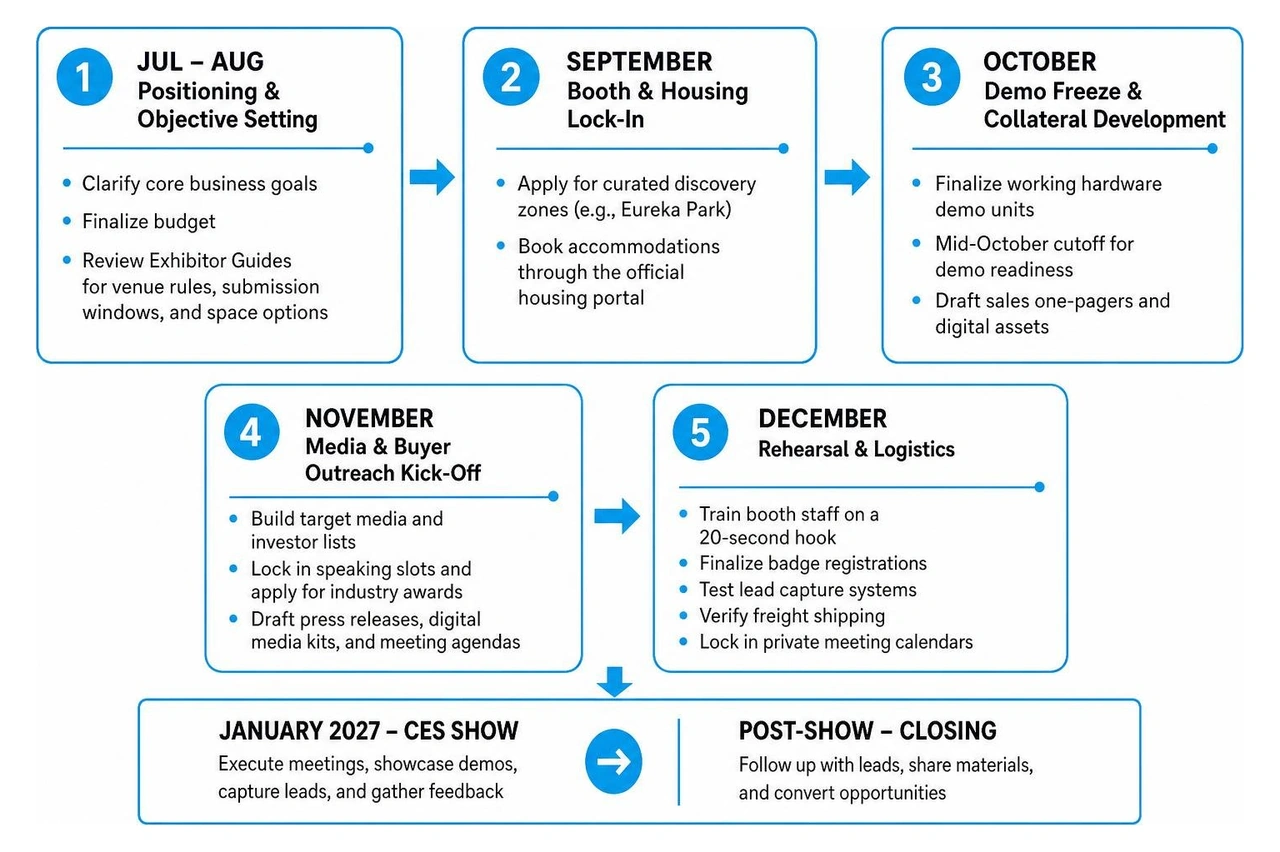
To maximize momentum leading up to January 2027, structure your operational milestones month by month:
- July – August (Set Goals and Explain Your Product): Clarify your core business goals. Are you raising a Series A, securing distribution partnerships, or driving pre-orders? Finalize your budget and review the official Exhibitor Guides for venue rules, submission windows, and space options.
- September (Booth & Housing): Plan applications for startup exhibit areas such as Eureka Park around official deadlines. Book accommodations through the official housing portal and compare available rates early.
- October (Demo Freeze & Sales Materials): Set mid-October as your internal target for working hardware demo units, not an official CES deadline. Prepare working units before offering journalists advance briefings with an agreed publication date. Draft sales one-pagers and digital assets.
- November (Media & Buyer Outreach): Build your target media and investor lists. Check deadlines for speaking opportunities and industry awards. Draft press releases, digital media kits, and meeting agendas.
- December (Rehearsal & Logistics): Train booth staff on a 20-second hook. Finalize badge registrations, test systems for recording visitor contact details, verify freight shipping, and confirm private meetings.
Essential Milestones in CES Launch Preparation for Startups
Do not expect the booth to do all the selling. Explain what your product does for buyers before listing its specifications. Plan pre-launch messages months ahead to explain the product, invite likely buyers to a waitlist, and build trust before CES.
| Milestone Phase | Early Strategic Planning | Last-Minute Execution |
|---|---|---|
| Messaging & Positioning | Clear, benefit-driven hook answering "Why now?" | Complex technical jargon that confuses casual foot traffic |
| Media Scheduling | 15–20 pre-booked briefings with signed embargos | Relying on walk-by reporters who already have full agendas |
| Demo Units | Stable hardware with backup devices and offline scripts | Untested prototypes prone to crashing on convention Wi-Fi |
| Travel & Logistics | Cost-controlled hotel blocks and locked-in freight | Peak hotel rates, shipping delays, and extra fees for moving freight within the venue |
| Contact Tracking | Automatically saved contacts in customer relationship management (CRM) software, with follow-up based on priority | Stacks of unsorted paper business cards forgotten in luggage |
2. Navigating Eureka Park, Innovation Awards, and Pre-Show Events
Choose exhibit space based on the buyers, investors, and journalists you want to meet. CES brings together exhibitors, startups, media, and industry professionals from around the world. Focus your plans on reaching the people most relevant to your product.
Qualifying for Eureka Park Discovery Zones
For emerging hardware companies, Eureka Park is CES’s startup exhibit area. It brings startups together with investors, media, and global partners looking for products from early-stage companies. Review the official page for participation options and current requirements.
Before applying for an independent booth in Eureka Park, check the current Consumer Technology Association (CTA) criteria:
- Review product-readiness requirements and prepare a working prototype rather than relying on conceptual mockups.
- Check company-age and funding-stage limits to confirm whether your startup qualifies.
- Review consumer technology and intellectual property requirements before applying.
- Check rules for first-time and returning exhibitors, including any participation limits intended to make room for new exhibitors.
Learning how to launch a tech product in startup-focused exhibit areas can help you prepare for conversations with individual investors and hardware investment firms.
CES Unveiled and Pre-Show Media Briefings
Plan for pre-show events as well as the official four-day show. Participating in official pre-show preview events, such as CES Unveiled Las Vegas (held two days prior to the show floor opening), lets you show your product to journalists preparing opening-day coverage.
Consider applying for the CES Innovation Awards as part of your press outreach. If your product receives an honoree distinction, include it in your press materials. It can give journalists another reason to consider covering your tech product launch.
3. Booth Layout and Live Demos
When visitors walk the trade show floor, you have mere seconds to earn their attention. When people don't get what your product does because your signs read like a spec sheet, potential buyers walk right past.
Technical Demo Execution in CES Launch Preparation for Startups
Use live demonstrations to show visitors how your hardware works. For a hardware showcase example, see the CES Transformers Lightyear K1 showcase. Plan hands-on interactions that help visitors understand what the product does for them.
To execute live demonstrations effectively on the show floor:
- Establish a 20-Second Hook: Train every booth staffer to explain what the product does for the user within 20 seconds before diving into how it works.
- Prepare Redundant Hardware: Always have backup units ready. Convention center Wi-Fi networks frequently suffer from interference, so build an offline demo mode into your presentation software.
- Lead With User Benefits: Show the real-world problem your device solves before breaking down processing speeds or battery chemistry.
Booth Design vs. Private Meeting Suites
Choosing between an open booth and a private meeting room depends on your launch goals:
| Consideration | Eureka Park Booth (The Venetian Expo) | Private Meeting Suite / Off-Site Room |
|---|---|---|
| Primary Advantage | High foot traffic, spontaneous discovery, press interest | Controlled environment, quiet acoustics, deep focus |
| Best Suited For | Consumer interest, live demos, early customer feedback | Negotiating investment terms, discussing confidential business deals |
| Visitor Dynamics | Walk-ins, general public, roving tech influencers | Investment partners screened in advance and national retail buyers |
| Key Limitation | High ambient noise, space constraints for long meetings | Zero spontaneous walk-in discovery |
4. Scheduling Meetings with Relevant Journalists and Retail Buyers
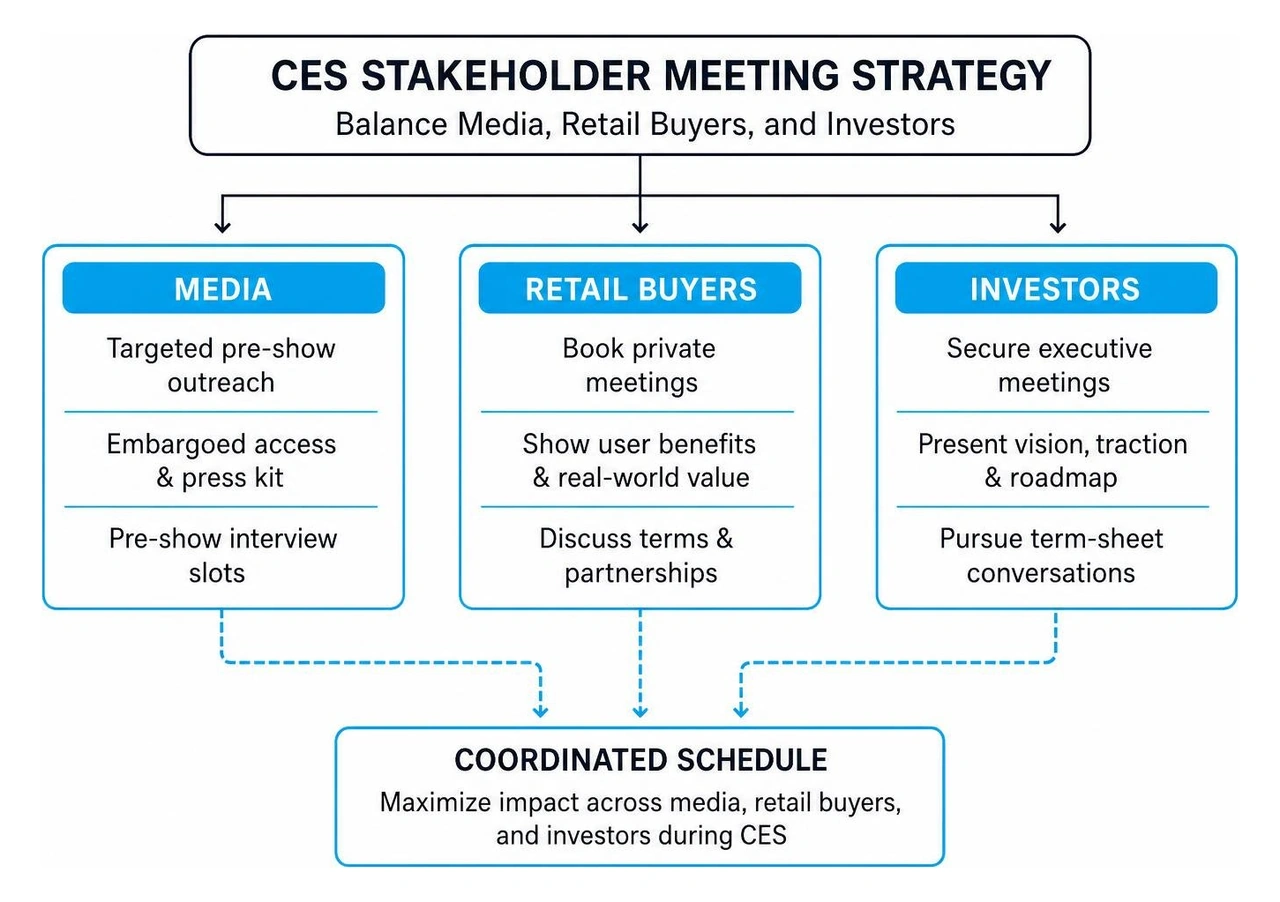
Do not rely only on walk-in visitors. Schedule meetings with relevant buyers, investors, and reporters before you travel.
Pre-Show Pitching and Agreed Publication Dates
Make each pitch relevant to the journalist’s coverage rather than sending the same email to everyone:
- Build a targeted list of 30 to 50 reporters who cover your hardware category.
- Aim to reach out 4 to 6 weeks before the show. Offer complete press kits, high-resolution lifestyle imagery, and pre-show interview slots. If you offer advance access under an embargo, get the journalist’s agreement not to publish before a set date.
- Focus on explaining how your product differs. State the buyer’s problem, then show how your product addresses it.
A structured product launch marketing plan can help you have your online press room and launch materials ready when journalists can publish the news.
Scheduling Retail Buyer Meetings Before CES
Retail buyers from major national chains attend CES to plan their upcoming seasonal selections. Use official matchmaking tools early to lock down focused 15-minute introductory meetings.
Ask buyers when they review products in your category. Use that timing to agree on a useful next step after the introductory meeting. For help preparing for retail buyer conversations, consider launch services.
5. Post-Show Lead Conversion, Rapid Follow-Up, and Measuring ROI
Your CES work continues after the convention center lights turn off. When growth stalls after launch, review whether your team is turning event interest into sales conversations with clear next steps. Assign an owner and a follow-up date to each relevant contact.
The 24-to-72-Hour Rapid Follow-Up Protocol
Use a structured post-show follow-up sequence:
- Tier 1 Leads (Within 24 Hours): Prioritize qualified investors, interested retail buyers, and journalists writing active stories. Send personalized follow-ups with requested data sheets or calendar booking links while you are still in Las Vegas.
- Tier 2 Leads (Within 48 to 72 Hours): Follow up with industry partners, qualified newsletter signups, and prospective distributors. Recap your conversation and offer relevant product documentation.
- Tier 3 Leads (Within 5 Business Days): Review general booth contacts and badge scans. For those who opted in, send a relevant follow-up email series that explains product benefits and market availability.
Calculating Total Commercial Impact and Return on Investment
Measuring the return on your CES investment requires looking beyond raw lead counts. Key performance indicators to track over the 90 days following the show include:
- Value of Potential Sales: Track the total dollar value of enterprise pilots, retail purchase orders, and distribution agreements initiated from show meetings. Separate potential deals from confirmed orders.
- Progress Toward Investment: Track follow-up partner meetings, requests to review your business, finances, or product, and signed investment agreements.
- Press Coverage: Track the number and prominence of press mentions, links to your website, and website visits from unpaid links.
- Digital Traffic Growth: Track growth in post-show website traffic, pre-order conversions, and qualified waitlist signups.
Frequently Asked Questions About CES Launch Preparation
What is the estimated total cost of exhibiting at CES 2027?
There is no single total that fits every startup. Costs depend on booth size, location, staffing, and demo needs. Check current exhibitor packages for startup exhibit areas such as Eureka Park. Budget separately for hotel accommodations, round-trip flights, booth construction, freight shipping, electrical hookups, apps for recording visitor contact details, and daily staff allowances. Confirm quotes before committing your budget.
When should hardware startups begin outreach to media and investors?
Use late October or early November as a planning target for initial outreach, and adjust to each contact’s schedule. Have a clear product story and working demo ready. If you offer journalists advance news under an embargo, agree on the publication date with them first. Early, targeted outreach can help you book meetings rather than relying on chance encounters.
How can early-stage startups stand out against major tech conglomerates?
Do not try to outspend global consumer electronics brands on flashy booth displays. Instead, explain what your product does and show that it works. Have working hardware available for hands-on demos, deliver a sharp 20-second hook that highlights user benefits, and consider applying for the CES Innovation Awards.
Conclusion
Plan your CES launch around product readiness, clear messaging, pre-booked meetings, and structured follow-up. Treat the show as a business milestone, not just a display. This can help you keep demos and follow-up focused on buyer needs.
At CRISPx, we plug in as your outsourced marketing and sales team, so you do not need a head of marketing. We guide technical founders through every stage of their launch through our dedicated Launch, Grow, Grow + Ads, and Scale plans.
Tony Crisp has 30 years in branding, 100+ hardware launches and 8+ patents. Robosen Optimus Prime went from Kickstarter to CES, then Hasbro and Disney licenses. FuzeDrive ran a top 1% Indiegogo campaign. SecureCircle was acquired by CrowdStrike.
We use The DOSE Method™ as a strategy framework to help make your message clear to buyers and investors: Diagnosis (find what's broken), Prescription (fix the biggest problem first), and Prognosis (set targets, track, adjust). The framework also uses four emotional drivers: Dopamine (they want it), Oxytocin (they trust it), Serotonin (they're proud of it), and Endorphins (they feel relief).
Ready to see how your messaging holds up before heading to Las Vegas? Get a free DOSEscore™ brand checkup of your website and story today, or book a strategy call with our team.
Get a free brand checkup.
We work like a brand doctor. The DOSE Method™ finds what's broken, fixes the biggest problem first, then tracks the results.
