

Deep Tech Branding: Help Buyers Understand Your Hardware

Deep tech buyers trust what they can follow: the business outcome, how the technology works, and proof they can check. Lead with the outcome, then make the science easy to verify.
Brand Strategy for Deep Tech: Make the Breakthrough Clear and Credible
A hardware launch can fall flat when the product is ready but the story isn't. Sales can jump at launch, then fade. A website that reads like a spec sheet can leave buyers unsure what the product does for them.
Start with what your technology makes possible, not how every part works. Then give readers a clear path to the mechanism, test results, and technical detail. Keep one core story, but let investors, technical partners, and buyers find the proof each needs.
This matters when a bold claim could sound like a promise you cannot prove. A strong brand does not hide the science. It makes the science easier to check. At CRISPx we plug in as the founder's marketing and sales team, so you don't need a head of marketing.
Why Hardware Buyers Need More Than Marketing Promises
Deep tech founders need to explain unfamiliar technology and show that it works. In consumer tech or software as a service (SaaS), marketing teams often use promises about a better future, easy sign-ups, and catchy comparisons. In deep tech, bold claims face close scrutiny. Without evidence, a breakthrough claim can sound like an unproven promise. Buyers and investors need a way to check it.
The more unfamiliar the technology, the more evidence buyers need before they trust your claims.
Hardware development can take years, require costly manufacturing, and involve extensive physical testing. Investors and business buyers need evidence that the product works. Your marketing should address those concerns:
| Dimension | Consumer & Traditional SaaS | Deep Tech & Hardware Startups |
|---|---|---|
| Sales & R&D Cycle | Weeks to months; rapid code deployments | Multi-year R&D hardware fabrication and testing |
| Core Brand Risk | Lack of user attention or high churn | Technical risk and doubts that the product works |
| Primary Proof Point | Free trials, self-serve UI, and star reviews | Unedited demo footage, bench tests, and data sheets |
| Audience Literacy | Broad consumer or general business buyer | Ph.D. scientists, systems engineers, and CFOs |
| Brand Goal | Increase sign-ups and give users a good experience | Show that the technology works and explain its business value |
To make their message clear and credible, founders can use a structured B2B brand strategy framework. In deep tech, start with evidence: lead with what the product does for the buyer, explain how it works, and support each claim with data readers can check.
The Three Audiences Deep Tech Brands Must Balance
Your hardware message needs to answer questions from three groups:
- Institutional Investors: They look for the potential to build a large business, the size of the market, intellectual property competitors cannot easily copy, and risks to their investment.
- Technical Evaluators and Partners: Systems engineers, research scientists, and technical architects examine your whitepapers, evaluate data sheets, and look for design flaws.
- Commercial Buyers and End Users: Program directors, procurement managers, and operating executives assess how easily the product fits their systems, its total cost to own and run, and whether it can operate without disruption.
Each group has different concerns about risk. To keep one clear message while answering each group's questions, map out how your buyers evaluate risk. Use a map of the buying committee to identify what each person needs to check. Give engineers technical evidence and budget owners clear costs and expected returns.
Show Buyers That the Hardware Works
To address doubts that your product works, remove vague promises from your website and marketing materials. Build credibility with concrete evidence:
- Unedited Demonstration Footage: Show prototypes operating in real environments.
- Third-Party Benchmarks and Validation: Share test reports from independent labs, academic research partners, and pilot programs.
- Progress Against Milestones: Publicly track technical progress against clear engineering timelines.
- Hardware Photography in Context: Show high-resolution images of real assemblies, test benches, and custom components rather than polished 3D concept renders.
Test reports, demonstrations, and other evidence help buyers assess how reliably your hardware works. Share them to support building startup brand advantage before commercial production begins.
Core Foundations of a Brand Strategy for Deep Tech
A useful brand strategy for deep tech does not start with physical schematics. It starts by identifying the buyer's problem.
Engineers often explain products from the inside out, detailing technical specifications before explaining why the problem matters. Reverse that order. Explain the buyer's problem and what current solutions cost. Show how your technology addresses it. Back each performance claim with test results.
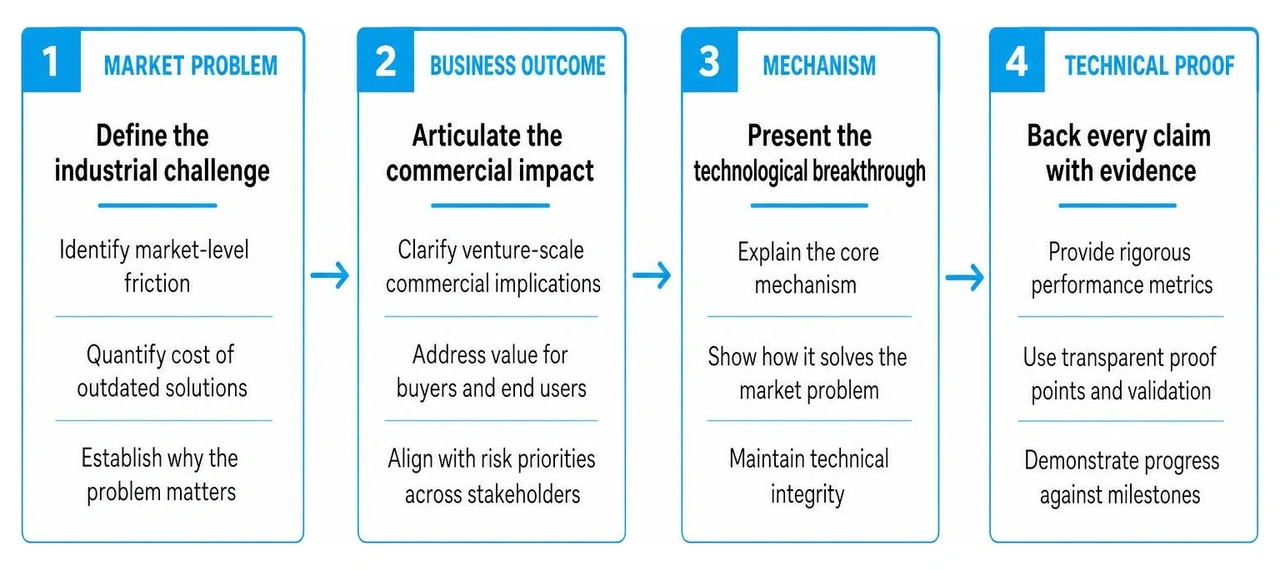
Start with the buyer's problem, then provide the technical detail readers need to check your claims. For further reading on bringing technology to market, explore technology commercialization coverage.
Explain the Science Without Losing Technical Detail
When explaining deep tech, use translation, not simplification.
Simplification strips away core engineering realities to make ideas sound catchy, leaving technical evaluators skeptical. Translation preserves technical depth while making the underlying logic clear to commercial decision-makers.
- Simplification: "We use advanced machine learning to build faster computer chips."
- Translation template: "For [the buyer's task], our chip uses [measured reduction] less energy than [tested comparison] because [verified design feature, explained plainly]. See [test results and conditions]."
Use a consistent set of product messages to describe how the technology works while keeping its value to buyers clear.
Organize Product Information for Different Readers
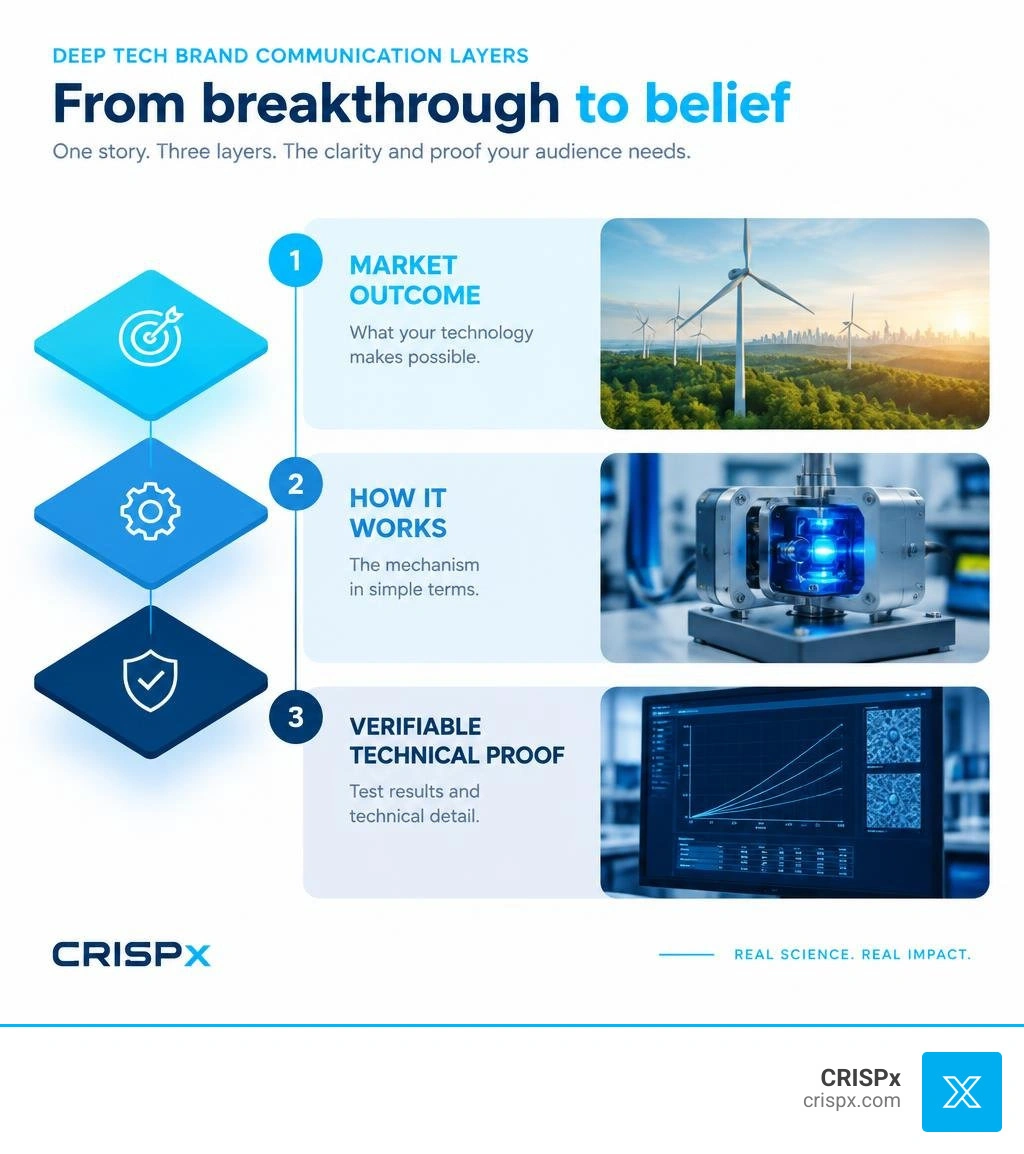
Deep tech websites must serve audiences with varying technical backgrounds without fragmenting the core message. The solution is progressive disclosure: organizing information in structured, digestible layers.
- Layer 1 (Market Outcome): Explain what the platform does, who it serves, and its main business benefit.
- Layer 2 (Operational Mechanism): Use pages for buyers evaluating the product to explain the system architecture, integration points, and underlying physics or algorithms.
- Layer 3 (Verifiable Proof): Provide detailed technical whitepapers, peer-reviewed documentation, raw test outputs, and application programming interface (API) specifications for thorough technical reviews.
This structure keeps the main message accessible while giving readers a path to detailed technical proof. Use the same three layers across web pages, technical briefs, and investor decks, including when you use AI to draft technical content.
Brand Visuals: Show Precision Without Overused Tech Imagery

Many deep tech startups default to overused visual clichés: glowing orbs, dark gradients, floating neon particles, and abstract double-helix renders. These tropes signal consumer software marketing rather than rigorous scientific development.
Hardware companies can use visual identities that reflect their engineering discipline. Use precise linework, readable type, clear grids, and data visualization design standards to help buyers understand the engineering instead of distracting them with digital effects.
Avoiding Glowing Orbs, Dark Gradients, and Sci-Fi Tropes
Help buyers see what makes your hardware different. Replace these overused images in your marketing materials:
- Glowing neon particles and plasma fields: Replace them with functional system schematics, real data plots, and engineering diagrams.
- Abstract geometric spheres: Replace them with documented system architectures, orthographic drawings, or real hardware photography.
- Stock biotech and digital network models: Replace them with authenticated molecular models, real sensor data, or actual production floor environments.
Show Processes You Cannot Photograph
When technology operates at subatomic, chemical, or algorithmic levels, photographing it directly is impossible. Instead of resorting to sci-fi renders, base your visuals on the technology's real structure and behavior:
- Waveform and Signal Data: Build custom graphic patterns directly from real oscilloscope readings, sensor outputs, or spectral data.
- Algorithmic and Structural Grids: Design layouts using coordinate systems, structural molecular geometries, or functional logic models.
- Dimensional Engineering Schematics: Use annotated diagrams, exploded hardware assemblies, and system integration maps.
Base visual assets on real technical properties. Use brand identity design principles to help buyers understand the technology and check what the visuals represent.
Update Your Brand as Your Hardware Company Grows
Update your message and materials as your company moves from raising money to delivering products to more customers.

What to Build at Seed, Series A, and Series B
Founders must carefully sequence brand investments at each stage of growth:
- Pre-Seed and Seed Stage (Clarity & Story): Start with a clear, repeatable statement of who the product is for and what it does for them. Build a clean website and an investor deck that explains the market opportunity before investing in a full visual identity.
- Series A Stage (Technical Validation & Evaluation): As investors and technical buyers take a closer look, add detailed technical whitepapers, complete spec sheets, system architecture diagrams, and an organized data room (a secure online space for sharing company documents) for their review.
- Series B and Commercial Expansion (Operational Scale): As production and sales grow, explain the product to new buyers. Create partner guides, customer case studies, and product materials for business buyers when executing high-tech product launches.
Build a shared set of materials for investor reviews. Use the same core message in pitch decks, spec sheets, website pages, and conference materials as the company grows.
Real-World Proof: How Evidence-First Branding Supports Deep Tech Growth
A disciplined, evidence-first brand strategy supports commercial growth across hardware categories. CRISPx has experience bringing hardware to market:
Tony Crisp has 30 years in branding, 100+ hardware launches and 8+ patents. Robosen Optimus Prime went from Kickstarter to CES, then Hasbro and Disney licenses. FuzeDrive ran a top 1% Indiegogo campaign. SecureCircle was acquired by CrowdStrike.
Measure Buyer Trust, Review Time, and Sales Progress

Measure deep tech branding against business results, not just attention. Use a brand measurement plan to track investor review time, recruiting results, and recognition among target buyers.
Track Investor Reviews and Partner Evaluations
Deep tech marketing performance can be evaluated using several operational indicators:
- Investor and Buyer Review Time: Track how long technical reviews take. Check whether clear whitepapers and organized data rooms reduce delays.
- Technical Recruiting Results: Track qualified applications and hiring rates for Ph.D. researchers, hardware engineers, and systems architects.
- Progress to Paid Pilots: Track how many business buyers move from technical evaluation to funded proof-of-concept projects, and how long that takes.
Track these results alongside marketing costs so founders and boards can review spending and progress.
Brand Search Visibility and Industry Recognition
Track whether more relevant buyers find and reference your company:
- Relevant Search Views: Track how often your pages appear for searches about the technical problems, product requirements, and buying decisions you address.
- Industry References and Links: Track mentions and links in industry whitepapers, research journals, and leading trade publications.
- AI Search Visibility: Check whether AI tools cite your company and accurately describe its architecture and capabilities.
Explain the product clearly and test the message with buyers. Use what you learn to build trust and help buyers judge whether the product fits their needs.
Frequently Asked Questions about Deep Tech Branding
How early should a deep tech startup invest in brand strategy?
Define who the product is for and what it does for them during pre-seed and seed stages. Start with one clear sentence explaining what the product does for buyers, an accessible explanation of the technology, and an investor deck that tells the same story. Make these a priority before a full visual identity redesign.
How do you balance scientific accuracy with commercial marketing claims?
Present information in layers. Start with the buyer's main problem and the business outcome you can prove. Then explain how the product works using accurate engineering terms. Link to supporting peer-reviewed research, data sheets, and whitepapers so technical evaluators can check the claims.
Why can consumer or SaaS branding approaches fall short for deep tech?
Attention-grabbing messages, simple comparisons, and quick sales are not enough when buyers need to check unfamiliar technology. Choose a team that can explain the engineering accurately and create materials that answer detailed questions from business buyers and investors. Ask how it would use test results, system diagrams, and technical documentation in your story.
Conclusion
Deep tech engineering teams turn ambitious physics, chemistry, and computation into physical products. To help buyers understand and choose those products, explain what they do for the buyer. Then show how they work and provide the evidence.
At CRISPx, we plug in as the founder's marketing and sales team for hardware and deep tech companies, so you don't need a head of marketing. You build the product; we build the demand. Our Launch, Grow, Grow + Ads, and Scale plans provide marketing and sales support without hiring a full in-house marketing department.
Our strategy framework is The DOSE Method™:
- Diagnosis: Find where the story is unclear, the website reads like a spec sheet, or buyers stop taking the next step.
- Prescription: Fix the biggest communication problem first. Explain what the product does for buyers and show evidence that supports the claims.
- Prognosis: Set clear performance targets, track review times and sales progress, and adjust as your technology scales.
- Emotional drivers: Dopamine (they want it), Oxytocin (they trust it), Serotonin (they're proud of it), and Endorphins (they feel relief).
Help buyers understand what your hardware does and why it matters. Book a strategy call or get a free DOSEscore™ brand checkup to review your website and technical story, and plan your next marketing step.
Get a free brand checkup.
We work like a brand doctor. The DOSE Method™ finds what's broken, fixes the biggest problem first, then tracks the results.
