

Brand Building Lessons From Hardware Launches
Strong hardware brands pick one clear promise before choosing logos or colors, then prove it in every launch. Examples from Apple, Volvo, John Deere and CRISPx launches show how that works.
Great hardware needs more than working circuits to succeed. Hardware founders must give buyers a clear reason to choose their product. A strong brand building strategy sets that clear promise early. It guides how you build, package, and sell your physical device.
Here are three core takeaways for engineer founders:
- Strategy comes first: Decide what singular promise your hardware owns before picking logos, colors, or ad channels.
- Lead with outcomes: Tell customers what real problem your device solves instead of showing dense component spec sheets.
- Test positioning early: Build an audience and validate customer demand before finishing factory tooling.
Many engineering teams treat branding as decoration. They build circuit boards, write firmware, test prototypes, and ask for a logo right before launch day. That approach confuses visual design with market positioning. When hardware teams skip strategic positioning, product pages read like part lists rather than clear commercial answers.
Studying brand building strategy examples helps hardware teams align engineering and marketing work.
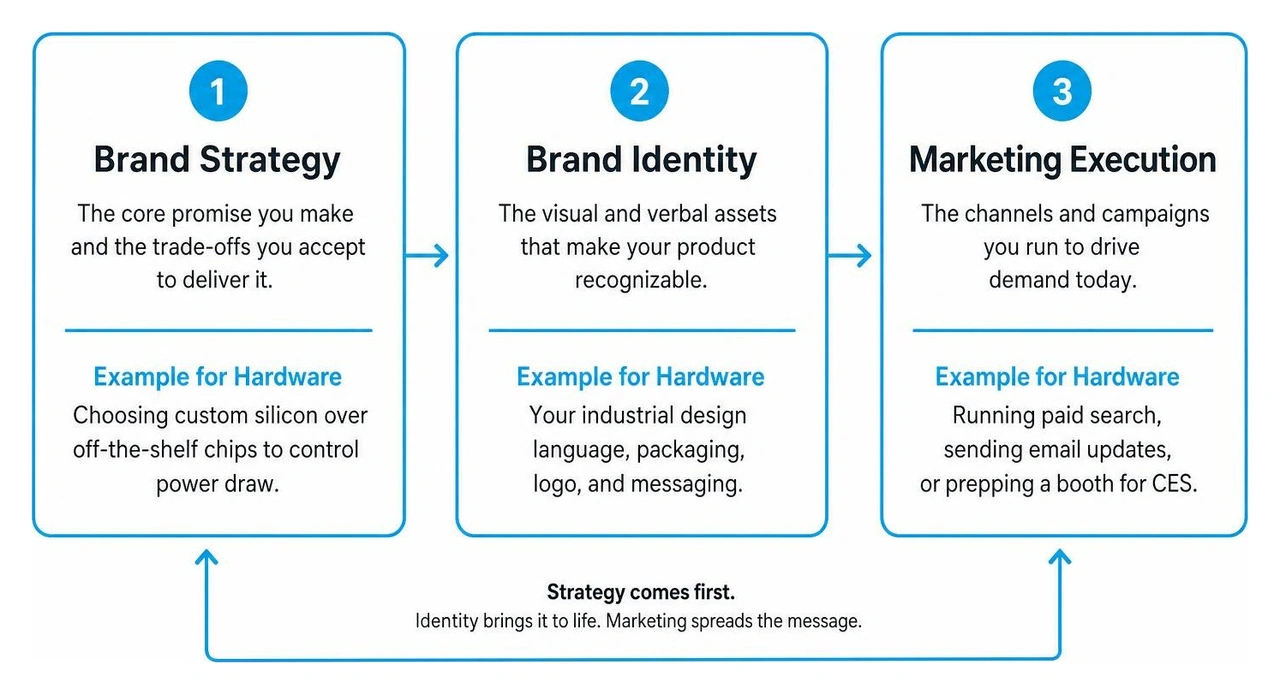
| Layer | What It Means | Examples for Hardware |
|---|---|---|
| Brand Strategy | The main promise you make and the practical choices you make to deliver it. | Choosing custom chips over standard parts to save battery power. |
| Brand Identity | The visual look and voice that make your product easy to recognize. | Your product casing, box design, logo, and developing your brand identity. |
| Marketing Tactics | The sales channels and campaigns you run to drive demand today. | Running search ads, sending email updates, or running a trade show booth. |
Strategy explains why your hardware exists and who benefits from it. Identity gives that idea a clean look, while marketing shares the message. When creating brand strategy, you choose the main idea your product will own.
Iconic Hardware Brand Building Strategy Examples
Leading hardware companies succeed by making focused product decisions. They decide what features not to build so their core promise stays clear to buyers. Here are three examples.
Apple: Hardware and Software Working as One
In November 2020, Apple announced M1, its first chip designed specifically for the Mac. Apple said the chip built on more than a decade of designing its own chips for iPhone, iPad, and Apple Watch (source: Apple Newsroom).
The lesson: when you control the parts that shape the experience, you control the promise you can make to buyers.
Volvo: Owning Vehicle Safety
In 1959, Volvo engineer Nils Bohlin perfected the modern three-point safety belt. Volvo then gave the patent to the rest of the industry to use free of charge, according to the Volvo Group heritage page.
Volvo gave up an exclusive advantage, and in return its name became closely tied to safety. The lesson: one clear promise, backed by a real decision, can define a brand for decades.
John Deere: Carrying an Established Brand Into Autonomy
John Deere first revealed its autonomous tractor technology at CES 2022 and showed more autonomous machines at CES 2025 (source: John Deere).
The lesson: when you add new technology, carry your existing promise into it instead of starting over.
Real-World Hardware Launches: CRISPx Case Studies
Early hardware startups face tight budgets and fixed production schedules. Using clear positioning before launch helps technical products find real buyers and sustain sales. Here are real hardware launches that show how clear positioning works in practice.
Consumer Robotics and Gaming
Consumer electronics and gaming hardware demand clear messaging. Buyers need to grasp what the device does without reading motor torque tables or circuit diagrams.
- Robosen Optimus Prime: Kickstarter to CES, then Hasbro and Disney licenses. Review the project in our Robosen Transformers case study.
Storage and Enterprise Security
Business buyers focus on speed, data uptime, and system protection. Strong b2b brand building explains complex technology so managers can approve purchase orders quickly.
- FuzeDrive: Top 1% Indiegogo campaign. Check out the project steps in our FuzeDrive launch case study.
- SecureCircle: Acquired by CrowdStrike. See how the company positioned its data security technology in our SecureCircle acquisition case study.
Five Brand Building Lessons for Hardware Founders Before Launch

When founders map out how to make branding strategy fit into active engineering schedules, five practical steps keep marketing aligned with hardware milestones:
- Lead with the Outcome, Not the Spec Sheet: Clarify what practical task or workflow improvement your device provides first. Place clock speeds, device dimensions, and battery chemistry in secondary specification tabs.
- Build Demand Before Tooling Is Complete: Do not wait for final production molds to test your market positioning. Launch prelaunch web pages with clear value messages, gather email sign-ups, and see which product benefits attract customer interest.
- Use the DOSE Method™ for Clear Messaging: Apply The DOSE Method™ framework (Diagnosis to find what is broken, Prescription to fix the biggest problem first, and Prognosis to set targets and track results). Balance your messaging across four emotional drivers:
- Dopamine: They want it (excitement about new device abilities).
- Oxytocin: They trust it (engineering testing, clear specifications, and product warranties).
- Serotonin: They are proud of it (the status of owning dependable, high-grade tools).
- Endorphins: They feel relief (removing an annoying daily delay or hardware failure point).
- Protect Your Launch Price: Cutting your price right after launch signals weak product confidence. If your positioning solves an expensive problem, your launch price will hold.
- Format Your Product Story for AI Search: Organize your site with clear headings, structured schema, and direct answers so AI engines summarize your hardware accurately. Follow Google's guidance on AI search and content to ensure technical documentation stays discoverable.
Common Mistakes and Signals to Measure
Hardware startups often run into predictable branding traps. Knowing what to avoid helps your team protect launch momentum.
Common Hardware Branding Mistakes
- Treating Brand as Just Visual Design: Waiting until the hardware build is finished before thinking about positioning leads to weak product messaging.
- Leading with Technical Jargon: Forcing customers to interpret component charts instead of explaining clear daily benefits.
- Discounting Early: Lowering prices immediately after rollout weakens buyer trust and cuts necessary gross margins.
- Ignoring Early Feedback: Failing to gather customer feedback during initial testing leaves messaging gaps unaddressed.
Simple Signals to Measure Success
Track four simple signals to see if your brand strategy is working:
- Branded Search: Increasing numbers of buyers search for your company or device name directly.
- Price Held After Launch: Selling units at your planned retail price without emergency discounting.
- Review and AI-Answer Mentions: Technical review sites and AI answers cite your device as the top answer for its core use case.
- Customer Referrals: Existing buyers recommend your hardware to their professional peers.
Frequently Asked Questions About Hardware Brand Strategy
What is the difference between brand strategy and product marketing for hardware?
Brand strategy sets your long-term market promise and primary design focus across product generations. Product marketing handles launch campaigns, product announcements, and sales collateral for individual devices.
When should an engineering team start brand building before launch?
Start once you have a working proof-of-concept. Defining your positioning during prototyping lets you test messaging on prelaunch pages, build a buyer waitlist, and prepare launch assets before manufacturing begins.
How does strong positioning help hardware sales?
Strong positioning shows buyers why your device is worth buying. It allows you to maintain retail pricing and helps your product stand out from generic hardware.
Conclusion
Building dependable hardware requires deep technical skill. Turning that physical product into a lasting business requires the same discipline in your market positioning.
CRISPx plugs in as the founder's marketing and sales team so they do not need a head of marketing. Whether preparing an upcoming hardware launch or expanding an existing product line, our available plans (Launch, Grow, Grow + Ads, and Scale) manage your go-to-market execution.
Get a free DOSEscore™ brand checkup to review your website and story, or book a strategy call with our team today.
Get a free brand checkup.
We work like a brand doctor. The DOSE Method™ finds what's broken, fixes the biggest problem first, then tracks the results.
