

Best AI Search Visibility Tools for Hardware Founders
AI search visibility tools show whether ChatGPT, Perplexity and other AI engines mention and cite your brand. Pick one that repeats tests, covers the engines your buyers use, and points to clear fixes.
Why AI Search Visibility Matters in 2026
The best AI search visibility tools include Profound, Peec AI, Semrush AI Toolkit, and ZipTie. Profound suits mid-market and enterprise teams that need repeated testing across large sets of questions. Peec AI gives small teams fast citation tracking with a clear interface. Semrush AI Toolkit fits teams already using Semrush, while ZipTie provides detailed tracking of Google AI Overviews. These platforms measure how often your brand appears in AI-generated answers across engines like ChatGPT, Perplexity, and Gemini.
Engineers, procurement managers, and enterprise buyers can also research hardware through AI answers. For example, they prompt conversational models like ChatGPT, Claude, and Gemini, or review Google AI Overviews, which now appear in nearly half of all web searches.
When users ask AI engines for product recommendations, the model combines information into answers directly on screen. If the answer does not name or cite your brand, that buyer may miss your product.
Understanding how AI affects buyer research helps technical teams assess how buyers find products. Alongside website traffic, track whether AI answers mention your brand and cite your product pages.
Traditional SEO Tracking vs. Generative Engine Visibility
Traditional search engine optimization (SEO) tools track rankings for target keywords on a search engine results page (SERP). Generative Engine Optimization (GEO) and Answer Engine Optimization (AEO) focus on helping content appear in AI-generated answers. Tracking those answers requires more than checking search rankings.
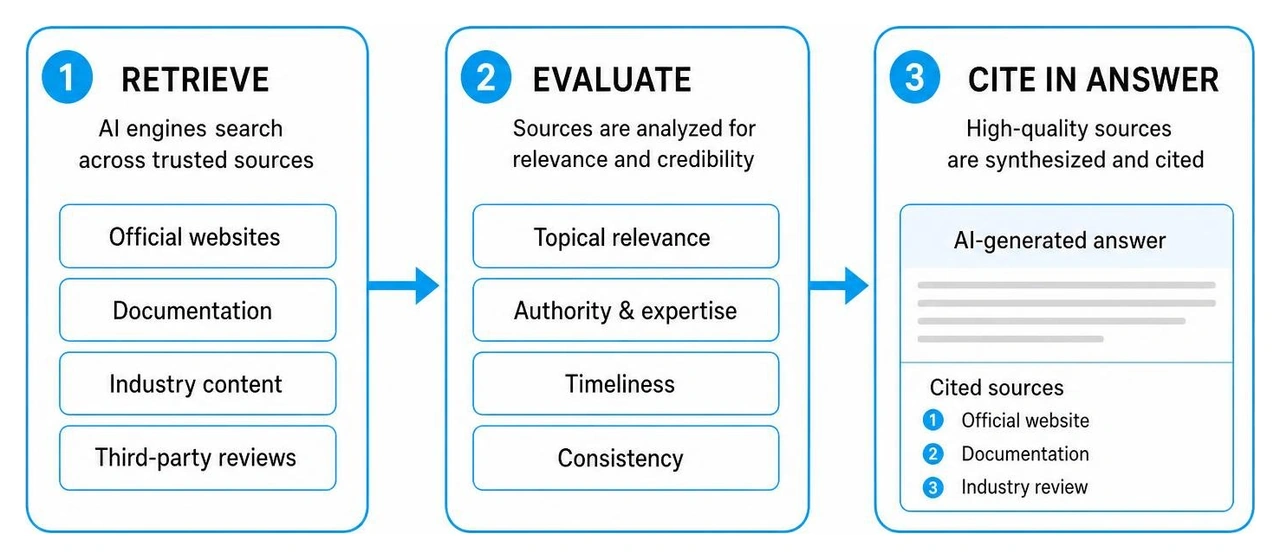
Large language models (LLMs) do not generate fixed, deterministic ranking lists. Answers and cited sources can vary across platforms and between runs.
Rank tracking alone does not show these differences. AI visibility platforms can track how answers vary, conversations with follow-up questions, how answers describe your brand, and query fanouts (the web searches an AI system runs before answering).
| Measurement Factor | Traditional SEO Tracking | Generative Engine Visibility (GEO/AEO) |
|---|---|---|
| Core Metric | SERP rank position (e.g., #1–#10) | Percentage of tested answers mentioning your brand / Your brand's share of tracked brand mentions |
| Output Nature | Deterministic (fixed URL order) | Probabilistic (variable answers per run) |
| Source Overlap | High consistency across engines | Cited sources can vary across engines |
| Analysis Scope | Keyword position and backlink counts | Mentions, citations, sentiment, and prompt context |
| User Interaction | Single search query | Multi-turn conversational prompts |
Relying solely on ranking trackers creates blind spots. Use data-driven marketing strategies to track how often AI answers mention your brand, how they describe it, and which sources they cite.
What to Look for in the Best AI Search Visibility Tools
Selecting an AI monitoring tool requires looking beyond its dashboard. Because AI answers vary between runs, check how often a tool repeats each test, which AI platforms it covers, and whether its findings suggest useful changes.

When evaluating software, an online visibility management platform should address four core operational requirements:
- Multi-Engine Reach: Look for coverage of the platforms your buyers use, including ChatGPT Search, Google AI Overviews, Perplexity, Claude, Gemini, and Microsoft Copilot.
- Sampling Depth & Frequency: A single test shows only one answer. Look for tools that repeat the same questions over several days and report how often your brand appears.
- Citation & Source Intelligence: Check whether the tool shows the exact URLs, review platforms, forums, and technical whitepapers cited in AI answers.
- Specific Content Recommendations: Look for gaps where competitors are recommended over your product, including missing citations and outdated specifications.
Core Features That Define the Best AI Search Visibility Tools
The top tools on the market share several technical capabilities:
- Browser Tests vs. API Tests: Browser tests use the platform's user interface. API tests connect through its application programming interface. Check which method a tool uses, because the answers and citations can differ.
- Sentiment & Positioning Analysis: Evaluates whether the model frames your hardware as a premium solution, an enterprise standard, or merely a budget alternative.
- Frequently Cited Sources: Shows which outside sites appear repeatedly in AI citations, such as Reddit, industry review sites, and component specification databases.
- Real-Time Visibility Alerts: Notifies your marketing team immediately when brand mentions drop or when inaccurate specifications appear in generated summaries.
How to Choose the Best AI Search Visibility Tools for Your Existing Tools
When auditing options, choose the software that matches your team structure and technical requirements:
- Calculate the Sampling Rate: Check how many times each question runs per month. If a tool tests a question once a month, you cannot see how answers vary between runs.
- Test Questions Your Buyers Ask: Ensure the tool lets you create and edit question sets that reflect how buyers ask about products. For example: "Compare low-power edge computing modules for industrial robotics."
- Fit with Your Existing Tools: Decide whether you need a separate tracker, an add-on to software you already use, or a tool that helps your team update content.
Top AI Visibility Platforms Compared
Different platforms excel in distinct environments, ranging from dedicated enterprise trackers to integrated marketing suites.
To see how the leading solutions compare, review the summary below:
| Platform | Primary Strength | Engine Coverage | Best For | Key Watchout |
|---|---|---|---|---|
| Profound | Testing large sets of questions & SOC 2 compliance (audited controls for handling customer data) | ChatGPT, Perplexity, Claude, Gemini, Copilot | Mid-market & enterprise teams | Steeper learning curve for non-analysts |
| Peec AI | Prompt & citation tracking with a clear interface | ChatGPT, Perplexity, Claude, Gemini | Small-to-mid teams needing fast insights | Less structured workflow for large content teams |
| Semrush AI Toolkit | Large prompt database (317M+) | Google AI Overviews, ChatGPT, Perplexity | Existing Semrush users | Add-on tied to the broader Semrush software suite |
| Rankscale | Broad cross-engine tracking (17+ engines) | 17+ AI platforms, global regions | Multi-brand setups and broad engine audits | Tests use credits from your allowance |
| OtterlyAI | Straightforward entry-level tracking | Google AI Overviews, ChatGPT, Perplexity | Early-stage startups establishing a baseline | Focused primarily on core prompt monitoring |
| AIclicks | Source analysis & outreach recommendations | 10+ AI platforms | Teams contacting sites that cite competitors but not their brand | Interface geared toward ongoing work to improve visibility in AI answers |
| ZipTie | In-depth Google AI Overviews intelligence | Google AI Overviews, ChatGPT, Perplexity | Detailed tracking to identify visibility problems in Google AI Overviews | Lacks extensive multi-turn conversation tracking |
| Nightwatch | Hybrid SEO rank tracking + LLM visibility | Core search engines + major LLMs | Teams wanting traditional rank & AI in one tool | Broader focus across both traditional and AI search |
When testing platforms, evaluate data transparency over polished dashboards. The best tool provides direct access to the raw answers generated by each engine, allowing you to verify what the model actually outputs.
How Hardware Brands Use AI Visibility Data to Improve Product Pages
Use AI visibility data to update your product pages and explain more clearly what buyers gain from your hardware. Three problems to look for: the launch falls flat because the product is ready but the story is not; growth stalls after early sales; or people do not get it because the site reads like a spec sheet.
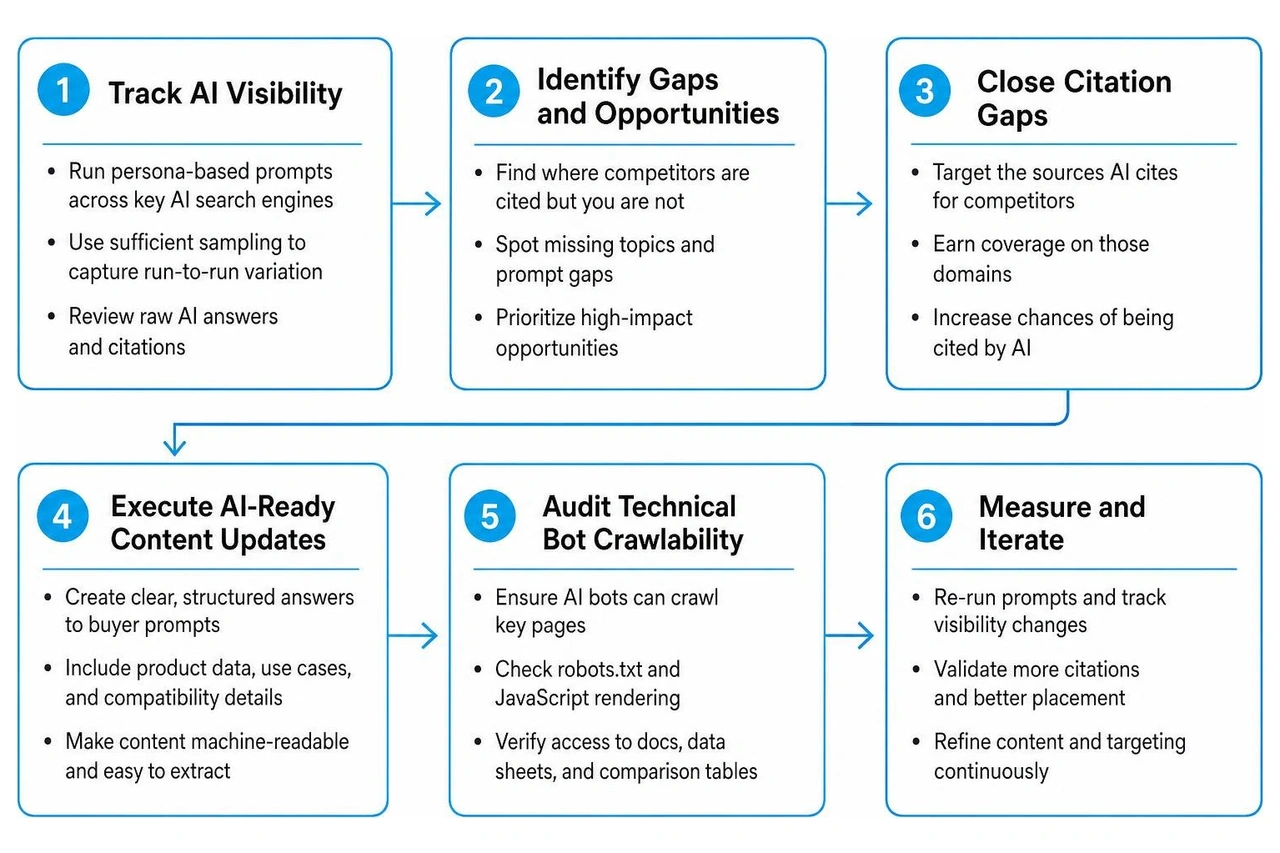
Leading with what the hardware does for the buyer, and supporting it with precise technical specifications, helps buyers and AI systems understand the product.
- Close Citation Gaps: Identify the third-party review sites, industry articles, and forum discussions cited by LLMs when recommending competitors. Coverage on those sites can give AI systems another source of information about your product.
- Update Product Pages for AI Search: Answer the questions buyers ask about your product. Use AI-driven content marketing to help organize product data, use cases, and compatibility details so software can read them.
- Check Whether AI Crawlers Can Read Your Site: Check whether automated bots such as GPTBot, ClaudeBot, and PerplexityBot can access your documentation, technical data sheets, and comparison tables. Review access rules in robots.txt and whether client-side JavaScript prevents the content from being read.
- Monitor and Refine Brand Messaging: If an AI engine repeatedly miscategorizes your product or cites outdated performance figures, update your pages with clear comparison tables and FAQ structured data, which labels questions and answers in code. This gives AI systems more accurate source material.
Frequently Asked Questions About AI Visibility Tools
How do AI visibility tools handle non-deterministic LLM responses?
Because language models can produce different answers to the same question, a prompt run at 9:00 AM can yield slightly different wording or citations than the same prompt run at 5:00 PM. AI visibility tools can measure this variation by repeating the same questions at regular intervals. By testing each question multiple times across days or weeks, the platform can report how often your brand appears and its share of tracked brand mentions, rather than relying on one answer.
Which AI search engines should brands monitor first?
Hardware and B2B brands should prioritize monitoring ChatGPT Search, Google AI Overviews, and Perplexity. Check these platforms using questions your buyers ask about product specifications, compatibility, and alternatives. Secondary monitoring should include Anthropic Claude, Microsoft Copilot, and Google AI Mode.
Can AI visibility tracking measure location-based answers for hardware distribution?
Yes, if the tool supports regional testing. Some tools test questions through servers in different regions or use regional settings. Hardware distributors, component suppliers, and regional service providers can use these tests to compare recommendations across locations. Check whether the tool covers your markets and shows differences in regional availability and supplier recommendations.
Conclusion
When buyers ask AI tools to recommend technical components, consumer electronics, or industrial robotics, check whether your company appears in the answers. Use AI search visibility tools to see where your brand appears and which product details need updating.
CRISPx plugs in as the outsourced marketing and sales team for hardware companies run by engineer founders, eliminating the need to hire a separate head of marketing. Available across four dedicated plans, Launch, Grow, Grow + Ads, and Scale, we help technical brands build sustained market demand.
Our work uses The DOSE Method™, a strategy framework:
- Diagnosis: We analyze your website, story, and digital presence to find what is broken.
- Prescription: We identify and fix the biggest problem first.
- Prognosis: We establish clear performance targets, track real-world progress, and adjust strategy over time.
Our experience in hardware and technology includes:Tony Crisp has 30 years in branding, 100+ hardware launches and 8+ patents. Robosen Optimus Prime went from Kickstarter to CES, then Hasbro and Disney licenses. FuzeDrive ran a top 1% Indiegogo campaign. SecureCircle was acquired by CrowdStrike.
Find out where your brand stands in modern search and generative answers. Get a free DOSEscore™ brand checkup of your website and story today, or book a strategy call with our team.
Get a free brand checkup.
We work like a brand doctor. The DOSE Method™ finds what's broken, fixes the biggest problem first, then tracks the results.
