Brand New: The Ultimate Guide to Building Your Product Identity
Learn how to build product service brand with LaunchX, OrbitX & AI. Master architecture, identity, growth marketing & launch excellence!


Learn how to build product service brand with LaunchX, OrbitX & AI. Master architecture, identity, growth marketing & launch excellence!
How to build product service brand starts with understanding that your brand is far more than a logo—it's the complete system of perception, promise, and emotional connection that shapes every customer interaction. Here's the essential framework:
The stakes are high. More than 50 percent of all product launches fail to hit business targets, despite companies investing over $1.5 trillion globally in R&D. The difference between success and failure often comes down to brand clarity—knowing exactly who you are, who you serve, and how you're uniquely positioned to solve real problems.
I'm Tony Crisp, founder of CRISPx, and I've spent two decades helping tech companies from startups to Fortune 500 brands master how to build product service brand value through data-driven creativity and strategic execution. My work with clients like Nvidia, HTC Vive, and Robosen has proven that the right branding framework—combined with psychological insights and rigorous testing—creates the foundation for sustainable growth.
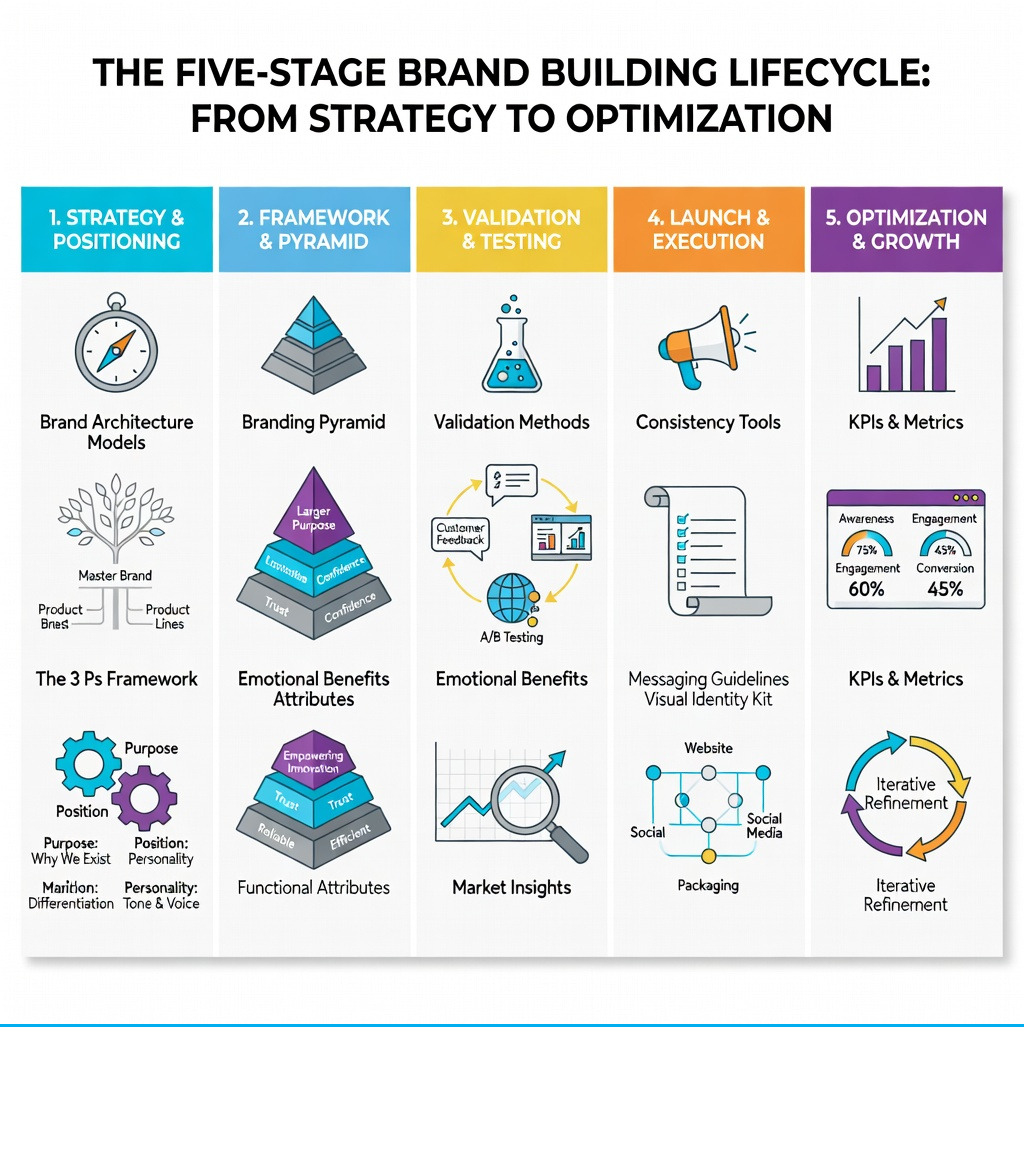
Must-know how to build product service brand terms:
When we look at how to build product service brand equity, the first fork in the road is often the most daunting: Do you use your current name or start fresh? This is the core of brand architecture. Think of it as the floor plan for your business’s future. If you’re a successful software company launching a new consulting arm, do you call it "[Company Name] Services" or give it a sleek, independent identity?
There are three primary models we use to navigate this:
Simply put, your brand is your promise to your customer. Whether you extend or create, that promise must remain unbroken. If you are currently Building Brand Identity for a new venture, your architecture should reflect your long-term exit strategy. If you plan to sell the new service separately later, a "House of Brands" approach is almost always better.
The decision to reuse or create isn't just about aesthetics; it’s about risk management and market fit. We often see founders fall into the trap of "brand ego," wanting their name on everything even when the audience overlap is zero.
Consider these factors before you commit:
| Feature | Branded House | House of Brands |
|---|---|---|
| Marketing Cost | Low (Shared equity) | High (Individual budgets) |
| Risk Spreading | Low (One fails, all suffer) | High (Siloed reputations) |
| Market Clarity | Can be confusing if broad | Very high for specific niches |
| Management | Simple, centralized | Complex, decentralized |
If you’re feeling stuck, organizations like a Small Business Development Center can provide additional local resources to help you weigh these corporate structures.
At CRISPx, we developed LaunchX to help companies move beyond "just a product" to a brand that people actually care about. To do this, we use the Branding Pyramid.
Most companies spend all their time at the bottom of the pyramid—the Functional Attributes. They talk about speeds, feeds, and price points. But features are easily copied. To build lasting value, you have to climb higher.
By focusing on the top of the pyramid, you create "hard-to-copy" Brand Strategy. A competitor can build a faster vacuum, but they can't easily steal the "sanctuary" feeling you've spent years cultivating.
You might think your idea is the greatest thing since sliced bread, but the market is a cold, hard judge. Average failure rates for product launches are over 40 percent across industries. To avoid becoming a statistic, you need a rigorous validation process.
We recommend using a Concept Summary—a two-paragraph "gut-check" that describes exactly what the product is, who it's for, and why it matters. Don't show this to your mom or your co-founder. Show it to 20 to 40 people who fit your target profile but have no reason to be nice to you.
We also lean on IDEO’s framework for evaluating potential success:
If you can't answer "yes" to all three, you aren't ready for Developing Your Brand Identity. You’re just expensive daydreaming.
If you want to know how to build product service brand foundations that last a decade, you have to nail the "3 Ps." This isn't fluff; it's the DNA of your business.
1. Purpose (The 10-Year Horizon)Your purpose is your "Big IdeaL." We use the Ogilvy framework which looks at the intersection of two circles:
2. Position (The 18-Month Horizon)Positioning is about how you sit in the mind of your target audience relative to competitors. It’s tactical. While purpose is why you exist, positioning is why someone should buy from you today instead of the other guy. Effective Creating Brand Strategy requires you to "own a word" in the customer's mind. Volvo owns "Safety." BMW owns "Performance." What word do you want to own?
3. Personality (The Voice)If your brand walked into a cocktail party, how would it act? Is it the "super-smart architect friend who is flawlessly dressed" or the "quirky, rebellious artist who tells it like it is"? Defining this early prevents your marketing from sounding like a generic corporate robot.
A positioning statement is an internal tool to keep your team aligned. We like the "Mad Libs" template because it forces you to be concise:
[Product/Service] is a [Category] for [Target Audience] that [Key Benefit] unlike [Competitor] because [Differentiation].
For example, if we were looking at How to Build a Service Brand for a new AI-driven law firm, it might look like this: "LexBot is a legal research tool for overworked paralegals that cuts research time by 80% unlike traditional databases because it uses natural language processing to find hidden case law."
Notice that the "Key Benefit" is what the customer says ("It saves me time"), while the "Differentiation" is the technical reason to believe ("It uses AI"). Don't mix them up!
Once you have your positioning, you need to decide how to say it. We suggest picking three core adjectives. If you choose "Playful, Professional, and Innovative," you then need a Voice Guide.
A voice guide should show examples of "This, Not That."
This ensures that whether a customer reads a tweet or an instruction manual, they feel the same "vibe." This is a critical step in Logo and Brand Identity Design—your visuals must match your voice. You wouldn't use a neon pink graffiti logo for a brand that describes itself as "Staid, Reliable, and Conservative."
To keep everyone on the same page, create a style guide for your brand that covers everything from logo usage to the specific words you never use.
Building the brand is only half the battle; the other half is making it move. This is where OrbitX comes in. OrbitX is our framework for growth marketing that leverages deep behavioral psychology.
We don't just look at clicks; we look at the "Why." Why did the user hesitate on the pricing page? Why did they share that specific blog post? By using User Journey Mapping, we can identify friction points where your brand promise isn't being met.
One of our favorite tools for this is the Six Thinking Hats exercise. We bring teams together to look at a launch through different lenses:
This prevents "Groupthink" and ensures that How to Make Branding Strategy isn't just a result of the loudest person in the room getting their way.
As humans, we are wired to make mistakes. In product development, three biases kill more brands than bad engineering:
Protecting your brand also means protecting your ideas. Check the government's website to ensure you have your trademarks and IP in order. There is nothing worse than building a beautiful brand only to get a cease-and-desist letter three months later. For more hands-on help, try these Branding Exercises for Startups.
In the modern landscape, how to build product service brand value requires more than just a gut feeling. We are living in the era of "Data-Driven Creativity."
At CRISPx, we use AI to analyze massive datasets—from social sentiment to competitor pricing—to find "Cultural Tensions" that aren't visible to the naked eye. AI allows us to:
This is especially powerful in B2B Brand Building, where the sales cycles are long and the decision-makers are many. Using data to prove your brand's value at every stage of the funnel is the only way to scale.
Consistency is the silent killer of brands. If your website looks like a tech startup but your customer service sounds like a 1980s bank, you have a "Brand Gap."
We use Brand Development Services to audit every touchpoint—from your email signature to your physical packaging.
Key Metrics to Track:
American families buy the same 150 products that make up 85 percent of their household needs. Breaking into that "inner circle" requires relentless consistency. If you change your logo every six months, you'll never build the "mental shortcuts" that lead to repeat purchases.
It depends on your "Brand Architecture." If the new service targets the same audience and has a similar risk profile, a "Branded House" extension is cost-effective. If it’s a radical departure or carries high reputational risk, build a new brand.
Don't just look at sales. Look at Share of Voice, Sentiment, and Conversion Rates. A successful launch like eero pulled in $2.5 million in sales in a fortnight via pre-orders—that’s a validation metric that proves the brand positioning worked before the product even shipped.
Start early. Search for trademarks before you fall in love with a name. Register your domain names and social handles immediately. Consult legal experts to ensure your "Reason to Believe" (the tech or process that makes you unique) is protected by patents if applicable.
Building a brand is a journey of self-discovery, market research, and psychological warfare. It’s about moving from a "boring" functional product to a purpose-driven identity that resonates with the human soul.
At CRISPx, we specialize in this transition. Using our DOSE Method™, we combine data-driven creativity with strategic marketing to ensure your launch isn't just a "blip" on the radar, but the start of an enduring legacy. We help tech leaders navigate the complexities of modern identity through a blend of psychological insights and high-performance execution.
Whether you are in Newport Beach or operating globally, the principles of how to build product service brand value remain the same: Be clear, be consistent, and be human.
Ready to take your brand to the next level? More info about our launch services.




Accessibility: If you are vision-impaired or have some other impairment covered by the Americans with Disabilities Act or a similar law, and you wish to discuss potential accommodations related to using this website, please contact our Accessibility Manager at (949) 791-9150