How to Build a SaaS Product Launch Strategy That Actually Scales
Build a scalable SaaS product launch strategy with our 3-phase framework: validate, hype, and optimize for explosive growth.


Build a scalable SaaS product launch strategy with our 3-phase framework: validate, hype, and optimize for explosive growth.
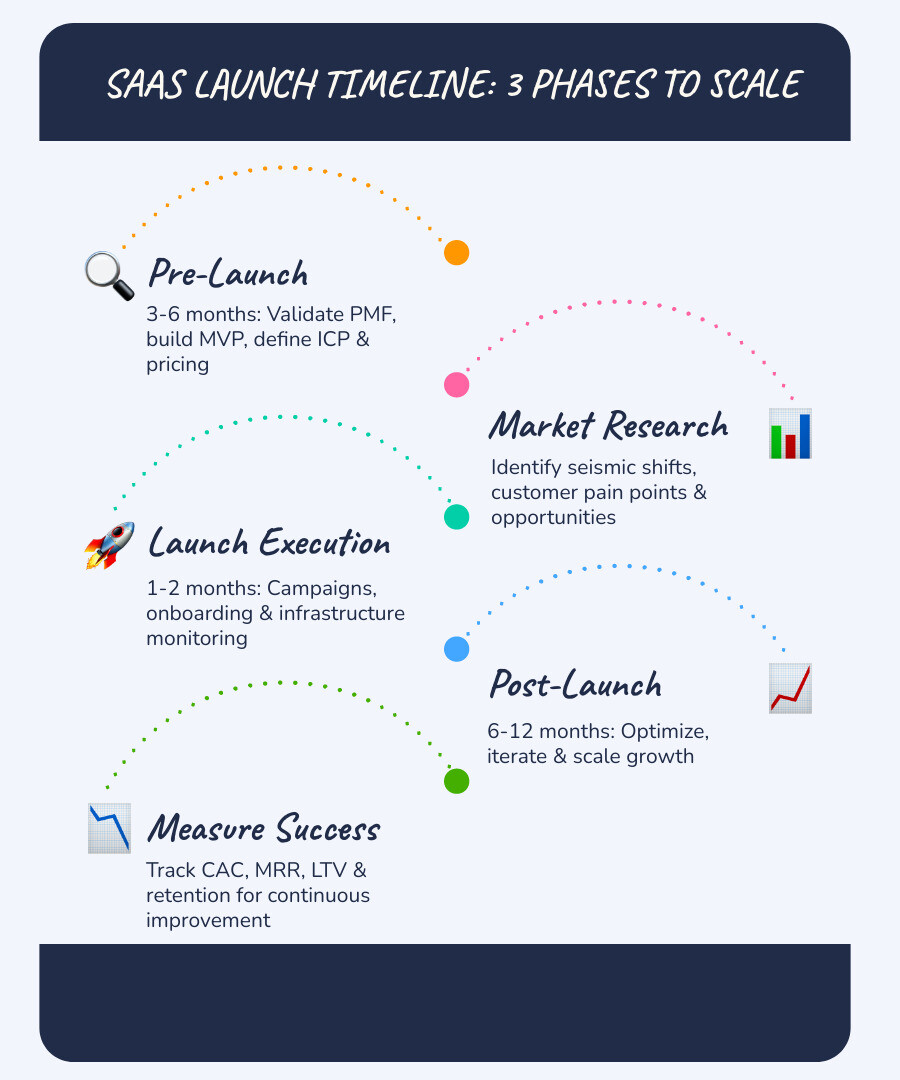
A saas product launch strategy requires three critical phases to maximize success:
Here's a sobering reality: only 8% of SaaS startups succeed. With approximately 30,000 SaaS companies competing for attention today, the margin for error has never been smaller. The difference between the winners and the 92% who fail? A clear, repeatable launch framework that goes beyond generic checklists.
Most founders make the same mistake—they treat launch as a single event rather than a systematic process. They skip crucial validation steps, assume they understand their market, and pour resources into features nobody asked for. As one expert put it: "The last thing you want is to do a big splashy launch of a product that is D.O.A. because you built what you assumed the customers wanted instead of what they actually demonstrated that they wanted."
The stakes are high, but the path forward is clear. Success comes from three pillars: building authentic brand value through customer validation (LaunchX), leveraging psychological growth triggers to create momentum (OrbitX), and using AI strategically to increase quality while reducing costs. Sales reps using AI to react to buyer emotions are 52% more likely to exceed their goals, and AI can increase leads by 50% while decreasing costs by 60%.
I'm Tony Crisp, and over my career working with tech companies from startups to Fortune 500 firms like Nvidia and HTC Vive, I've developed a proven saas product launch strategy framework that addresses the real challenges founders face—from validation to scale. This guide will walk you through each phase with actionable steps, not theory.
Before we spend a single dollar on ads or write a single line of production code, we have to talk about Brand Value. In the SaaS world, brand value isn't just a logo; it’s the trust you build by proving you understand a problem better than anyone else. This is where our LaunchX methodology begins.
A successful High-Tech Product Launch is rooted in deep market research. We don't just look at what features people want; we look for the "seismic shifts" in the industry. Are you moving into a new market? Is there a regulatory change? Understanding these external factors allows us to position your product as the inevitable solution.
The foundation of this phase is the Minimum Viable Product (MVP). An MVP isn't a "broken" version of your vision; it's the smallest version of your product that delivers the core value. By focusing on an MVP, we can test How to Launch a Tech Product without the risk of over-engineering.
To make this work, you need a crystal-clear Ideal Customer Profile (ICP). You can use persona templates to map out exactly who your buyers are—their job titles, their daily frustrations, and what keeps them up at night. Once we know who they are, we craft a brand story that resonates emotionally. Even in B2B SaaS, you are selling to humans.
Validation is the antidote to failure. We recommend a 3-to-6-month pre-launch window dedicated to testing. This involves recruiting early adopters who are "feeling the pain" of the problem you solve. Tools like Userfeel can help you observe how these users actually interact with your software.
During beta testing, we look for product/market fit signals. Are users coming back? Is the "time-to-value" short enough? If it takes three weeks for a user to see a result, they’ll churn. We want them to have that "a-ha" moment in minutes. This feedback loop allows us to prioritize features that actually drive retention rather than just adding "bloatware."
In a sea of 30,000 competitors, "good enough" is a death sentence. We use a rigorous Semrush SWOT guide approach to analyze the strengths, weaknesses, opportunities, and threats in your niche.
Your USP shouldn't just be "we're cheaper" or "we have more features." It should be a specific promise of an outcome. For example, "We save marketing managers 15 hours a week on reporting." That is a benefit-focused USP. By conducting a thorough competitor analysis, we find the gaps they’ve left behind—perhaps their UI is clunky or their support is non-existent—and we make that our winning edge.
Once the product is validated, we shift into OrbitX. This is where we execute growth marketing using human psychology. We don’t just "post on social media"; we create a movement.

Successful Innovative Product Launch Strategies leverage triggers like scarcity and urgency. Think about the most successful SaaS launches of the last decade—they often started with an invite-only waitlist. This creates a "Builder Circle" of elite users who feel like insiders.
When we look for Creative Product Launch Ideas, we often look at platforms like Product Hunt. However, a Product Hunt launch shouldn't be your only move; it should be one "relay" in a larger sequence of events designed to build compounding momentum.
If you already have a customer base, they are your greatest asset. Existing customers spend about 67% more than new customers. However, launching to them requires a delicate touch. You need a rock-solid migration plan to ensure the transition from their old workflow to your new service is hassle-free.
We often look to Clarity.fm expert advice on migration to remind us that failure to handle the "hassle factor" can lead to a loss of your existing base. We suggest offering "loyalty rewards" or early-bird pricing to your current users first. This not only drives early adoption but also provides you with a group of "champions" who can provide testimonials for the public launch.
Hype is built through a sequence of "teasers." We don't just announce the product; we teach the problem.
Statistics show that 73% of B2B sales leaders believe webinars are the best way to generate leads, especially when they include a Q&A session. We also lean heavily into social selling. Since 84% of C-level executives are influenced by social media, your founders should be "building in public" on LinkedIn, sharing the highs and lows of the journey to build authentic trust.
In 2026, a saas product launch strategy that doesn't utilize AI is like trying to win a Formula 1 race on a bicycle. We use AI to automate the heavy lifting so our team can focus on creativity and strategy.
| Task | Manual Workflow | AI-Powered Workflow (CRISPx Style) |
|---|---|---|
| Lead Generation | Hours of manual LinkedIn searching | Automated ICP matching and intent signals |
| Content Creation | 1 week per whitepaper | 1 day for a draft + personalized versions |
| Sales Outreach | Generic "cold" templates | Hyper-personalized emails based on buyer emotions |
| Customer Support | Reactive ticket queue | Proactive AI chatbots solving 60% of queries |
According to The State of AI in Sales, AI can decrease costs by 60% while increasing lead volume. We use AI for predictive analytics to identify which beta users are most likely to become high-value customers.
Furthermore, 79% of consumers say they were convinced to buy software by watching a brand's video. We use AI-powered video tools to create personalized product tours at scale. This allows us to follow Sales AI trends where every prospect feels like the demo was built specifically for them.
Launch day is "all hands on deck." It’s the culmination of your Product Launch Marketing Plan. We monitor everything in real-time: server loads, sign-up conversions, and customer support tickets.
One of the most effective ways to drive conversion on launch day is through Storylane interactive demos. Instead of asking a user to "Book a Demo" and wait 24 hours, let them play with a sandbox version of the product immediately. This reduces friction and capitalizes on the excitement of the launch.
Post-launch, the focus shifts to onboarding. If a user sign-ups but doesn't "activate" (i.e., perform a key action) within the first 24 hours, the chance of them churning skyrockets. We prioritize technical monitoring and proactive support to catch "gremlins" before they frustrate your new users.
You cannot manage what you do not measure. We move beyond "vanity metrics" like website hits and focus on:
We often perform KPI recalibration after the first 30 days. The goals you set in pre-launch might need to shift based on how the market actually responded. We look closely at customer engagement metrics to see which features are driving the most value and double down on those in our next development sprint.
We typically recommend a 3-to-6-month window for the pre-launch phase. This isn't just for coding; it's for validation. You need time to build a waitlist, recruit beta testers, and create your content engine. Use a product launch checklist to track milestones like "ICP Defined" and "MVP Stable" to ensure you don't rush to market with a half-baked product.
An MVP should solve one specific problem exceptionally well. Don't try to build an "all-in-one" platform on day one. Follow the Y Combinator approach of doing things that don't scale initially—like manually onboarding your first 50 users—to learn exactly what the core functionality needs to be.
The primary reason is a lack of Product-Market Fit (PMF). Many teams fall in love with their technology and forget to check if anyone actually wants to buy it. This leads to a dismal 8% success rate. Other common mistakes include scaling too fast before the product is stable or having poor positioning that doesn't differentiate the product from existing incumbents.
Building a saas product launch strategy that actually scales isn't about luck; it's about a disciplined framework. At CRISPx, we've spent years refining the DOSE Method™ to help tech brands move from "just another startup" to a market leader.
By combining the brand-building power of LaunchX, the psychological growth triggers of OrbitX, and the efficiency of modern AI, we create launches that don't just spike—they sustain. Whether you are based near our headquarters in Newport Beach, CA, or operating globally, the principles of data-driven creativity and strategic validation remain the same.
Ready to take your product to the next level? Explore our Launch services and let's build a roadmap to success together. We don't just launch products; we launch the future of tech.
We work like a brand doctor. The DOSE Method™ finds what's broken, fixes the biggest problem first, then tracks the results.




Accessibility: If you are vision-impaired or have some other impairment covered by the Americans with Disabilities Act or a similar law, and you wish to discuss potential accommodations related to using this website, please contact our Accessibility Manager at (949) 791-9150