How to Master Data-Driven Web Development Without Losing Your Mind
Master data driven web development: workflows, tools, tech stacks & psychology-led strategies for high-conversion sites without the chaos.


Master data driven web development: workflows, tools, tech stacks & psychology-led strategies for high-conversion sites without the chaos.


Data-driven web development is the practice of using real user behavior, analytics, and testing to guide every decision about your website—from layout and content to features and performance. Instead of guessing what works, you measure, test, and optimize based on actual evidence.
Quick Answer: The Data-Driven Development Workflow
The stakes are high. Google found that a 0.5-second delay in page loading decreased traffic by 20%. Companies using discount banners informed by data saw conversion rates jump 15%. Yet most businesses collect mountains of analytics data without ever turning it into website improvements.
The problem isn't the data itself—it's the gap between analytics teams and developers. Data sits in dashboards while websites remain static. Features launch based on gut feelings instead of evidence. Resources get wasted on changes that don't move the needle.
Data-driven development bridges this gap. It transforms analytics from a reporting exercise into a systematic process where insights become development tickets, tests validate assumptions, and every change is measured against real user behavior.
This approach works for everyone—from tech startups launching their first product to established companies optimizing conversion funnels. The tools are more accessible than ever. Small teams can now implement the same data-driven workflows that big tech companies have used for years.
I'm Tony Crisp, founder of CRISPx, where I've spent years helping tech startups and Fortune 500 companies implement data-driven web development strategies that increase conversions and build brand value. Through LaunchX and OrbitX methodologies, I've seen how combining analytics with psychology-led marketing transforms product launches and growth trajectories.
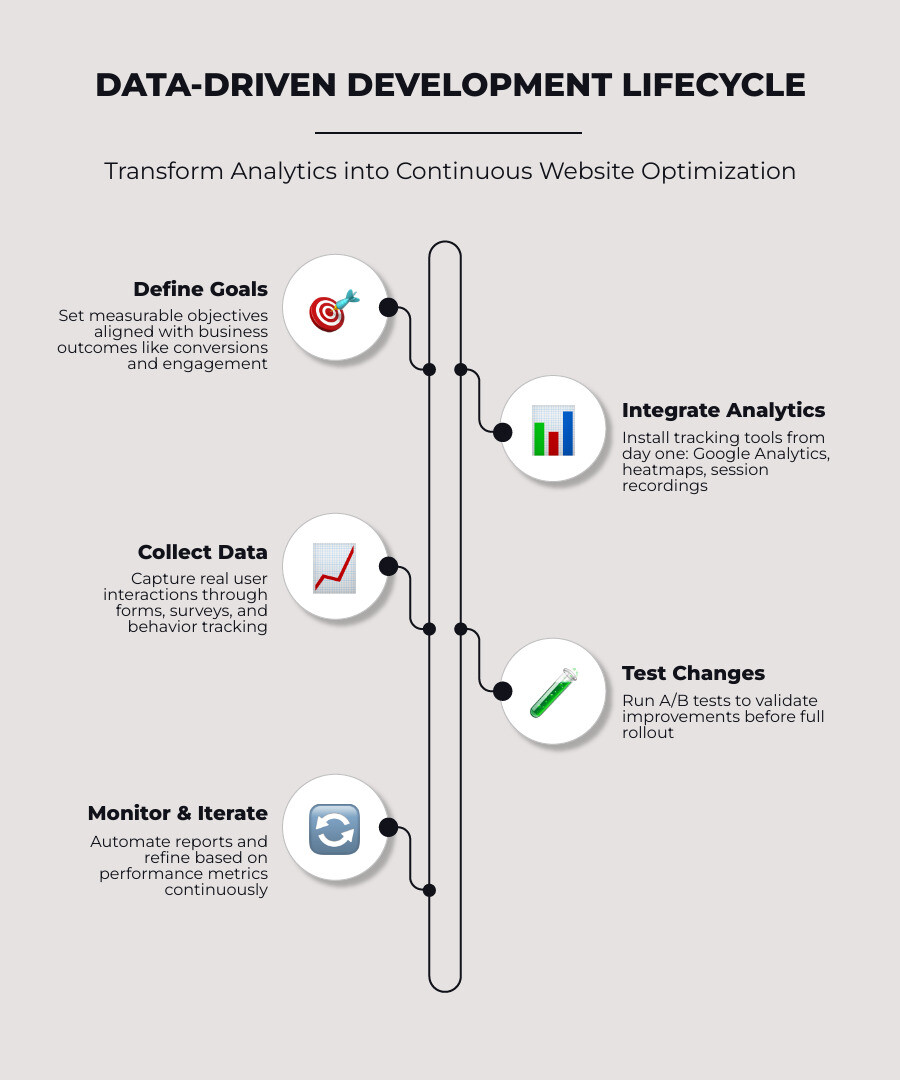
Quick look at data driven web development:
In traditional web development, the process often feels like a "one-and-done" project. You design a beautiful interface, launch it, and hope for the best. We call this the "billboard in the forest" syndrome—it looks great, but if no one sees it or interacts with it the way you intended, it’s not doing its job.
Data driven web development flips this script. It treats a website as a living organism that evolves based on evidence. Instead of subjective opinions like "I think this button should be red," we use a hypothesis-based design approach: "We believe a red button will increase click-through rates because it contrasts better with our brand palette, and we will measure the result."
Speed is perhaps the most critical pillar. Research from Google highlights that even a 0.5-second delay can lead to a 20% drop in traffic. In a data-driven world, performance isn't just a technical metric; it’s a user experience (UX) requirement. We use performance data to identify bottlenecks and optimize the "critical path" of the user journey.
A truly data-driven website isn't just a site with Google Analytics installed. It possesses specific traits that allow it to learn from its visitors:
| Feature | Traditional Website | Data-Driven Website |
|---|---|---|
| Decision Making | Based on "gut feel" or trends | Based on user behavior data |
| Updates | Occasional, major redesigns | Continuous, iterative improvements |
| User Experience | Static for all users | Personalized based on behavior |
| SEO Focus | Keyword stuffing | Performance and user intent data |
Transitioning to a data-heavy workflow isn't without its hurdles. Many developers struggle with "frontend data transformation." This happens when you pull massive amounts of raw data from a database and try to format it inside the user's browser using JavaScript. This often leads to memory leaks and sluggish performance, especially in complex React applications.
Another common pitfall is GraphQL overhead. While GraphQL is popular, it can sometimes be overkill for simple data tables, leading to slower query times than traditional REST APIs.
However, the biggest challenge is rarely technical—it’s organizational. Harvard Business School notes that even big tech giants like Microsoft have had to physically relocate offices to ensure analytics and development teams meet more frequently. For us in Newport Beach, CA, we’ve found that successful data driven web development requires a "cross-skilling" culture where developers understand analytics and analysts understand the limitations of the tech stack.
To master this without losing your mind, you need a repeatable workflow. At CRISPx, we focus on Data Analysis for Marketing to ensure the technical build supports the business goals.
How do you know if it’s working? You have to move beyond "vanity metrics" like page views and look at Data-Driven Customer Insights.
Key metrics to track include:
Automated reporting is your best friend here. Instead of manually digging through Google Analytics every week, set up dashboards that highlight these KPIs in real-time. This allows your team to react quickly to changes in user behavior.
The ultimate goal of data driven web development is to make the user feel like the website was built just for them. This is achieved through Data-Driven Application Design.
Choosing the right tech stack can prevent the "memory leak" headaches mentioned earlier. The HTTP Archive's Web Almanac tracks millions of pages to see how the web is built, and the trends are clear: developers are moving toward tools that prioritize both data handling and performance.
We often aim for the "pit of success"—a concept from the creators of Observable 2.0. This means using tools with opinionated defaults that nudge you toward building fast, accessible, and performant data apps by default.
To truly innovate, you need to be able to test features safely. Platforms like Statsig have democratized the tools used by giants like Facebook and Microsoft.
Essential analytics tools to consider:
At CRISPx, we don't just build websites; we launch brands. Our LaunchX methodology focuses on building Brand Value from the ground up. By using data driven web development, we ensure that your brand's digital home is built on a foundation of user needs, not just aesthetic trends.
Once the site is live, OrbitX takes over. This is our growth marketing engine that uses psychology and data to keep users engaged. We look at Data-Driven Marketing Strategies to understand the "why" behind user actions. Why did they abandon the cart? Was it a lack of trust (psychology) or a slow page load (data)?
By combining these two, we move users through a brand value pyramid—from awareness to loyalty—using data as the fuel for every step.
AI is the newest member of the data-driven team. By integrating AI into brand marketing, we can increase both quality and efficiency. For example, developers using AI "function calling" features have reported a 25% decrease in post-processing time.
We use AI to:
This isn't about replacing humans; it's about giving our creative teams better tools to build more effective, data-driven marketing campaigns.
Traditional development relies on a static plan and "gut feelings" about what users want. Data driven web development uses a continuous loop of measurement, testing, and optimization. It treats the website as a product that is never "finished" but always improving.
Data-driven development improves SEO by focusing on performance metrics (like page speed) and user intent data. It boosts conversion rates by using A/B testing and heatmaps to identify and remove "friction" in the user journey. As we saw, a 15% increase in conversions is entirely possible when you use data to inform your design.
For Python-heavy teams, Streamlit and Plotly Dash are fantastic. For traditional web teams, React paired with a robust state management library is standard. Tools like Statsig are essential for managing experiments, while Elasticsearch is the go-to for high-performance data searching.
Mastering data driven web development doesn't have to be overwhelming. It starts with a shift in mindset: moving from "launching a site" to "launching an experiment." By aligning your teams, choosing the right tools, and committing to continuous optimization, you can build a digital presence that actually grows your business.
At CRISPx, our DOSE Method™ ensures that every project we touch—whether it's a new brand launch or a growth marketing campaign—is rooted in data-driven creativity. We’ve helped brands in Newport Beach and beyond turn their data into their most valuable asset.
Ready to see it in action? View our successful data-driven case studies and see how we can help you build a smarter, faster, and more profitable website.




Accessibility: If you are vision-impaired or have some other impairment covered by the Americans with Disabilities Act or a similar law, and you wish to discuss potential accommodations related to using this website, please contact our Accessibility Manager at (949) 791-9150