The 2026 Guide to Mastering B2B Brand Awareness Strategy
Master your 2026 B2B brand awareness strategy: 95-5 rule, LinkedIn growth, AI scaling & ROI measurement for tech brands.


Master your 2026 B2B brand awareness strategy: 95-5 rule, LinkedIn growth, AI scaling & ROI measurement for tech brands.


A b2b brand awareness strategy is your systematic approach to making your brand recognizable and memorable to business decision-makers before they're ready to buy. Here's what an effective strategy includes:
Core Components of a B2B Brand Awareness Strategy:
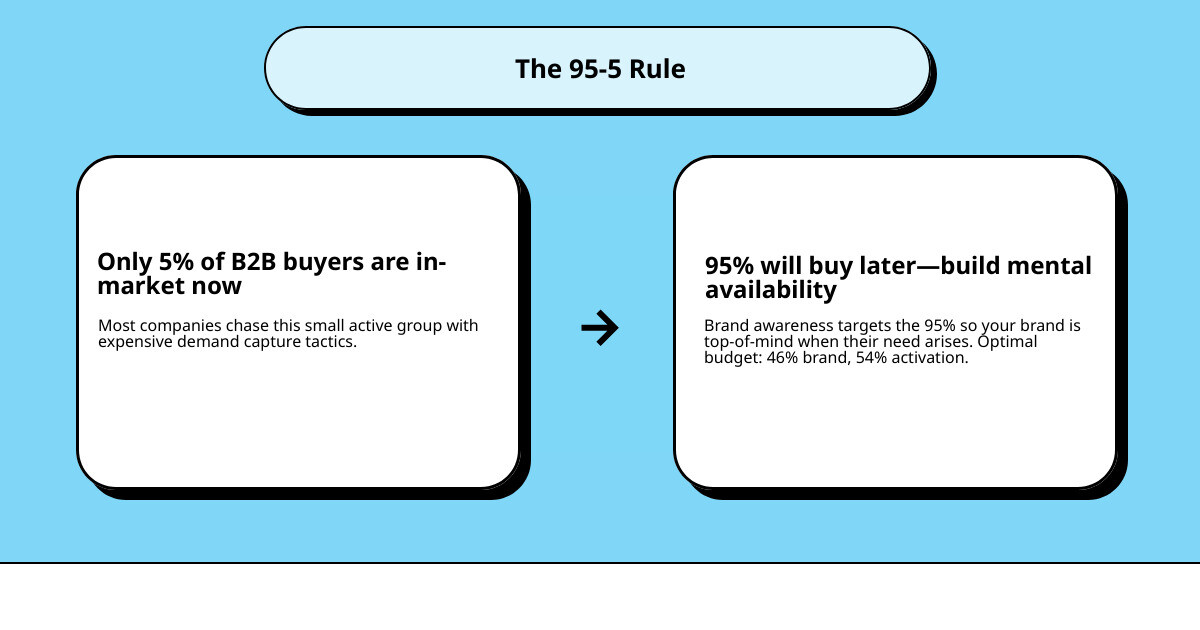
Most B2B companies face a critical challenge: only 5% of your potential buyers are actively shopping at any given time. The other 95% aren't in-market yet.
This is the 95-5 rule, and it changes everything about how you should approach growth.
If you focus only on capturing demand from that 5%, you're competing in an expensive, crowded space. But when you build brand awareness with the 95%, you create mental availability. Your brand becomes the one they think of first when their need finally arrives.
The data backs this up. Research from LinkedIn's B2B Institute shows that emotional brand campaigns in B2B deliver 1.4 very large business effects compared to just 0.2 for purely rational campaigns. B2B buyers are humans too, and they make decisions the same way consumers do—with emotion first, then logic to justify.
Yet most B2B marketers are doing the opposite of what works. A LinkedIn survey found that only 4% measure impact beyond six months, and over 64% believe growth comes from loyalty rather than penetration. The research is clear: customer acquisition drives growth far more effectively than loyalty programs.
The gap between what works and what most companies do creates a massive opportunity. Build brand awareness the right way, and you'll outperform competitors still chasing only the 5%.
I'm Tony Crisp, and over the past two decades I've helped tech companies from startups to Fortune 500 build b2b brand awareness strategy frameworks that drive long-term growth—working with brands like Nvidia, HTC Vive, and Element U.S. Space & Defense to launch products and fight commoditization. The principles in this guide combine proven research with real-world execution.
B2b brand awareness strategy word guide:
In the tech corridors of Newport Beach, CA, we often see companies mistake "lead generation" for "brand building." They want the phone to ring today, which is understandable. However, if you ignore the upper funnel, you are essentially trying to harvest a crop you never planted.
A lack of brand awareness is often the root cause of almost every marketing woe: lackluster leads, zero engagement, and a sales team that spends half their time explaining who the company is rather than how they can help. Brand awareness acts as the tide that lifts all marketing boats. When your target audience knows who you are, your click-through rates go up, your cost-per-acquisition goes down, and your sales cycle shortens.
The 95-5 rule reminds us that at any given moment, 95% of your potential customers are not currently looking to buy. They are "out-of-market." If your b2b brand awareness strategy only targets people with "high intent," you are ignoring the vast majority of your future revenue.
The goal is to build mental availability. As Professor Jenni Romaniuk of the Ehrenberg-Bass Institute puts it, mental availability is about increasing the probability that your brand comes to mind in different buying situations. These situations are known as Category Entry Points (CEPs)—the internal and external cues that trigger a buyer to think of a solution. For example, "We need to scale our cloud security" is a CEP. If your brand isn't in their memory when that thought occurs, you've already lost.
To win in 2026, we must look beyond vanity metrics and focus on the scientific drivers of growth.
For a deeper dive into how these elements connect, check out our guide on Brand Strategy.
When we launch a brand using our LaunchX framework, we focus on one undeniable truth: B2B buyers are people. While we like to think of business decisions as purely rational spreadsheets of features and pricing, the reality is much more "human."
Brand messaging with an emotional strategy outperformed rational messaging by 7X. Why? Because rational messaging (features, specs, data) only works when someone is already in-market and looking to compare. Emotional messaging, however, builds long-term memory. It creates a "gut feeling" of trust that stays with the buyer during the 95% of the time they aren't shopping.
At CRISPx, we use our DOSE Method™ to ensure that every brand launch creates this necessary emotional resonance. We aren't just selling "software-as-a-service"; we are selling peace of mind, career security, or the thrill of innovation. This is how you build brand identity that sticks.
In the age of AI and automated "outreach," authenticity has become a premium currency. One of the best ways to build trust is to provide a behind-the-scenes look at your company. Authenticity is a top quality that attracts customers to a brand.
Once the brand is launched, we move into OrbitX, our framework for executing growth marketing using psychology and behavioral science. We don't just want "reach"; we want "resonance."
B2B sales cycles are long, often involving weeks or months of research. During this time, buyers are looking for social proof. They want to know that people like them trust you. This is where B2B brand building meets behavioral psychology.
LinkedIn is the undisputed heavyweight champion for B2B. 97% of B2B marketers use it, and it drives 50% of all social traffic to B2B content campaigns.
But it’s not just about posting links. It’s about reaching decision-makers in a professional mindset. 91% of executives cited LinkedIn as the best place to find quality content related to their industry.
To maximize LinkedIn:
AI is no longer a futuristic concept; it is a fundamental tool for scaling a b2b brand awareness strategy. However, we don't use AI to replace creativity; we use it to amplify it.
At CRISPx, we use AI to analyze vast amounts of market data to identify "Category Entry Points" we might have missed. We can see which topics are trending in Newport Beach tech circles and tailor our content to meet those specific needs.
One of the biggest hurdles to brand awareness is the sheer volume of content required. AI allows us to repurpose video content with incredible efficiency. A single executive interview can be turned into:
This ensures that your brand stays top-of-mind without burning out your creative team. With 93% of B2B organizations already using content marketing, the winners will be those who use AI to maintain high quality at a higher frequency.
AI also plays a role in Generative Engine Optimization (GEO). As buyers increasingly use AI tools to research solutions, your brand needs to be part of the "knowledge graph." This requires creating high-authority, original research and thought leadership that AI models recognize as credible.
How do you measure something as "soft" as brand awareness? While it is less direct than tracking a "Buy Now" button, it is entirely measurable.
| Metric | Short-Term Activation | Long-Term Brand Building |
|---|---|---|
| Primary Goal | Direct Leads / Sales | Mental Availability / Recall |
| Fastest Metric | Click-Through Rate | Ad Recall / Brand Lift |
| ROI Timeline | 0-3 Months | 6-18 Months |
| Measurement Tool | CRM / Google Analytics | Brand Perception Surveys |
| Growth Driver | Capturing 5% in-market | Influencing 95% out-of-market |
You should look for leading indicators within the first 90 days. These include:
For more on how we link these metrics to business results, we focus on tracking brand strategy effectiveness through comprehensive data analysis and attribution modeling.
B2B brand strategy investments typically show measurable impact within 6-12 months. Leading indicators, such as increased organic search and social engagement, are often visible within 90 days. Revenue attribution usually becomes clear within 12-18 months, as the "out-of-market" 95% begins to enter the buying cycle.
LinkedIn is unique because its users are in a "professional mindset." Unlike other social platforms where people are looking for entertainment, LinkedIn members are looking for industry insights and solutions. With 4 out of 5 members driving business decisions and having 2x the buying power of the average web audience, it is the most efficient place to reach high-value stakeholders.
The 95-5 rule dictates that your marketing shouldn't just be about "selling." Since 95% of your audience isn't ready to buy today, your campaigns must focus on being helpful, memorable, and emotionally resonant. This ensures that when those buyers do enter the market, your brand is the first one they call.
Mastering a b2b brand awareness strategy is not about a single viral post or a one-off ad campaign. It is about a consistent, data-driven commitment to staying top-of-mind with the people who matter most.
At CRISPx, we specialize in helping tech brands navigate this journey. Whether you are using LaunchX to build foundational brand value or OrbitX to scale your growth through psychological triggers, our DOSE Method™ ensures your brand doesn't just exist—it dominates.
Based in Newport Beach, CA, we understand the unique pressures of the tech industry. We know that you need to show results today while building the engine for tomorrow. If you're ready to stop chasing the 5% and start owning the market, we are here to help.




Accessibility: If you are vision-impaired or have some other impairment covered by the Americans with Disabilities Act or a similar law, and you wish to discuss potential accommodations related to using this website, please contact our Accessibility Manager at (949) 791-9150