Why Advanced Marketing Analytics is Your New Best Friend
Unlock advanced marketing analytics to boost ROI, predict trends, and drive growth with AI-powered insights and strategies.


Unlock advanced marketing analytics to boost ROI, predict trends, and drive growth with AI-powered insights and strategies.
Advanced marketing analytics is the use of sophisticated techniques like predictive modeling, machine learning, and multi-touch attribution to understand why customer behaviors happen—not just what happened—so you can forecast future trends and recommend optimal marketing actions.
Key aspects of advanced marketing analytics:
The difference between basic and advanced analytics is fundamental. Basic digital marketing analytics tells you that 5,000 people visited your landing page last month. Advanced marketing analytics tells you which combination of touchpoints drove those visitors, predicts which ones will convert, calculates their lifetime value, and recommends exactly where to allocate your next dollar of marketing spend.
The stakes are high. Organizations utilizing advanced analytics outperform competitors who rely on traditional methods, yet analytics influences only about 54% of marketing decisions. Poor data quality alone costs organizations $13 million annually, much of it tied to inconsistent metrics and misaligned reporting.
The revolution in big data has enabled a game-changing approach to marketing. Companies can now collect customer data asynchronously and continuously, enabling adaptive, dynamic marketing that responds to individual behavior changes in real time. Netflix demonstrates this power—up to 80% of watches come from personalized recommendations powered by predictive analytics.
But here's the challenge: most marketing teams still rely on third-party data despite growing privacy concerns. Traditional technology isn't built for the complexity modern marketers face. Analysts spend 60-80% of their time cleaning data instead of analyzing it.
The opportunity is massive. Real-world implementations show dramatic results: one business intelligence firm saved clients 30% on marketing costs while increasing acquisition through multi-touch attribution. An e-commerce retailer increased average order value by 1% through product recommendations based on customer segmentation—translating to millions in revenue for companies with scale. A pricing optimization test added an extra €0.42 to each order, delivering a six-figure annual revenue boost.
I'm Tony Crisp, and I've spent two decades helping tech startups and Fortune 500 companies build meaningful brands through data-driven strategies, working hands-on with clients like Nvidia, HTC Vive, and Robosen to leverage advanced marketing analytics for strategic growth. In this guide, I'll walk you through the techniques, tools, and frameworks that transform marketing from a cost center into a strategic revenue driver.
Common advanced marketing analytics vocab:
To truly grasp the power of advanced marketing analytics, we have to look past the surface-level metrics that most teams settle for. While basic reporting tells us where we’ve been, advanced analytics acts as a high-definition GPS for where we’re going. It’s a strategic blend of data science, machine learning, and visualization that turns raw data into a competitive weapon.

At its core, advanced marketing analytics leverages predictive modeling and data mining to identify patterns that the human eye (and standard Excel sheets) would miss. Instead of just looking at a "conversion rate," we look at the latent sensitivity of different customer segments. We move from reactive reporting to proactive strategy.
The strategic value lies in the ability to close the gap between what is possible and what is executed. Research from Gartner shows that analytics currently influences only about 54% of marketing decisions. This "influence gap" is usually caused by siloed systems and a lack of clear governance. By implementing a unified data foundation, we can ensure that every dollar spent is backed by a statistical probability of success.
| Feature | Basic Digital Analytics | Advanced Marketing Analytics |
|---|---|---|
| Primary Focus | Historical "What" | Future "Why" and "How" |
| Data Sources | Single channel (e.g., Google Analytics) | Multi-source (CRM, ERP, Social, Ads, Offline) |
| Techniques | Counting, averaging, basic A/B testing | Machine learning, regression, clustering |
| Outcome | Static reports | Actionable data products and forecasts |
| Decision Style | Reactive | Proactive and Automated |
For a deeper dive into how this transforms your day-to-day operations, check out more info about data analysis in marketing.
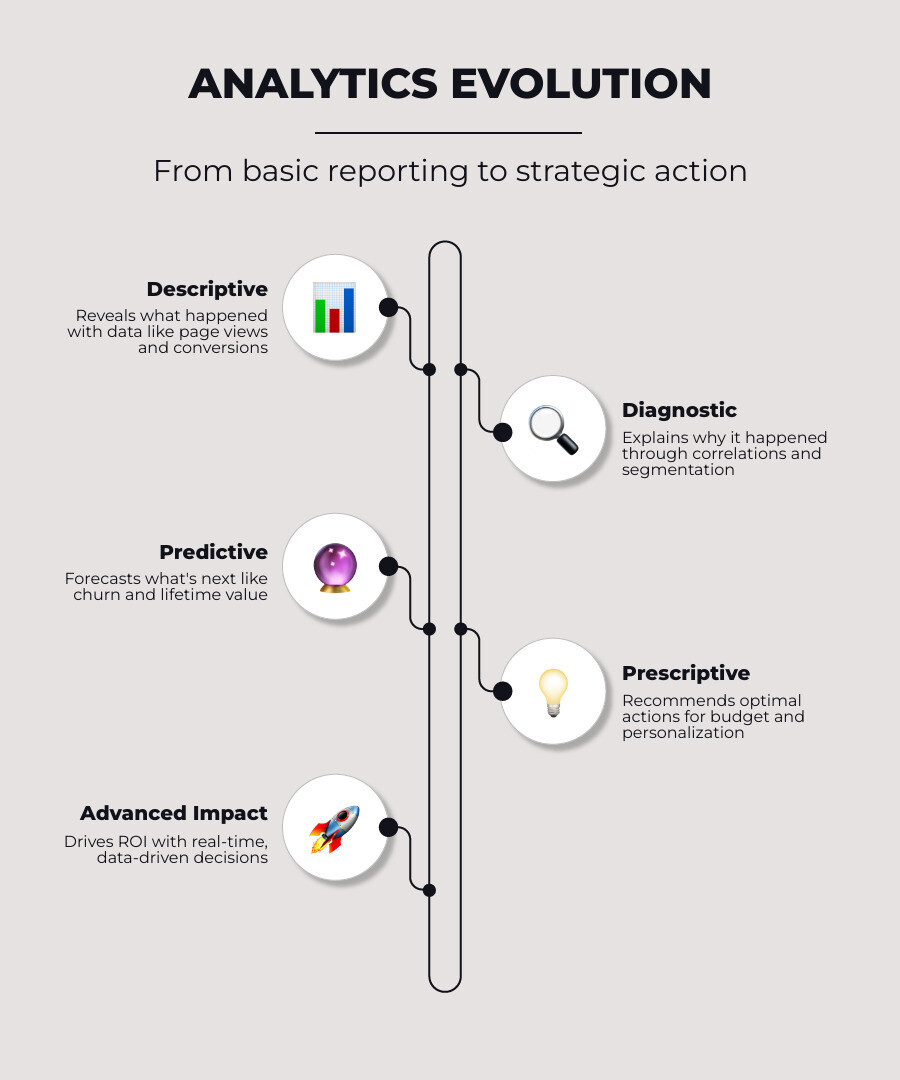
To master this field, we categorize analytics into four progressive stages. Each stage adds more value but also requires more sophisticated tools and expertise.
As we move through these stages, we must remain vigilant about data ethics. Modern analytics must adhere to GDPR data principles, ensuring data minimization, transparency, and security. We believe that a privacy-first approach isn't just a legal hurdle—it's a way to build lasting trust with your audience.
One of the biggest headaches for any Marketing Director is proving exactly which campaign drove a sale. Traditional "last-click" models are notoriously flawed; they give 100% of the credit to the final ad a customer clicked, ignoring the five blog posts, three social media interactions, and two webinars that actually convinced them to buy.
Advanced marketing analytics solves this through multi-touch revenue attribution. This model assigns a weighted value to every single touchpoint in the customer journey. By connecting every interaction to a closed deal in your CRM, you can finally see the true ROI of your awareness campaigns.
For example, a SaaS company might find that while their "Free Trial" ads get the final click, it’s actually their educational whitepapers that have the highest correlation with long-term customer retention. Without multi-touch mapping, that whitepaper budget might have been cut.
If you’re ready to stop guessing, you can learn more about how to do attribution reporting to connect your marketing efforts directly to revenue.
In growth marketing, data is the fuel. But not all fuel is created equal. To drive high-performance results, we utilize specific techniques that go beyond simple spreadsheets.
One of the most powerful techniques is Customer Segmentation and Clustering. Instead of treating your audience as a monolith, we use machine learning algorithms to group customers based on behavior, preferences, and "unmet needs." A retailer might discover a segment of "Eco-conscious Early Adopters" who respond better to sustainability messaging than to discount codes.
Another critical pillar is Customer Lifetime Value (CLV) Analysis. CLV tells us the total net profit we can expect from a customer over the entirety of our relationship. By understanding CLV, we can justify spending more to acquire a high-value customer while optimizing our budget for those who only buy once. For a technical deep dive, you can explore the best guide to calculate CLV.
For more on integrating these methods into your broader plan, see more info about data-driven marketing strategies.
At CRISPx, our LaunchX framework is designed to build brand value from the ground up using data. We don't just "guess" what your brand should stand for; we use advanced marketing analytics to find the perfect market fit.
To see this in action, read how data helped sharpen product-market fit.
Once a brand is launched, we move into OrbitX, our growth marketing engine. This is where we combine behavioral science with hard data. We know that humans aren't always rational—we are driven by cognitive biases and psychological triggers.
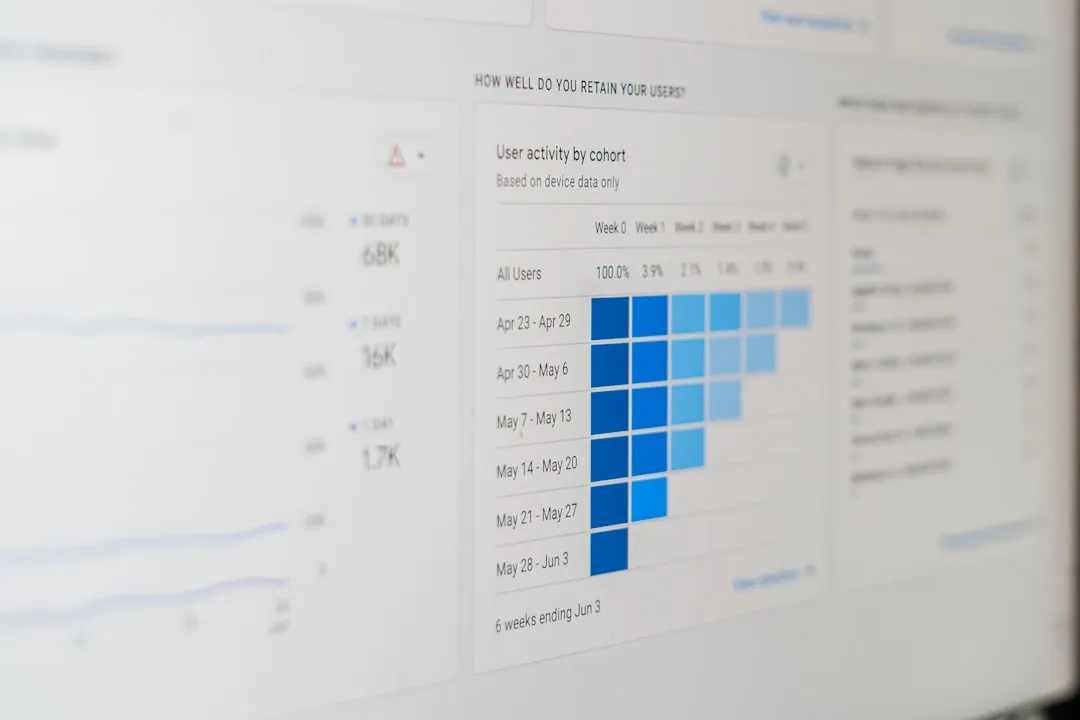
Using advanced marketing analytics, we track how these psychological triggers influence the conversion path. We might use Cohort Analysis to see how users who joined during a specific holiday promotion behave differently over six months compared to those who joined via organic search.
By mapping the "time between touchpoints," we can identify where customers are getting stuck and deploy automated interventions. This isn't just about more traffic; it's about optimizing the quality of the journey. You can find more info about tracking marketing performance to see how we keep our "Orbit" on track.
AI is no longer a futuristic concept; it's the engine room of modern marketing. By automating the "grunt work" of data processing, we free up our creative teams to do what they do best: innovate.
Machine learning excels at Anomaly Detection. If your cost-per-acquisition (CPA) suddenly spikes at 2:00 AM on a Tuesday, an AI-driven system can alert you immediately, potentially saving thousands in wasted ad spend.
We also use AI for Predictive Churn Modeling. By analyzing patterns—such as a decrease in login frequency or a change in support ticket volume—we can identify at-risk customers before they leave. This allows for proactive outreach, like a personalized "we miss you" offer. This level of personalization is why research on Netflix personalized recommendations shows they drive 80% of their viewership.
In a fast-moving market, waiting for a monthly report is a recipe for failure. Advanced marketing analytics allows for Real-Time Optimization.
Learn how to apply these insights to your paid media in more info about data-driven ad campaigns.
Content is king, but data is the kingmaker. We use AI-driven content analysis to move beyond simple "likes" and "shares." By using NLP, we can determine which topics, tones, and even specific words resonate most with your target audience.
This efficiency allows us to create "data-driven creative." Instead of one generic ad, we can launch 50 variations, each tailored to a specific micro-segment of your audience. The AI then analyzes the engagement metrics in real-time, doubling down on the winners and cutting the losers.
For more on this creative revolution, check out more info about data-driven creative campaigns.
While the benefits are clear, the path to advanced analytics isn't without its bumps. The most common hurdle we see is Data Silos. When your social media data lives in one tool, your CRM in another, and your sales data in a third, you can't get a holistic view of the customer.
Furthermore, Data Quality is a massive issue. As the saying goes, "garbage in, garbage out." If your data is messy, inconsistent, or outdated, your predictive models will be useless. This isn't a small problem—Gartner research on the cost of poor data quality suggests it costs organizations an average of $13 million annually.
We also have to navigate the complex world of privacy. With the sunsetting of third-party cookies and the rise of regulations like the CCPA and GDPR, marketers must be more careful than ever. We look to the OECD privacy guidelines as a gold standard for ethical data handling.
The future of marketing is First-Party Data. This is data you collect directly from your audience with their consent. It’s more accurate, more reliable, and completely compliant.
According to the Salesforce State of Marketing Report, most teams still rely heavily on third-party data, but the leaders are shifting. By building a robust data governance framework, you can ensure that your analytics strategy is future-proof. This involves:
You don't need a PhD in statistics to benefit from advanced marketing analytics, but you do need a baseline of Data Literacy. We often find that the biggest challenge isn't the technology—it's the people and the culture.
To succeed, organizations need to bridge the gap between their data scientists and their marketing creatives. This involves:
For teams looking to scale their capabilities, we offer more info about marketing data analytics solutions that simplify the complex.
Basic reporting is descriptive; it tells you what happened (e.g., "We got 100 leads"). Advanced marketing analytics is diagnostic, predictive, and prescriptive. It tells you why you got those leads, which leads are most likely to buy, and how to spend your next $1,000 to get 200 leads instead.
While every business is unique, we recommend focusing on:
Predictive models identify "churn signals"—patterns of behavior that typically precede a customer leaving. This could be a drop in app usage, a specific type of customer support interaction, or even a change in payment method. Once identified, you can trigger automated, personalized retention campaigns to win them back before they officially cancel.
In today's hyper-competitive landscape, intuition is no longer enough. To build a brand that lasts, you need a partner who understands how to blend the "magic" of creativity with the "logic" of data.
At CRISPx, we use our proprietary DOSE Method™ to ensure that every brand launch and growth campaign is rooted in advanced marketing analytics. We don't just want to see your metrics go up; we want to transform your marketing department into a strategic revenue driver that fuels long-term growth.
Whether you're launching a new tech product or looking to optimize an existing brand, the data is there—you just need the right tools and strategy to unlock it.
Ready to turn your data into your greatest competitive advantage?Scale your growth with OrbitX




Accessibility: If you are vision-impaired or have some other impairment covered by the Americans with Disabilities Act or a similar law, and you wish to discuss potential accommodations related to using this website, please contact our Accessibility Manager at (949) 791-9150